🔬 Biology · Class 12 · NEET
Sexual Reproduction in Flowering Plants - Practice Questions with Answers
75 free MCQs on Sexual Reproduction in Flowering Plants, each with its own worked answer and explanation. Flower structure, pollination, double fertilization, and seed/fruit development - the highest-scoring Class 12 biology chapter in NEET.
Take the timed Sexual Reproduction in Flowering Plants chapterwise test →75 practice questions on Sexual Reproduction in Flowering Plants, sorted Easy → Hard. Try each one first, then open its answer page for the worked explanation. Want the full theory first? Read the Sexual Reproduction in Flowering Plants notes.
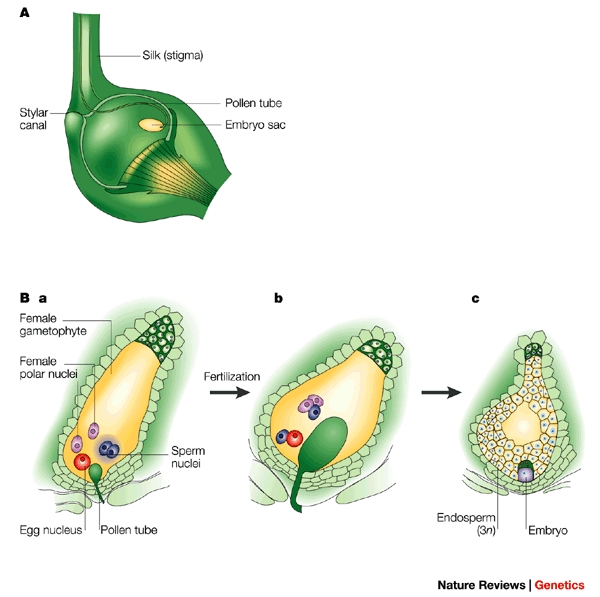
Double fertilisation in angiosperms: one male gamete fuses with the egg to form the diploid zygote (syngamy), while the second fuses with the two polar nuclei to form the triploid primary endosperm nucleus (triple fusion). Image: Triploid, CC BY 3.0, via Wikimedia Commons.
Easy - 25 questions
Q1.
The tapetum is the innermost wall layer of the anther and mainly serves to:
- A Nourish the developing pollen grains
- B Protect the ovule from drying
- C Anchor the stigma to the style
- D Store starch for the fruit
Show answer & explanation →
Q2.
A typical mature dicot pollen grain shed from the anther is usually at which stage?
- A 1-celled
- B 2-celled
- C 4-celled
- D 8-celled
Show answer & explanation →
Q3.
In a typical anatropous ovule, the stalk that attaches the ovule to the placenta is the:
- A Raphe
- B Hilum
- C Funicle
- D Chalaza
Show answer & explanation →
Q4.
The narrow pore in the ovule through which the pollen tube usually enters is the:
- A Raphe
- B Chalaza
- C Hilum
- D Micropyle
Show answer & explanation →
Q5.
A mature embryo sac of a typical angiosperm is best described as:
- A 7-celled and 8-nucleate
- B 8-celled and 8-nucleate
- C 3-celled and 3-nucleate
- D 7-celled and 7-nucleate
Show answer & explanation →
Q6.
The flower is the organ of _____ reproduction in flowering plants:
- A Vegetative
- B Sexual
- C Asexual
- D All types of
Show answer & explanation →
Q7.
Pollen grains are produced in the:
- A Pistil, the female reproductive structure
- B Ovary, where ovules later develop into seeds
- C Anther of the stamen
- D Petal, the colorful part attracting pollinators
Show answer & explanation →
Q8.
The transfer of pollen from anther to stigma is called:
- A Fertilization
- B Germination
- C Pollination
- D Dispersal
Show answer & explanation →
Q9.
The female reproductive part of a flower is the:
- A Stamen, the male reproductive structure
- B Petal, the often brightly colored part
- C Carpel (pistil)
- D Sepal, the protective outer floral whorl
Show answer & explanation →
Q12.
Self-pollination occurs when:
- A Pollen is carried across a field by air currents
- B Pollen from the same flower or same plant fertilizes the ovule
- C Bees or other insects carry pollen between separate plants
- D Pollen floats on water to reach a different plant
Show answer & explanation →
Q13.
Which agent is most important for pollination in wind-pollinated flowers?
- A Insects
- B Water
- C Wind
- D Animals
Show answer & explanation →
Q14.
Vegetative reproduction in plants includes:
- A Formation of seeds after fertilization
- B Production of spores in sporangia only
- C Bulbs, runners, rhizomes, tubers (asexual)
- D Combination of seed and spore production together
Show answer & explanation →
Q15.
Double fertilization is unique to:
- A Gymnosperms such as pine and cycads
- B Ferns that reproduce via free-living gametophytes
- C Angiosperms (flowering plants)
- D Mosses with a dominant gametophyte generation
Show answer & explanation →
Q16.
The endosperm in a seed provides:
- A A hard protective coat around the seed
- B Nourishment for the developing embryo
- C Auxins and gibberellins that trigger germination
- D Storage of water absorbed during imbibition
Show answer & explanation →
Q17.
Germination is the process by which:
- A Seeds are scattered away from the parent plant
- B A seed begins to grow into a new plant
- C Pollen grains mature inside the anther
- D Flower buds differentiate on the shoot apex
Show answer & explanation →
Q18.
Cross-pollination promotes:
- A Genetic uniformity across successive generations
- B Genetic variation and vigor (hybrid vigor)
- C Reproduction of the pollinating insect species itself
- D Dormancy mechanisms that delay seed germination
Show answer & explanation →
Q19.
Seed dispersal by wind (anemochory) is aided by:
- A Hooks and spines that cling to animal fur
- B Wings, tufts of hair (pappus), or lightweight seeds
- C Fleshy, sugar-rich fruits that attract birds
- D Hard, woody shells that float on water currents
Show answer & explanation →
Q20.
The pollen tube grows from the stigma through the style to reach the:
- A Petal, where it deposits the male gametes
- B Nearest leaf, absorbing nutrients along the way
- C Ovule (for fertilization)
- D Root, traveling down through the vascular tissue
Show answer & explanation →
Q21.
Parthenogenesis in plants (apomixis) refers to:
- A Fertilization occurring without any pollen transfer
- B Seed development without fertilization
- C Cloning achieved through tissue culture techniques
- D Vegetative propagation using only stem cuttings
Show answer & explanation →
Q22.
The embryo sac is the female gametophyte of angiosperms and contains:
- A 4 cells arranged symmetrically around one single, large central vacuole space
- B 6 cells, each one carrying a single diploid nucleus derived from the megaspore
- C 8 nuclei in 7 cells (including egg, two synergids, two polar nuclei, three antipodals)
- D Just the egg cell, surrounded entirely by several layers of sterile nucellus tissue
Show answer & explanation →
Q24.
The female reproductive part of a flower is the:
- A carpel or pistil
- B the male stamen
- C the coloured petal
- D the green sepal
Show answer & explanation →
Medium - 25 questions
Q26.
The three cells grouped at the micropylar end of the embryo sac form the:
- A Antipodal cells
- B Egg apparatus
- C Central cell
- D Synergid pair only
Show answer & explanation →
Q27.
Filiform apparatus, the special thickening in synergids, functions mainly to:
- A Anchor the antipodal cells
- B Supply stored starch to the developing endosperm
- C Guide the pollen tube into the embryo sac
- D Secrete nectar for pollinators
Show answer & explanation →
Q28.
If a fruit develops without fertilisation, it is called parthenocarpic; such fruits are characteristically:
- A Produced only in cereals
- B Larger than normal
- C Rich in endosperm
- D Seedless
Show answer & explanation →
Q29.
Emasculation, the removal of anthers from a bisexual flower bud, is done by a plant breeder to:
- A Prevent self-pollination in the seed parent
- B Increase the number of ovules
- C Speed up endosperm formation
- D Make the flower attractive to insects
Show answer & explanation →
Q30.
In an albuminous seed such as castor, the stored food persists because:
- A The cotyledons completely absorb all of the endosperm
- B Endosperm is not fully consumed during embryo development
- C There is no double fertilisation
- D The nucellus replaces the endosperm
Show answer & explanation →
Q31.
The mechanism of double fertilization in angiosperms produces:
- A Two separate embryos formed from two genetically independent egg cells within the ovule
- B One embryo (from egg + sperm) and endosperm (from central cell + second sperm)
- C One embryo alone, with the second sperm degenerating without ever being used
- D Two separate zygotes that later fuse together into a single diploid embryo
Show answer & explanation →
Q32.
Pollen tube growth is directionally guided by:
- A Random diffusion through the stylar tissue matrix without any clear directional molecular cue present
- B Chemotropic signals from the ovule (LURE peptides secreted by synergid cells guide pollen tube)
- C Gravitropic sensing of the gravitational field acting specifically within the elongated style tissue
- D Wind direction sensed by specialized mechanoreceptors supposedly located at the pollen tube tip
Show answer & explanation →
Q33.
Self-incompatibility (SI) in plants prevents self-fertilization by:
- A Physical separation of stamens and pistil onto entirely different flowers altogether
- B Molecular recognition between pollen and pistil S-gene products rejecting same-genotype pollen
- C Releasing volatile insect repellents that actively prevent pollinator visits to the flower
- D Producing no functional pollen grains whatsoever throughout anther development
Show answer & explanation →
Q34.
Apomixis in plants is economically important because:
- A It is sometimes mistakenly thought to create considerably greater genetic diversity through frequent meiotic recombination as frequently observed in practice
- B It produces seeds without fertilization, allowing production of genetically uniform crops and fixing hybrid vigor across generations
- C It is sometimes mistakenly thought to increase disease resistance by introducing novel resistance alleles each generation in many documented cases
- D It is sometimes mistakenly thought to substantially accelerate the rate of spontaneous mutation within the genome according to conventional understanding
Show answer & explanation →
Q35.
In plant embryogenesis, the first asymmetric division of the zygote produces:
- A Two genetically identical daughter cells of exactly equal size and identical developmental fate each time in routine practice
- B A small apical cell (embryo proper) and large basal cell (suspensor that attaches to seed coat and nourishes embryo)
- C Endosperm tissue directly, largely bypassing the usual formation of the embryo proper itself overall in most cases
- D A largely formed multicellular embryo supposedly produced within just a single cell division event under typical conditions
Show answer & explanation →
Q36.
Wind-pollinated flowers (anemophilous) differ from insect-pollinated in having:
- A Large, brightly colored petals specifically evolved to attract pollinating insects from nearby areas according to standard textbooks
- B Small, inconspicuous flowers; large stigmas to catch pollen; copious, light, dry pollen; no nectaries or scent
- C Sweet nectar glands together with a strong, distinctive floral scent to attract visiting pollinators in general practice
- D Sticky pollen grains that are clumped together tightly in heavy, cohesive masses for insect transport as frequently described
Show answer & explanation →
Q37.
Polyembryony occurs in plants when:
- A More than one ovule matures and develops fully within a single ovary chamber simultaneously
- B Multiple embryos develop in one seed (from zygote, synergids, nucellus cells, or unfertilized egg)
- C Seeds are released from the mature fruit in tightly clustered groups all at the same time
- D A single flower develops several largely independent and separate pistils side by side
Show answer & explanation →
Q38.
The concept of alternation of generations in plants means:
- A Plants simply alternate between summer and winter growth phases each year
- B Diploid sporophyte and haploid gametophyte generations alternate in the life cycle
- C Plants alternate between sexual and asexual reproduction depending on the season
- D Different plant species gradually alternate dominance within a single ecosystem
Show answer & explanation →
Q39.
Pollination by animals (zoophily) benefits plants because:
- A Animals actively consume and eliminate competing plant species growing nearby the flower over time under usual circumstances according to most researchers
- B Animals transfer pollen precisely between same species with high efficiency (compared to wind), especially via directed foraging behavior
- C Animals physically damage flowers during visits, which is sometimes thought to trigger a burst of pollen release in the majority of cases studied
- D Animals supply nitrogen-rich nutrients directly into the flower tissue during each visitation event as widely reported in standard practice
Show answer & explanation →
Q40.
In heterosporous plants (like seed plants), microspores develop into:
- A Female gametophytes housed within the megasporangium
- B Male gametophytes (pollen grains containing the male gametes)
- C Sporophytes directly, bypassing the gametophyte generation
- D Embryos formed without any intervening fertilization step
Show answer & explanation →
Q41.
The nucellus in an ovule corresponds to:
- A The seed coat formed later from the hardened outer integument layers of the ovule
- B The megasporangium (diploid tissue surrounding and nourishing the megaspore/embryo sac)
- C The embryo that develops only after double fertilization of the egg has occurred
- D The endosperm tissue that forms from the fertilized central cell after fertilization
Show answer & explanation →
Q42.
Coevolution between flowers and pollinators is demonstrated by:
- A Flower shapes that vary largely at random with little underlying functional correlation overall under most conditions encountered
- B Morphological matching between flower structure and pollinator anatomy (orchid-bee coevolution, yucca-yucca moth mutualism)
- C Generalist pollinators that visit nearly every available flower species with little discrimination as frequently observed in practice
- D Plants that rely mainly on ambient wind currents for transferring pollen between flowers in many documented cases according to conventional understanding
Show answer & explanation →
Q43.
Elaiosomes on seeds attract which seed dispersers?
- A Birds, which swallow the seeds whole and disperse them in droppings
- B Ants (myrmecochory -- ants carry seeds to their nests, dispersing them)
- C Wind currents that carry the lightweight seed structures
- D Water currents that float the seeds downstream
Show answer & explanation →
Q44.
In vegetative propagation, micropropagation uses:
- A Seeds that have been collected specifically from selectively bred parent plant lines over generations under typical conditions
- B Tissue culture (callus formation from explants on hormone-containing media) to produce large numbers of clonal plants
- C Simple stem cuttings that are rooted directly in ordinary garden soil without any special treatment according to standard textbooks
- D Mainly bulbs and tubers that are planted directly into the field without any culturing process in general practice
Show answer & explanation →
Q45.
Serotiny is a reproductive strategy where:
- A Seeds germinate almost immediately upon release from the parent plant with very little delay as frequently described in most textbook accounts
- B Seeds are stored in cones or fruits and released only after a specific trigger such as fire (e.g., lodgepole pine, Banksia)
- C Fruits develop and reach full maturity without any prior fertilization event ever taking place during normal conditions
- D Pollen is released from the anther mainly during the late nighttime hours specifically as generally observed in typical laboratory settings
Show answer & explanation →
Q46.
The embryo of a monocot has how many cotyledons?
- A None, since monocot embryos lack cotyledon tissue entirely
- B One (single cotyledon called scutellum in grasses)
- C Two cotyledons fused together along the embryonic axis
- D Three to four cotyledons arranged around the plumule
Show answer & explanation →
Q47.
The transfer of pollen from an anther to a stigma is called:
- A pollination
- B fertilisation
- C germination
- D respiration
Show answer & explanation →
Hard - 25 questions
Q51.
Perisperm, when present in a seed, is derived from the:
- A Integuments
- B Fused polar nuclei
- C Nucellus
- D Zygote
Show answer & explanation →
Q52.
In the development of a dicot embryo, the suspensor chiefly functions to:
- A Develop directly into the protective outer seed coat
- B Form the future shoot apex
- C Give rise to the radicle
- D Push the embryo into the endosperm and aid nutrient uptake
Show answer & explanation →
Q53.
Geitonogamy is functionally cross-pollination but genetically resembles self-pollination because:
- A Pollen is transferred between two flowers of the same plant
- B Pollen lands on the stigma of the same flower
- C Pollen always comes from a genetically different parent plant
- D No pollinator is involved
Show answer & explanation →
Q54.
Apomictic seeds that develop from diploid nucellar cells (as in many Citrus) are valuable to breeders because the seedlings are:
- A Always triploid
- B Genetically identical to the mother plant
- C Free of any endosperm
- D Formed entirely without any protective seed coat
Show answer & explanation →
Q55.
In chasmogamous flowers out-crossing is favoured, whereas cleistogamous flowers are notable because they:
- A Cannot set seed at all
- B Open very widely to attract many flying insects
- C Do not open and ensure assured self-pollination
- D Produce only male gametes
Show answer & explanation →
Q56.
The gametophytic self-incompatibility system (GSI) in plants is controlled by:
- A Diploid sporophytic tissue of the pistil acting largely alone, without requiring much input from the pollen grain itself directly during normal conditions
- B Haploid pollen S-gene product interacting with pistil S-gene product; both encoded by multiallelic S-locus (e.g., RNase-based in Solanaceae)
- C The diploid seed coat tissue alone, acting mostly independently of any pollen-pistil molecular signaling interaction happening as generally observed
- D Epigenetic chromatin marks alone, occurring with little underlying genetic S-locus sequence ever being involved in practice in typical laboratory settings
Show answer & explanation →
Q57.
Polyspermy is prevented in angiosperms by:
- A A simple physical size restriction at the narrow micropyle opening that permits only one pollen tube through at a time
- B Synergid cells sending signals to block subsequent pollen tube entry after the first tube enters and bursts
- C The developing endosperm tissue actively repelling any additional pollen tubes immediately after fertilization occurs
- D Specialized anti-pollen enzymes that are secreted directly by the egg cell cytoplasm itself before fertilization
Show answer & explanation →
Q58.
Endosperm development in angiosperms can be:
- A Mainly cellular in most species, with rigid cell wall formation accompanying every nuclear division that occurs
- B Nuclear (nuclear divisions without walls), cellular (with walls), or helobial (in monocots) depending on species
- C Mainly liquid in form throughout development, rarely forming any solid cellular tissue structure whatsoever
- D Mainly starchy from the very beginning, largely lacking any free nuclear or true cellular developmental phase
Show answer & explanation →
Q59.
Transcription factors MADS-box proteins in floral organ identity (ABC model) determine:
- A Leaf identity only, having absolutely no documented role whatsoever in determining the fate of any floral organ
- B Which floral organs form in which whorl (A genes: sepals/petals, B genes: petals/stamens, C genes: stamens/carpels)
- C Root system formation specifically through direct control over lateral root primordia initiation and emergence
- D Pollen tube growth rate and its precise chemotropic guidance pathway toward the awaiting ovule structure
Show answer & explanation →
Q60.
The CONSTANS (CO) protein promotes flowering in Arabidopsis by:
- A Directly activating the entire complete set of vegetative growth genes simultaneously, all at the exact same developmental time under usual circumstances
- B Activating FT (florigen) transcription in leaves only in long-day conditions when CO protein accumulates in the light (CO is degraded in dark by COP1)
- C Inhibiting gibberellin biosynthesis specifically within the actively dividing cells of the shoot apical meristem region according to most researchers
- D Directly triggering the onset of meiosis within developing reproductive cells of the flower, bypassing other key signals in the majority of cases studied
Show answer & explanation →
Q61.
Sporopollenin in pollen walls is resistant to:
- A Heat exposure alone, while showing essentially little resistance to either chemical or biological degradation processes occurring nearby naturally as widely reported in standard practice
- B Chemical degradation and biological attack (most powerful natural polymer), protecting pollen during transport -- only fluorescence microscopy and acetolysis can reveal patterns
- C Physical mechanical damage alone, while nevertheless remaining quite fragile and vulnerable to any chemical attack that occurs nearby under most conditions encountered as frequently observed in practice
- D UV radiation exposure alone, offering essentially little protection against any form of ongoing microbial degradation activity nearby in many documented cases according to conventional understanding
Show answer & explanation →
Q62.
Maternal effects on seed quality are due to:
- A Paternal DNA contributed mainly through the second sperm nucleus delivered during double fertilization, largely on its own in routine practice overall
- B The maternal plant providing nutrients, protective layers (testa from integuments), and imprinted genes that influence seed development and composition
- C Endosperm genes acting largely alone, mostly independent of any contribution from surrounding maternal tissue nearby in most cases under typical conditions
- D The single fertilization event occurring alone, largely without any meaningful contribution from maternal resources available according to standard textbooks
Show answer & explanation →
Q63.
Recombinant inbred lines (RILs) are produced by:
- A Repeated self-incompatible crosses occurring between unrelated parent breeding lines over time
- B Repeated self-fertilization of F<sub>2</sub> plants until homozygosity is ~99%, useful for QTL mapping
- C Backcrossing alone, without any intervening self-fertilization steps taking place
- D Vegetative cloning of a single heterozygous parent plant repeatedly over time
Show answer & explanation →
Q64.
The SEPALLATA (SEP) MADS-box genes are required in Arabidopsis for:
- A Root system development through specific control over the formation of lateral root primordia along the main root structure
- B Formation of any floral organs (in sep1 sep2 sep3 triple mutants, all organs become leaf-like despite functional ABC genes)
- C Pollen tube guidance alone, specifically directing tube growth toward the micropyle opening of the developing ovule
- D Seed dormancy mechanisms that are regulated largely independently of any floral organ identity gene activity present
Show answer & explanation →
Q65.
Hybrid seed production requires male sterility in the seed parent. CMS (cytoplasmic male sterility) is:
- A A nuclear recessive mutation that is inherited generally according to standard Mendelian segregation ratios across generations
- B Sterility caused by mitochondrial genes that prevent pollen development (used in hybrid seed production in rice, maize, sorghum)
- C A condition that is caused specifically by deletion of particular genes located on the X chromosome itself
- D A condition induced largely by a persistent, latent viral infection that specifically targets the developing anther tissue
Show answer & explanation →
Q66.
In conifer reproduction, the pollen grain germinates and the pollen tube grows for:
- A Just a few hours typically pass before fertilization is fully completed
- B Days to months (up to 12 months in some species) before fertilization occurs
- C Mainly a matter of seconds pass before the egg becomes fertilized
- D A fixed period of exactly two weeks occurs in every conifer species studied
Show answer & explanation →
Q67.
The endosperm balance number (EBN) concept explains:
- A Endosperm size alone, with little reference to underlying hybrid genetic compatibility between species involved in general practice as frequently described
- B Why interspecific hybrids often fail due to imbalanced maternal:paternal genomic contributions to endosperm (2m:1p required), controlled by imprinted genes
- C How starch granules are synthesized and subsequently packaged within the developing endosperm tissue structure itself in most textbook accounts during normal conditions
- D Embryo dormancy mechanisms that are triggered largely independently of any underlying endosperm genetic factor present as generally observed in typical laboratory settings
Show answer & explanation →
Q68.
The use of embryo rescue in plant breeding allows:
- A Regenerating embryos that have already been largely lost from otherwise mature, largely developed seed tissue structures under usual circumstances
- B Saving hybrid embryos that would otherwise abort due to genetic incompatibility by culturing excised embryos on artificial medium
- C Cloning plants considerably more rapidly than would be possible through conventional vegetative propagation methods alone according to most researchers
- D Producing polyploid plants mainly, with few other documented breeding applications existing for this particular technique in the majority of cases studied
Show answer & explanation →
Q69.
Pollen competition refers to:
- A Direct competition occurring specifically between male and female flowers located on the very same individual plant species as widely reported in standard practice
- B Multiple pollen grains competing to fertilize the egg -- pollen with superior competitive ability (faster tube growth) selected, potentially improving offspring fitness
- C Pollen grains competing directly against fern spores for occupation of the exact same ecological niche space available under most conditions encountered as frequently observed in practice
- D Competition that occurs mainly between different plant species when attracting the same shared pollinator visitors nearby in many documented cases according to conventional understanding
Show answer & explanation →
Q70.
In angiosperm evolution, the endosperm may have evolved as:
- A A largely protective structure that serves little functional role in nutrient allocation toward the developing embryo overall in routine practice overall in most cases
- B A mechanism for maternal resource control over offspring -- endosperm is a battleground between maternal and paternal genomes for resource allocation (imprinting conflicts)
- C Mainly a food storage tissue, with little underlying genomic conflict of any kind being involved in its actual formation under typical conditions according to standard textbooks
- D An immune defense system specifically evolved mainly to protect the developing seed from pathogen and pest attack in general practice as frequently described in most textbook accounts
Show answer & explanation →
Q71.
Heterostyly (e.g., in Primula) prevents self-pollination by:
- A Having largely separate male and female plants existing individually within the same breeding population in general practice as frequently described
- B Having morphologically distinct flower types (pin and thrum) where stamens of one type are at the same height as stigma of other type, promoting cross-pollination
- C Relying mainly upon chemical self-incompatibility reactions occurring specifically at the receptive stigma surface itself in most textbook accounts during normal conditions
- D Temporal separation occurring mainly between the timing of pollen release and the period of stigma receptivity, as observed in typical laboratory settings
Show answer & explanation →
Q72.
Seed banks use cryopreservation and control seed moisture to:
- A Increase the overall rate of seed germination immediately upon subsequent planting under typical field growing conditions each season during normal conditions as generally observed
- B Preserve genetic diversity of plant species for thousands of years by slowing metabolism to near zero in liquid nitrogen or at -20 to -18 degrees C with low moisture content
- C Preserve mainly commercially important agricultural crop varieties, while largely excluding most wild relative species nearby in typical laboratory settings under usual circumstances
- D Store seeds in a state that is immediately ready for planting and rapid germination without requiring any further preparation steps taken according to most researchers
Show answer & explanation →
Q73.
Transgenerational epigenetic inheritance in plants occurs when:
- A Permanent changes to the underlying DNA sequence itself are sometimes thought to be passed directly on to the resulting offspring generation each time
- B Epigenetic marks (methylation, chromatin states) established in response to stress are transmitted through seeds to offspring, influencing their phenotype
- C The underlying gene sequences themselves are sometimes thought to undergo permanent change specifically within the offspring generation by itself
- D Mainly small interfering RNA molecules are sometimes thought to be inherited, with little chromatin or methylation marks being involved
Show answer & explanation →
Q74.
In double fertilisation, while one male gamete fuses with the egg, the second fuses with:
- A the two polar nuclei
- B a single synergid
- C one antipodal cell
- D the nucellus tissue
Show answer & explanation →
Q75.
The endosperm formed after triple fusion in most angiosperms is:
- A triploid (3n)
- B diploid (2n)
- C haploid (n)
- D tetraploid (4n)
Show answer & explanation →