Answer: Seeds are stored in cones or fruits and released only after a specific trigger such as fire (e.g., lodgepole pine, Banksia).
- A Seeds germinate almost immediately upon release from the parent plant with very little delay as frequently described in most textbook accounts
- B Seeds are stored in cones or fruits and released only after a specific trigger such as fire (e.g., lodgepole pine, Banksia)
- C Fruits develop and reach full maturity without any prior fertilization event ever taking place during normal conditions
- D Pollen is released from the anther mainly during the late nighttime hours specifically as generally observed in typical laboratory settings
Correct answer: B. Seeds are stored in cones or fruits and released only after a specific trigger such as fire (e.g., lodgepole pine, Banksia)
Explanation: Serotiny: seeds sealed in fire-adapted cones or fruits (by resin). Fire melts resin, releasing seeds onto ash-enriched, competitor-free soil. Adaptation to fire-prone environments.
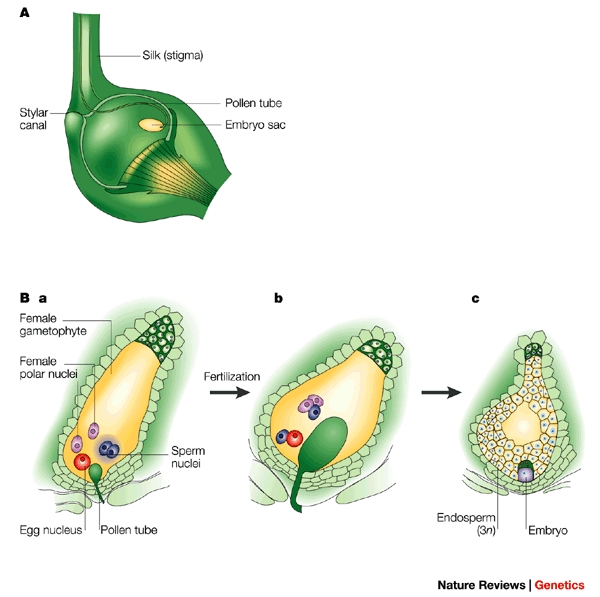
Double fertilisation in angiosperms: one male gamete fuses with the egg to form the diploid zygote (syngamy), while the second fuses with the two polar nuclei to form the triploid primary endosperm nucleus (triple fusion). Image: Triploid, CC BY 3.0, via Wikimedia Commons.
Concept context
Flower structure, pollination, double fertilization, and seed/fruit development - the highest-scoring Class 12 biology chapter in NEET.
Read the full Sexual Reproduction in Flowering Plants notes →