🎯 Key Points
- Microsporogenesis: MMC in microsporangium (anther) → 4 microspores by meiosis → each → mature pollen grain (2-celled: vegetative + generative)
- Megasporogenesis: MMC in nucellus → 4 megaspores by meiosis → 3 degenerate → functional megaspore → embryo sac (7-celled, 8-nucleate by 3 free nuclear divisions)
- Embryo sac cells: 2 synergids + 1 egg (micropyle end), 3 antipodals (chalazal end), 1 central cell with 2 polar nuclei
- Double fertilization (unique to angiosperms): sperm 1 + egg = zygote (2n) → embryo; sperm 2 + 2 polar nuclei = PEN (3n) → endosperm
- Pollination agents: wind (anemophily - light pollen, feathery stigma), insects (entomophily - colour/nectar), water (hydrophily - Vallisneria)
- Outbreeding devices: unisexuality, self-incompatibility, protandry/protogyny, heterostyly
- Seed = fertilised ovule; Fruit = ripened ovary (true) or thalamus (false - apple, strawberry)
- Apomixis: seed without fertilization (Citrus, mango nucellar embryony); Polyembryony: multiple embryos in one seed
Male Reproductive Structures
- Anther: 4 microsporangia (dithecous); wall = epidermis → endothecium → middle layers → tapetum (nutritive, PEN)
- Pollen grain = male gametophyte; exine (sporopollenin - most resistant biological material) + intine (cellulose/pectin)
- Mature pollen: 2-celled (vegetative cell + generative cell) or 3-celled (vegetative + 2 male gametes)
- Pollen viability: 30 min (rice/wheat) to months (Rosa); pollen banks at −196 °C in liquid nitrogen
Female Reproductive Structures
- Pistil: stigma (pollen landing) + style + ovary (contains ovules)
- Ovule (integumented megasporangium): 2 integuments → testa + tegmen of seed; nucellus; chalaza; micropyle; funicle; hilum
- Embryo sac development: monosporic (1 functional megaspore, most common - Polygonum type)
- Chalazogamy: pollen tube enters through chalaza (Casuarina)
Pollination & Fertilization
- Autogamy: pollen transferred within same flower; cleistogamous flowers (never open) guarantee it - Viola, Oxalis
- Geitonogamy: different flower of same plant; genetically autogamy though functionally cross-pollination
- Xenogamy: pollen from different plant; genetically cross-pollination
- Pollen tube enters ovule via micropyle (porogamy, most common); grows through style to embryo sac; releases 2 male gametes
- Endosperm: free nuclear → cellular (coconut water vs coconut kernel); in monocots persists (albuminous seed), in dicots consumed (non-albuminous)
Seed and Fruit Development
- Seed: testa (outer integument) + tegmen (inner integument) + cotyledon(s) + embryo (radical + plumule + hypocotyl)
- Cotyledon in monocot = scutellum; coleoptile (plumule sheath) + coleorhiza (radicle sheath) in grasses
- Parthenocarpy: seedless fruit without fertilization (banana, some grapes) - induced by auxins
Structure of a Flower
- The flower is the reproductive unit of angiosperms; four whorls arise on the thalamus - calyx (sepals), corolla (petals), androecium (stamens, male), gynoecium/pistil (carpels, female)
- Stamen (microsporophyll): filament + anther; a typical anther is bilobed and tetrasporangiate (4 pollen sacs / microsporangia)
- Carpel (megasporophyll): stigma + style + ovary; the ovary encloses ovules attached to the placenta
- A bisexual flower bears both androecium and gynoecium; unisexual flowers bear only one, which promotes cross-pollination
Types of Pollination and Adaptations
| Agent | Type | Flower / pollen adaptations |
|---|---|---|
| Wind | Anemophily | Light, dry, non-sticky pollen in large numbers; well-exposed stamens; large feathery stigma (grasses, maize) |
| Water | Hydrophily | Long ribbon-like or mucilage-coated pollen protected from wetting (Vallisneria, Hydrilla, Zostera) |
| Insect | Entomophily | Large, colourful, scented flowers with nectar; sticky, spiny pollen (most flowers) |
- Pollen-pistil interaction: the stigma recognises compatible pollen (accepts, allowing germination and pollen-tube growth) or incompatible pollen (rejects) through chemical signals
- Artificial hybridisation: emasculation (removing the anthers of a bisexual flower before they dehisce) followed by bagging protects the stigma, ensuring controlled cross-pollination in crop improvement
Double Fertilisation and Triple Fusion
- The pollen tube discharges two male gametes into the embryo sac (through a synergid); double fertilisation is unique to angiosperms
- Syngamy: one male gamete (n) fuses with the egg (n) to form the diploid zygote (2n), which develops into the embryo
- Triple fusion: the second male gamete (n) fuses with the two polar nuclei (n + n) of the central cell, forming the triploid primary endosperm nucleus (PEN, 3n) that develops into the endosperm
- Because both male gametes are used, no gamete is wasted
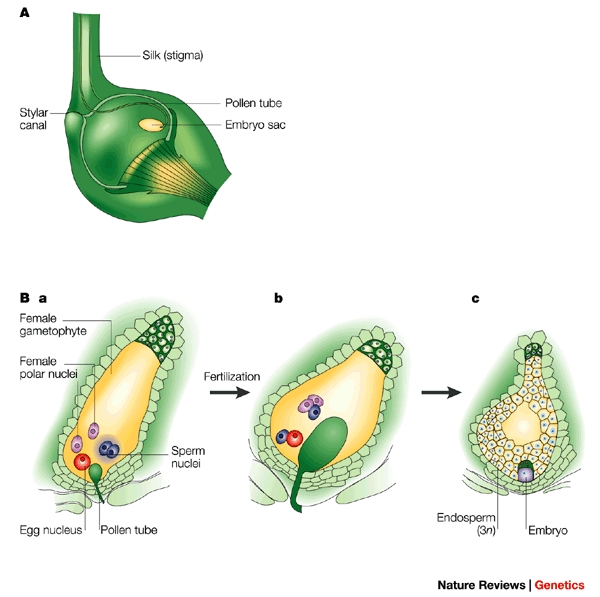
Double fertilisation in angiosperms: one male gamete fuses with the egg to form the diploid zygote (syngamy), while the second fuses with the two polar nuclei to form the triploid primary endosperm nucleus (triple fusion). Image: Triploid, CC BY 3.0, via Wikimedia Commons.
Embryo Development
- Zygote → proembryo → globular → heart-shaped → mature embryo (embryogeny); the endosperm develops first and nourishes the growing embryo
- Dicot embryo: two cotyledons and an embryonal axis - epicotyl ending in the plumule above and hypocotyl ending in the radicle below
- Monocot embryo: a single cotyledon called the scutellum; the plumule is enclosed in a coleoptile and the radicle in a coleorhiza (as in grasses)
Apomixis and Polyembryony
- Apomixis: the formation of seeds without meiosis and fertilisation, producing offspring genetically identical to the mother plant - valuable for preserving hybrid vigour across generations; e.g. nucellar embryony in Citrus and mango, and in many grasses and Asteraceae
- Polyembryony: occurrence of more than one embryo in a single seed (e.g. Citrus, mango) - often a result of apomixis
- Parthenocarpy: development of a fruit without fertilisation, giving seedless fruit (banana), and can be induced by growth hormones such as auxins
Outbreeding Devices
- Continued self-pollination causes inbreeding depression, so many flowering plants have evolved devices to encourage cross-pollination (outbreeding)
- Temporal separation: pollen release and stigma receptivity are not synchronised - the anther matures before the stigma (protandry) or the stigma matures before the anther (protogyny)
- Spatial separation: anther and stigma are placed at different positions (herkogamy) or at different heights on different flowers (heterostyly), so self-pollen cannot easily reach the stigma
- Self-incompatibility: a genetic (physiological) mechanism controlled by S-locus genes that prevents self-pollen from germinating or growing a tube on the stigma of the same flower
- Unisexual flowers: making flowers unisexual prevents autogamy; if male and female flowers are on the same plant (monoecious, e.g. maize, castor) it prevents only autogamy, whereas separate male and female plants (dioecious, e.g. papaya) prevent both autogamy and geitonogamy
Pollen-Pistil Interaction and Fertilisation
- Pollen-pistil interaction is a continuous dialogue: the stigma chemically recognises compatible pollen (allowing it to germinate) or rejects incompatible pollen (preventing germination or tube growth)
- Compatible pollen germinates on the stigma to produce a pollen tube; the tube grows through the tissues of the style, guided by chemical signals, and reaches the ovary
- The pollen tube usually enters the ovule through the micropyle (porogamy), then penetrates one of the synergids, guided by its filiform apparatus
- The tube discharges the two male gametes into the embryo sac, where double fertilisation takes place
- Because the whole pathway from stigma to embryo sac can be manipulated, this interaction is exploited in artificial hybridisation for crop improvement
Endosperm Development
- The triploid primary endosperm nucleus (PEN, 3n) formed by triple fusion divides repeatedly to form the endosperm, the nutritive tissue that feeds the developing embryo
- Free-nuclear endosperm (most common): the PEN undergoes many nuclear divisions without cell wall formation, forming free nuclei that later become walled - coconut water is a familiar free-nuclear endosperm, while the surrounding coconut kernel is the later cellular endosperm
- Cellular endosperm: cell wall formation follows each nuclear division from the start; helobial is an intermediate type
- Endosperm may persist in the mature seed (albuminous/endospermic seeds - wheat, maize, castor) or be completely consumed by the developing embryo (non-albuminous/ex-albuminous seeds - pea, gram, groundnut)
Significance of Seed and Fertilisation
- The seed is the final product of sexual reproduction - a fertilised, matured ovule containing an embryo, stored food, and a protective seed coat
- Advantages of the seed habit: reliable dispersal to new habitats, dormancy that lets the seed survive unfavourable conditions and germinate only when conditions improve, and stored reserves that give the young seedling a strong start
- Seeds generated by sexual reproduction carry new genetic combinations, providing the variation on which natural selection and crop breeding act; seeds are the basis of agriculture
- Seed viability varies enormously - some seeds are short-lived (a few months), while others remain viable for years; there are records of very old seeds germinating, such as a 2000-year-old date palm (Phoenix dactylifera) seed and Lupinus arcticus seeds recovered from arctic tundra
Structure of the Anther and Microsporogenesis
- A typical anther is bilobed and tetrasporangiate, with four microsporangia located at the corners.
- Each microsporangium has four wall layers: epidermis, endothecium, middle layers and the innermost nourishing tapetum.
- The tapetum nourishes the developing pollen grains and its cells are often multinucleate.
- Microsporogenesis is the formation of microspores from the pollen mother cells (microspore mother cells) by meiosis.
- The microspores are arranged in clusters of four called microspore tetrads and later dissociate into pollen grains.
Structure of the Pollen Grain
- The pollen grain represents the male gametophyte and is generally spherical.
- The wall has two layers: the hard outer exine made of resistant sporopollenin, and the inner cellulose-pectin intine.
- The exine has apertures called germ pores where sporopollenin is absent, allowing the pollen tube to emerge.
- A mature pollen grain contains a larger vegetative cell and a smaller generative cell.
- Pollen is shed at the 2-celled stage in many species, or the 3-celled stage in others after the generative cell divides.
Structure of the Ovule (Megasporangium)
- The ovule is a small structure attached to the placenta by a stalk called the funicle.
- The junction between the body of the ovule and the funicle is the hilum.
- Protective envelopes called integuments enclose the ovule except at a small opening, the micropyle.
- The basal part opposite the micropyle is the chalaza; the tissue enclosed within the integuments is the nucellus.
- The nucellus contains reserve food and houses the embryo sac (female gametophyte).
Megasporogenesis and the Embryo Sac
- Megasporogenesis is the formation of megaspores from the megaspore mother cell by meiosis.
- Usually one functional megaspore develops while the other three degenerate.
- The functional megaspore forms the embryo sac (female gametophyte) by three free nuclear mitotic divisions, giving a typical 7-celled, 8-nucleate structure.
- At the micropylar end lies the egg apparatus of one egg cell and two synergids; the chalazal end has three antipodal cells.
- The large central cell contains two polar nuclei; the synergids bear filiform apparatus that guide the pollen tube.
Artificial Hybridisation Techniques
- Artificial hybridisation is a crop-improvement method that ensures only desired pollen fertilises selected female flowers.
- Emasculation is the removal of anthers from a bisexual flower bud before the anthers dehisce, to prevent self-pollination.
- Bagging is covering the emasculated flower with a butter-paper bag to protect the stigma from unwanted pollen.
- When the stigma becomes receptive, mature desired pollen is dusted on it and the flower is re-bagged.
- In female (unisexual) flowers emasculation is not needed; the flower buds are simply bagged before opening.