Answer: Repeated self-fertilization of F 2 plants until homozygosity is ~99%, useful for QTL mapping.
- A Repeated self-incompatible crosses occurring between unrelated parent breeding lines over time
- B Repeated self-fertilization of F<sub>2</sub> plants until homozygosity is ~99%, useful for QTL mapping
- C Backcrossing alone, without any intervening self-fertilization steps taking place
- D Vegetative cloning of a single heterozygous parent plant repeatedly over time
Correct answer: B. Repeated self-fertilization of F<sub>2</sub> plants until homozygosity is ~99%, useful for QTL mapping
Explanation: RILs: F<sub>2</sub> plants are self-fertilized for 6-8 generations. Resulting lines are nearly 100% homozygous but carry a mosaic of the two parental genomes. Invaluable for QTL mapping and marker-assisted selection.
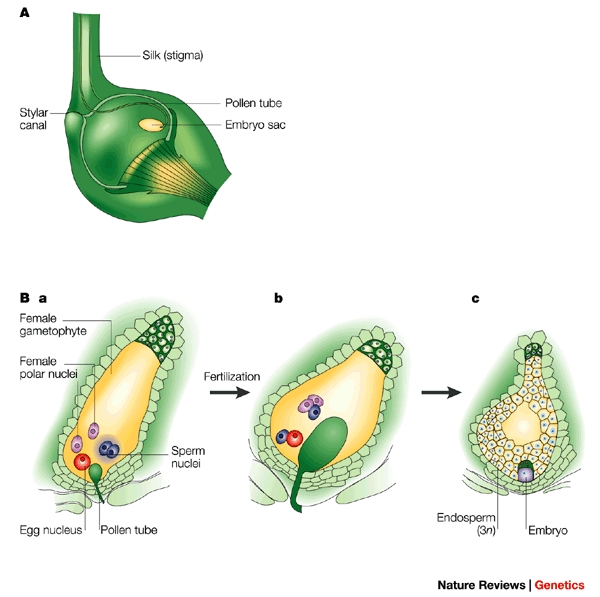
Double fertilisation in angiosperms: one male gamete fuses with the egg to form the diploid zygote (syngamy), while the second fuses with the two polar nuclei to form the triploid primary endosperm nucleus (triple fusion). Image: Triploid, CC BY 3.0, via Wikimedia Commons.
Concept context
Flower structure, pollination, double fertilization, and seed/fruit development - the highest-scoring Class 12 biology chapter in NEET.
Read the full Sexual Reproduction in Flowering Plants notes →