Answer: Having morphologically distinct flower types (pin and thrum) where stamens of one type are at the same height as stigma of other type, promoting cross-pollination.
- A Having largely separate male and female plants existing individually within the same breeding population in general practice as frequently described
- B Having morphologically distinct flower types (pin and thrum) where stamens of one type are at the same height as stigma of other type, promoting cross-pollination
- C Relying mainly upon chemical self-incompatibility reactions occurring specifically at the receptive stigma surface itself in most textbook accounts during normal conditions
- D Temporal separation occurring mainly between the timing of pollen release and the period of stigma receptivity, as observed in typical laboratory settings
Correct answer: B. Having morphologically distinct flower types (pin and thrum) where stamens of one type are at the same height as stigma of other type, promoting cross-pollination
Explanation: Heterostyly (distyly/tristyly): flowers differ in position of stamens and stigma. Pin (long style, low anthers) x Thrum (short style, high anthers) ensures pollen lands on stigma of opposite type -- mechanical self-incompatibility.
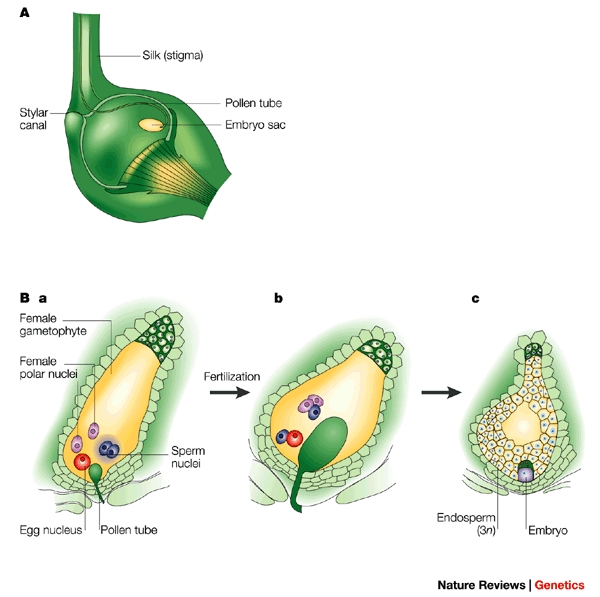
Double fertilisation in angiosperms: one male gamete fuses with the egg to form the diploid zygote (syngamy), while the second fuses with the two polar nuclei to form the triploid primary endosperm nucleus (triple fusion). Image: Triploid, CC BY 3.0, via Wikimedia Commons.
Concept context
Flower structure, pollination, double fertilization, and seed/fruit development - the highest-scoring Class 12 biology chapter in NEET.
Read the full Sexual Reproduction in Flowering Plants notes →