Answer: Which floral organs form in which whorl (A genes: sepals/petals, B genes: petals/stamens, C genes: stamens/carpels).
- A Leaf identity only, having absolutely no documented role whatsoever in determining the fate of any floral organ
- B Which floral organs form in which whorl (A genes: sepals/petals, B genes: petals/stamens, C genes: stamens/carpels)
- C Root system formation specifically through direct control over lateral root primordia initiation and emergence
- D Pollen tube growth rate and its precise chemotropic guidance pathway toward the awaiting ovule structure
Correct answer: B. Which floral organs form in which whorl (A genes: sepals/petals, B genes: petals/stamens, C genes: stamens/carpels)
Explanation: ABC model of floral development: A alone = sepals; A+B = petals; B+C = stamens; C alone = carpels. MADS-box TFs (AP1, AP3/PI, AG) control floral organ identity in Arabidopsis.
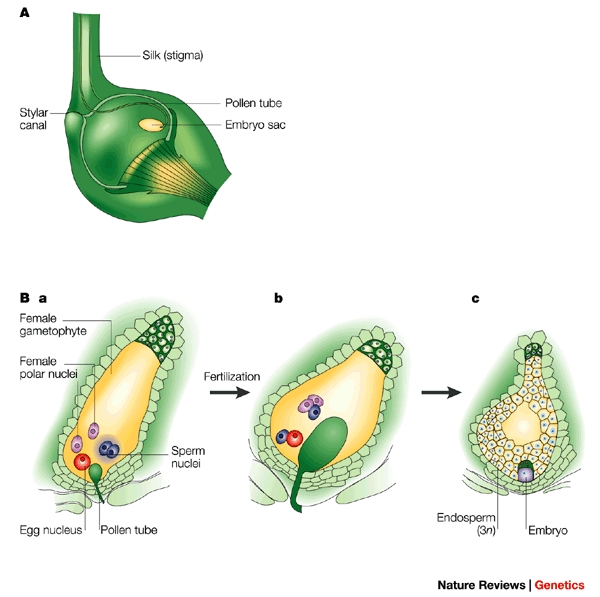
Double fertilisation in angiosperms: one male gamete fuses with the egg to form the diploid zygote (syngamy), while the second fuses with the two polar nuclei to form the triploid primary endosperm nucleus (triple fusion). Image: Triploid, CC BY 3.0, via Wikimedia Commons.
Concept context
Flower structure, pollination, double fertilization, and seed/fruit development - the highest-scoring Class 12 biology chapter in NEET.
Read the full Sexual Reproduction in Flowering Plants notes →