Answer: Nuclear (nuclear divisions without walls), cellular (with walls), or helobial (in monocots) depending on species.
- A Mainly cellular in most species, with rigid cell wall formation accompanying every nuclear division that occurs
- B Nuclear (nuclear divisions without walls), cellular (with walls), or helobial (in monocots) depending on species
- C Mainly liquid in form throughout development, rarely forming any solid cellular tissue structure whatsoever
- D Mainly starchy from the very beginning, largely lacking any free nuclear or true cellular developmental phase
Correct answer: B. Nuclear (nuclear divisions without walls), cellular (with walls), or helobial (in monocots) depending on species
Explanation: Endosperm types: nuclear (free nuclear divisions in coconut liquid endosperm), cellular (walls after each division, as in many dicots), helobial (intermediate, common in monocots).
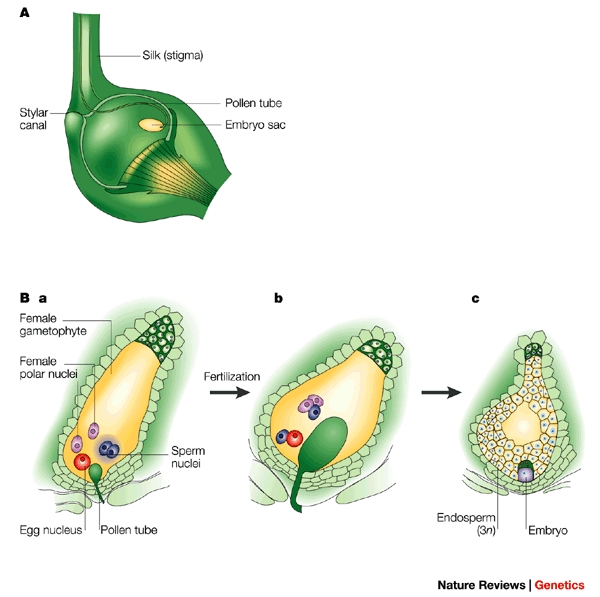
Double fertilisation in angiosperms: one male gamete fuses with the egg to form the diploid zygote (syngamy), while the second fuses with the two polar nuclei to form the triploid primary endosperm nucleus (triple fusion). Image: Triploid, CC BY 3.0, via Wikimedia Commons.
Concept context
Flower structure, pollination, double fertilization, and seed/fruit development - the highest-scoring Class 12 biology chapter in NEET.
Read the full Sexual Reproduction in Flowering Plants notes →