Answer: Haploid pollen S-gene product interacting with pistil S-gene product; both encoded by multiallelic S-locus (e.g., RNase-based in Solanaceae).
- A Diploid sporophytic tissue of the pistil acting largely alone, without requiring much input from the pollen grain itself directly during normal conditions
- B Haploid pollen S-gene product interacting with pistil S-gene product; both encoded by multiallelic S-locus (e.g., RNase-based in Solanaceae)
- C The diploid seed coat tissue alone, acting mostly independently of any pollen-pistil molecular signaling interaction happening as generally observed
- D Epigenetic chromatin marks alone, occurring with little underlying genetic S-locus sequence ever being involved in practice in typical laboratory settings
Correct answer: B. Haploid pollen S-gene product interacting with pistil S-gene product; both encoded by multiallelic S-locus (e.g., RNase-based in Solanaceae)
Explanation: GSI: pollen S-allele product determines incompatibility. In Solanaceae: S-RNase (pistil) degrades RNA in incompatible pollen tubes. In Papaveraceae: Ca<sup>2+</sup> signaling inhibits pollen tube growth.
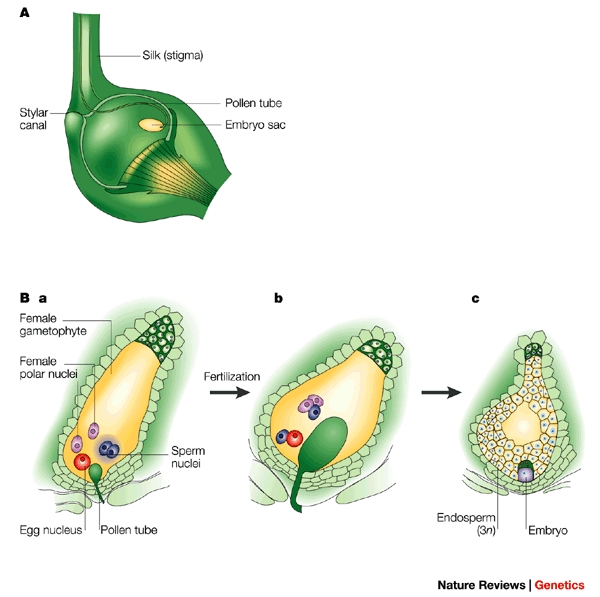
Double fertilisation in angiosperms: one male gamete fuses with the egg to form the diploid zygote (syngamy), while the second fuses with the two polar nuclei to form the triploid primary endosperm nucleus (triple fusion). Image: Triploid, CC BY 3.0, via Wikimedia Commons.
Concept context
Flower structure, pollination, double fertilization, and seed/fruit development - the highest-scoring Class 12 biology chapter in NEET.
Read the full Sexual Reproduction in Flowering Plants notes →