Answer: Preserve genetic diversity of plant species for thousands of years by slowing metabolism to near zero in liquid nitrogen or at -20 to -18 degrees C with low moisture content.
- A Increase the overall rate of seed germination immediately upon subsequent planting under typical field growing conditions each season during normal conditions as generally observed
- B Preserve genetic diversity of plant species for thousands of years by slowing metabolism to near zero in liquid nitrogen or at -20 to -18 degrees C with low moisture content
- C Preserve mainly commercially important agricultural crop varieties, while largely excluding most wild relative species nearby in typical laboratory settings under usual circumstances
- D Store seeds in a state that is immediately ready for planting and rapid germination without requiring any further preparation steps taken according to most researchers
Correct answer: B. Preserve genetic diversity of plant species for thousands of years by slowing metabolism to near zero in liquid nitrogen or at -20 to -18 degrees C with low moisture content
Explanation: Seed banks (e.g., Svalbard Global Seed Vault): reduce seed moisture to 5-7% and store at -18 to -20 C (or cryopreservation in liquid N<sub>2</sub>). Metabolic activity essentially halted; viability maintained for decades to centuries.
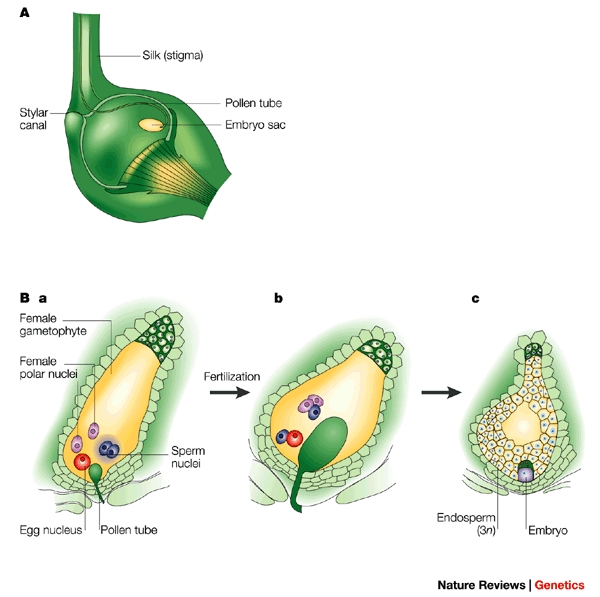
Double fertilisation in angiosperms: one male gamete fuses with the egg to form the diploid zygote (syngamy), while the second fuses with the two polar nuclei to form the triploid primary endosperm nucleus (triple fusion). Image: Triploid, CC BY 3.0, via Wikimedia Commons.
Concept context
Flower structure, pollination, double fertilization, and seed/fruit development - the highest-scoring Class 12 biology chapter in NEET.
Read the full Sexual Reproduction in Flowering Plants notes →