Answer: Sterility caused by mitochondrial genes that prevent pollen development (used in hybrid seed production in rice, maize, sorghum).
- A A nuclear recessive mutation that is inherited generally according to standard Mendelian segregation ratios across generations
- B Sterility caused by mitochondrial genes that prevent pollen development (used in hybrid seed production in rice, maize, sorghum)
- C A condition that is caused specifically by deletion of particular genes located on the X chromosome itself
- D A condition induced largely by a persistent, latent viral infection that specifically targets the developing anther tissue
Correct answer: B. Sterility caused by mitochondrial genes that prevent pollen development (used in hybrid seed production in rice, maize, sorghum)
Explanation: CMS: mitochondrial gene (non-Mendelian) causes pollen abortion. Nuclear restorer genes (Rf) can restore fertility. Used in F<sub>1</sub> hybrid seed production: CMS female x normal male -- no manual emasculation needed.
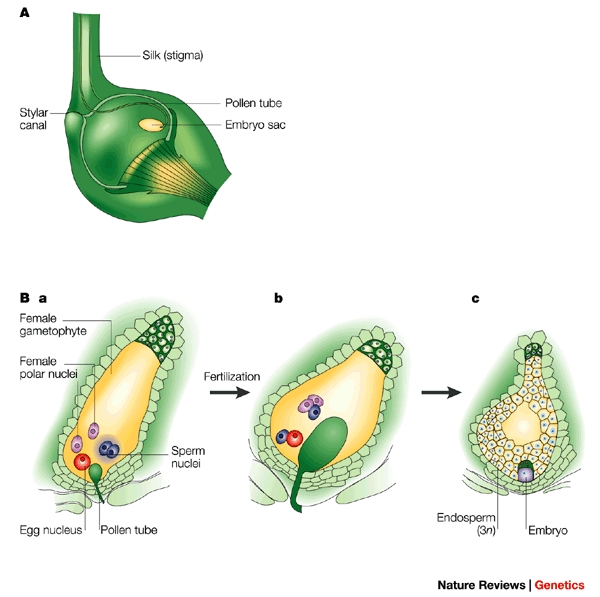
Double fertilisation in angiosperms: one male gamete fuses with the egg to form the diploid zygote (syngamy), while the second fuses with the two polar nuclei to form the triploid primary endosperm nucleus (triple fusion). Image: Triploid, CC BY 3.0, via Wikimedia Commons.
Concept context
Flower structure, pollination, double fertilization, and seed/fruit development - the highest-scoring Class 12 biology chapter in NEET.
Read the full Sexual Reproduction in Flowering Plants notes →