Answer: Epigenetic marks (methylation, chromatin states) established in response to stress are transmitted through seeds to offspring, influencing their phenotype.
- A Permanent changes to the underlying DNA sequence itself are sometimes thought to be passed directly on to the resulting offspring generation each time
- B Epigenetic marks (methylation, chromatin states) established in response to stress are transmitted through seeds to offspring, influencing their phenotype
- C The underlying gene sequences themselves are sometimes thought to undergo permanent change specifically within the offspring generation by itself
- D Mainly small interfering RNA molecules are sometimes thought to be inherited, with little chromatin or methylation marks being involved
Correct answer: B. Epigenetic marks (methylation, chromatin states) established in response to stress are transmitted through seeds to offspring, influencing their phenotype
Explanation: Transgenerational epigenetic inheritance: stress-induced chromatin changes (DNA methylation, small RNA) can persist through meiosis and be inherited by offspring. Plants may be primed for same stress. Less erased than in animals.
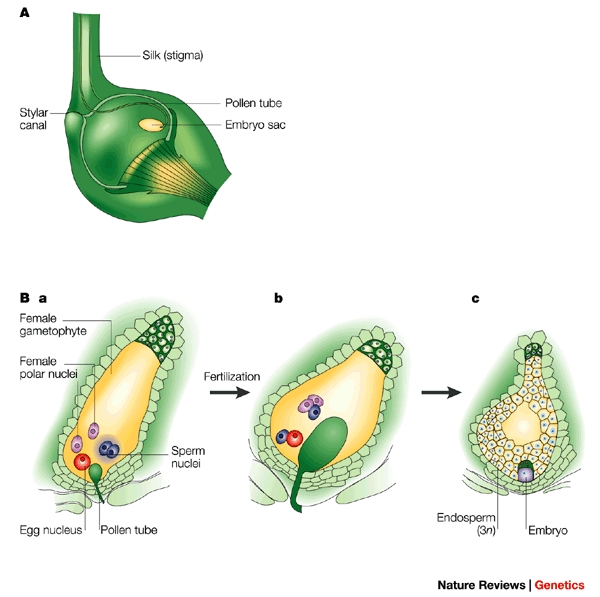
Double fertilisation in angiosperms: one male gamete fuses with the egg to form the diploid zygote (syngamy), while the second fuses with the two polar nuclei to form the triploid primary endosperm nucleus (triple fusion). Image: Triploid, CC BY 3.0, via Wikimedia Commons.
Concept context
Flower structure, pollination, double fertilization, and seed/fruit development - the highest-scoring Class 12 biology chapter in NEET.
Read the full Sexual Reproduction in Flowering Plants notes →