83 practice questions on Magnetism and Matter, sorted Easy → Hard. Try each one first, then open its answer page for the worked explanation. Want the full theory first? Read the Magnetism and Matter notes.
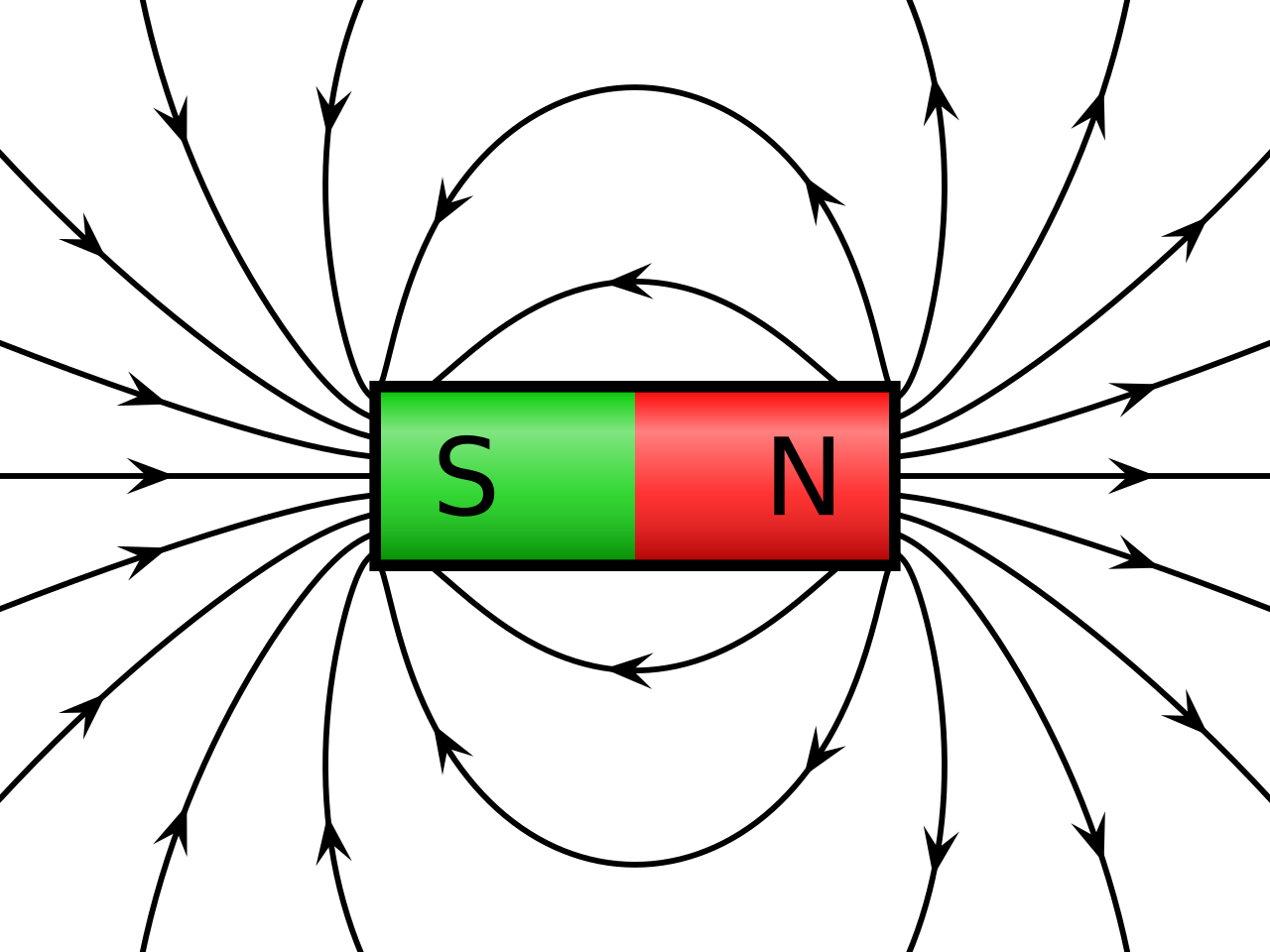
Magnetic field of a bar magnet: field lines emerge from the north pole and re-enter at the south pole outside the magnet, forming continuous closed loops. Image: Geek3, CC BY-SA 3.0, via Wikimedia Commons.
Easy - 25 questions
Q1.
The magnetic field lines of a bar magnet form:
- A Open curves ending at poles
- B Closed continuous loops
- C Straight radial lines
- D A single point
Show answer & explanation →
Q3.
The magnetic declination at a place is the angle between:
- A Geographic and magnetic meridians
- B The field and the horizontal plane
- C The Earth's two magnetic poles
- D The field and the vertical plane
Show answer & explanation →
Q4.
A permanent magnet is best made from a material that is magnetically:
- A Soft
- B Temporary
- C Diamagnetic
- D Hard
Show answer & explanation →
Q6.
A magnetic pole that does not exist alone is called:
- A North pole, which can exist in isolation under strong fields
- B South pole, which can be isolated by cutting a magnet
- C Monopole (they do exist)
- D Poles always come in pairs (no monopoles)
Show answer & explanation →
Q7.
Earth has a magnetic field. Geographic north corresponds to:
- A Magnetic north pole
- B Magnetic south pole
- C No magnetic pole
- D Varies by location
Show answer & explanation →
Q9.
What happens to a diamagnetic material when placed in an external magnetic field?
- A It is strongly attracted
- B It is weakly attracted
- C It is weakly repelled
- D It becomes permanently magnetised
Show answer & explanation →
Q10.
The SI unit of magnetic moment is:
- A Tesla, the unit of magnetic flux density
- B Weber, the unit of total magnetic flux
- C Ampere metre squared (A·m²)
- D Henry, the unit of inductance
Show answer & explanation →
Q11.
What is the angle that the Earth's magnetic field makes with the horizontal called?
- A Declination
- B Inclination (dip)
- C Latitude
- D Azimuth
Show answer & explanation →
Q12.
Above the Curie temperature, a ferromagnetic material becomes:
- A Diamagnetic
- B Paramagnetic
- C Superconducting
- D Permanently magnetised
Show answer & explanation →
Q13.
When a bar magnet is suspended freely and allowed to rotate, it eventually comes to rest pointing approximately:
- A Along the east-west direction
- B Vertically up and down
- C In a random horizontal direction
- D Along the north-south direction
Show answer & explanation →
Q14.
A material that gets weakly magnetised in a direction opposite to the applied magnetic field is called:
- A Diamagnetic
- B Paramagnetic
- C Ferromagnetic
- D Non-magnetic
Show answer & explanation →
Q15.
The imaginary lines used to represent a magnetic field, drawn so that the tangent at any point gives the field direction, are called:
- A Electric field lines
- B Magnetic field lines
- C Equipotential lines
- D Isobars
Show answer & explanation →
Q16.
A freely suspended bar magnet finally comes to rest pointing in the:
- A north–south direction
- B east–west direction
- C up–down direction
- D a random direction
Show answer & explanation →
Q17.
Like magnetic poles placed near each other:
- A repel each other
- B attract each other
- C do nothing at all
- D merge together
Show answer & explanation →
Q18.
Unlike magnetic poles placed near each other:
- A attract each other
- B repel each other
- C do nothing at all
- D cancel out
Show answer & explanation →
Q19.
An isolated single magnetic pole (a magnetic monopole):
- A does not exist
- B exists freely
- C is very common
- D is a north pole only
Show answer & explanation →
Q20.
The region around a magnet where its influence is felt is called the:
- A magnetic field
- B electric field
- C gravitational field
- D null region
Show answer & explanation →
Q21.
The SI unit of magnetic pole strength is the:
- A ampere-metre (A·m)
- B the tesla unit (T)
- C the weber unit (Wb)
- D the henry unit (H)
Show answer & explanation →
Q24.
Materials that are strongly attracted by a magnet are called:
- A ferromagnetic
- B diamagnetic
- C paramagnetic
- D non-magnetic
Show answer & explanation →
Q25.
When a bar magnet is cut into two pieces, each piece:
- A is a complete magnet
- B has only one pole
- C loses all magnetism
- D becomes non-magnetic
Show answer & explanation →
Medium - 26 questions
Q26.
A diamagnetic substance placed in a non-uniform magnetic field tends to move:
- A towards the stronger field region
- B along the field lines only
- C perpendicular to the field
- D towards the weaker field region
Show answer & explanation →
Q27.
A bar magnet of moment 2 A m<sup>2</sup> is placed perpendicular to a uniform field of 0.25 T. The torque on it is:
- A 0.25 N m
- B 0.5 N m
- C 1 N m
- D 2 N m
Show answer & explanation →
Q28.
A paramagnetic sample has susceptibility 3 × 10<sup>-3</sup> at 300 K. By Curie's law, at 150 K its susceptibility becomes:
- A 1.5 × 10<sup>-3</sup>
- B 3 × 10<sup>-3</sup>
- C 6 × 10<sup>-3</sup>
- D 9 × 10<sup>-3</sup>
Show answer & explanation →
Q29.
At a place the horizontal component of Earth's field is 0.26 × 10<sup>-4</sup> T and the angle of dip is 60°. The total field is:
- A 0.26 × 10<sup>-4</sup> T
- B 0.30 × 10<sup>-4</sup> T
- C 0.45 × 10<sup>-4</sup> T
- D 0.52 × 10<sup>-4</sup> T
Show answer & explanation →
Q30.
The work done in rotating a magnetic dipole of moment m from alignment with a field B to a position perpendicular to it is:
Show answer & explanation →
Q31.
A magnetising field H = 800 A/m produces magnetisation M = 2.4 × 10<sup>5</sup> A/m in a material. Its susceptibility is:
Show answer & explanation →
Q32.
How does the magnetic susceptibility of a paramagnetic substance change as temperature increases?
- A It increases
- B It decreases
- C It stays constant
- D It becomes negative
Show answer & explanation →
Q33.
A bar magnet of magnetic moment m is placed in a uniform external field B at angle theta to the field. What is the potential energy of the magnet?
- A U = mB sin(theta)
- B U = mB cos(theta)
- C U = -mB cos(theta)
- D U = -mB sin(theta)
Show answer & explanation →
Q34.
Why does a superconductor behave differently from an ordinary diamagnetic material?
- A It has mainly a small negative magnetic susceptibility like other ordinary diamagnets under usual circumstances
- B It completely expels magnetic field lines from its interior (Meissner effect), with susceptibility exactly -1
- C It is actually paramagnetic underneath, aligning weakly with the applied external field according to most researchers
- D It has exactly zero magnetic susceptibility, behaving magnetically just like a vacuum in the majority of cases studied
Show answer & explanation →
Q35.
Soft iron is preferred over steel for making transformer cores because soft iron has:
- A High retentivity and a wide hysteresis loop, much like a permanent bar magnet as widely reported
- B Low retentivity and a narrow hysteresis loop, minimising hysteresis energy loss per AC cycle
- C Zero magnetic permeability, behaving magnetically just like a non-magnetic vacuum in standard practice
- D Negative magnetic susceptibility, behaving magnetically like a diamagnetic substance under most conditions encountered
Show answer & explanation →
Q36.
A bar magnet is cut into two equal pieces along its axis (lengthwise, so each piece is thinner but the same length as the original). Compared to the original, the pole strength of each new piece is:
- A The same as the original pole strength
- B Roughly half of the original pole strength
- C Twice the original pole strength
- D One-fourth of the original pole strength
Show answer & explanation →
Q37.
A bar magnet placed in a uniform magnetic field experiences zero net force but, in general, a non-zero torque. This happens because:
- A The north pole of the magnet interacts with the field, while the south pole stays unaffected in most observed cases
- B The magnet's poles experience forces mainly when the field is non-uniform, rather than when it is uniform under typical physiological conditions
- C The two poles experience equal and opposite forces that form a couple unless the magnet is aligned with the field
- D A uniform field exerts force on a magnet but produces no torque on it according to standard texts in general clinical practice
Show answer & explanation →
Q38.
Curie's law states that the magnetic susceptibility of a paramagnetic material is:
- A Directly proportional to the absolute temperature
- B Independent of temperature
- C Inversely proportional to the square of the temperature
- D Inversely proportional to the absolute temperature
Show answer & explanation →
Q39.
A magnetic compass shows zero dip at a certain location. This location is most likely close to:
- A The magnetic equator
- B The magnetic north pole
- C The magnetic south pole
- D A point midway between the equator and a magnetic pole
Show answer & explanation →
Q40.
A hysteresis loop for a magnetic material shows the area enclosed by the B-H curve during one complete cycle of magnetisation and demagnetisation. This enclosed area represents:
- A The maximum magnetic field reached inside the material
- B Energy dissipated as heat per unit volume of the material in one cycle
- C The retentivity of the material in that one cycle
- D The total magnetic flux passing through the material in one cycle
Show answer & explanation →
Q41.
A bar magnet of magnetic moment m and a solenoid of the same size and magnetic moment are both suspended freely near each other. Compared to the bar magnet, the solenoid:
- A Produces a noticeably weaker external field, since coiled current loops behave quite differently from a permanent magnet
- B Produces a field mainly inside itself, with little field reaching the space outside
- C Produces essentially the same magnetic field pattern outside, since both behave as equivalent magnetic dipoles
- D Produces a field that points radially outward rather than along an axis
Show answer & explanation →
Q42.
The magnetic dipole moment of a bar magnet points from its:
- A south pole to north pole
- B north pole to south pole
- C east side to west
- D centre outward
Show answer & explanation →
Q43.
Diamagnetic materials are ___ by a magnetic field:
- A weakly repelled
- B strongly attracted
- C strongly magnetised
- D completely unaffected
Show answer & explanation →
Q44.
Paramagnetic materials are ___ by a magnetic field:
- A weakly attracted
- B strongly repelled
- C weakly repelled
- D totally unaffected
Show answer & explanation →
Q45.
The magnetic susceptibility of a diamagnetic material is:
- A small and negative
- B small and positive
- C large and positive
- D exactly zero
Show answer & explanation →
Q46.
The magnetic susceptibility of a ferromagnetic material is:
- A large and positive
- B small and negative
- C small and positive
- D exactly zero
Show answer & explanation →
Q48.
The torque on a magnetic dipole of moment m in a uniform field B is:
- A mB sinθ
- B mB cosθ
- C always mB
- D m divided by B
Show answer & explanation →
Q49.
The relative permeability of a ferromagnetic material is:
- A much greater than 1
- B much less than 1
- C exactly equal to 1
- D exactly zero
Show answer & explanation →
Q50.
The angle of dip is 90° at the Earth’s:
- A magnetic poles
- B magnetic equator
- C surface everywhere
- D geometric centre
Show answer & explanation →
Q51.
The angle of dip is 0° at the Earth’s:
- A magnetic equator
- B magnetic poles
- C geographic north pole
- D geographic south pole
Show answer & explanation →
Hard - 32 questions
Q52.
A short bar magnet of moment 0.4 A m<sup>2</sup> gives an axial (end-on) field at 0.2 m of (μ<sub>0</sub>/4π = 10<sup>-7</sup>):
- A 2.5 × 10<sup>-6</sup> T
- B 5 × 10<sup>-6</sup> T
- C 1 × 10<sup>-5</sup> T
- D 2 × 10<sup>-5</sup> T
Show answer & explanation →
Q53.
For the same short magnet (moment 0.4 A m<sup>2</sup>) the equatorial (broadside-on) field at 0.2 m is:
- A 2 × 10<sup>-5</sup> T
- B 1 × 10<sup>-5</sup> T
- C 2.5 × 10<sup>-6</sup> T
- D 5 × 10<sup>-6</sup> T
Show answer & explanation →
Q54.
A thin bar magnet of moment m is bent into a semicircle. Its new magnetic moment is:
- A 2m/π
- B m/π
- C m/2
- D πm/2
Show answer & explanation →
Q55.
In a vibration magnetometer the time period is 3 s. If the magnetic moment of the needle is doubled while the field is unchanged, the new period is:
- A 6 s
- B 3 s
- C 2.12 s
- D 1.5 s
Show answer & explanation →
Q56.
In MRI machines, strong magnetic fields are used. A proton's Larmor frequency in 3 T field:
- A 12.77 MHz
- B 63.87 MHz
- C 127.7 MHz
- D 637 MHz
Show answer & explanation →
Q57.
Magnetic susceptibility of diamagnetic materials is:
- A Large and positive
- B Small and positive
- C Small and negative
- D Zero
Show answer & explanation →
Q58.
A ferromagnetic material loses its magnetisation as soon as a small external field is removed, while another retains strong magnetisation. What do these two materials represent, and why does only one retain magnetism?
- A Soft ferromagnet (low retentivity, narrow hysteresis loop) vs hard ferromagnet (high retentivity, wide hysteresis loop) - the difference lies in how strongly domain alignment persists without an external field
- B Both materials are physically identical in every microscopic respect including domain structure, and the apparent difference in retention observed between them is mainly a random measurement artifact with little underlying physical cause
- C The first material described in the scenario is actually paramagnetic in its underlying nature, while the second material described is in fact mainly diamagnetic rather than ferromagnetic in many documented cases
- D Magnetic retention behaviour in both of these materials depends mainly on each one's bulk electrical resistivity value, and not on any internal magnetic domain structure within the crystal according to conventional understanding
Show answer & explanation →
Q59.
A short bar magnet of magnetic moment 0.5 J/T is placed at 30° with a uniform external magnetic field of 0.2 T. The torque acting on the magnet is approximately:
- A 0.05 N·m
- B 0.1 N·m
- C 0.025 N·m
- D 0.087 N·m
Show answer & explanation →
Q60.
A bar magnet has magnetic moment m and length 2l. It is cut into two equal halves with a cut perpendicular to its length, so each piece is half as long. The magnetic moment of each new piece is:
Show answer & explanation →
Q61.
A magnetic needle free to rotate in a vertical plane oriented along the magnetic meridian dips at an angle of 60° at a place where the horizontal component of Earth's field is 0.3 × 10⁻⁴ T. The vertical component of Earth's magnetic field at that place is approximately:
- A 0.30 × 10⁻⁴ T
- B 0.17 × 10⁻⁴ T
- C 0.52 × 10⁻⁴ T
- D 0.60 × 10⁻⁴ T
Show answer & explanation →
Q62.
A solenoid with a ferromagnetic core has a magnetising field H = 1500 A/m, producing a magnetic field B = 2.4 T inside the core. The relative permeability of the core material is approximately:
Show answer & explanation →
Q63.
Two identical magnetic dipoles of moment m each are placed at a separation r, one in the end-on (axial) position and one in the broadside-on (equatorial) position relative to a reference point at the same distance r. The ratio of the magnetic field at that point due to the axial arrangement to the field due to the equatorial arrangement is:
Show answer & explanation →
Q64.
A toroid with a ferromagnetic core has 1000 turns per metre and carries a current of 2 A. If the core has a magnetic susceptibility of 599, the magnetisation of the core material is approximately:
- A 2000 A/m
- B 1.198 × 10⁶ A/m
- C 599 A/m
- D 1.2 × 10³ A/m
Show answer & explanation →
Q65.
A compass needle is placed at a point where the resultant magnetic field has equal horizontal and vertical components. The angle of dip at that point is closest to:
Show answer & explanation →
Q66.
Above its Curie temperature, a ferromagnetic material becomes:
- A paramagnetic
- B diamagnetic
- C a permanent magnet
- D completely non-magnetic
Show answer & explanation →
Q67.
The potential energy of a magnetic dipole in a field is minimum when the dipole is aligned ___ the field:
- A parallel to
- B antiparallel to
- C perpendicular to
- D at 45° to
Show answer & explanation →
Q68.
Curie’s law states that the susceptibility of a paramagnet is ___ the absolute temperature:
- A inversely proportional to
- B directly proportional to
- C exactly equal to
- D entirely unrelated to
Show answer & explanation →
Q69.
The three elements of the Earth’s magnetism are declination, the angle of dip and the ___ component of the field:
- A horizontal
- B purely vertical
- C diagonal
- D radial
Show answer & explanation →
Q70.
A material that retains its magnetism after the external field is removed is:
- A hard magnetic, like steel
- B soft magnetic material
- C a diamagnetic one
- D a paramagnetic one
Show answer & explanation →
Q71.
Soft iron is preferred for electromagnet cores because it is:
- A easily magnetised and demagnetised
- B able to retain magnetism forever
- C impossible to magnetise
- D strongly diamagnetic
Show answer & explanation →
Q73.
The angle between the geographic meridian and the magnetic meridian is called the angle of:
- A declination
- B the dip angle
- C the incidence
- D the refraction
Show answer & explanation →
Q74.
Hysteresis is the lagging of the ___ behind the magnetising field:
- A magnetisation
- B temperature
- C electric current
- D applied voltage
Show answer & explanation →
Q76.
A bar magnet of magnetic moment m is cut into two equal pieces along its length (perpendicular to its axis). The magnetic moment of each piece is:
Show answer & explanation →
Q77.
Diamagnetic materials are characterized by a magnetic susceptibility that is:
- A small and negative
- B small and positive
- C large and positive
- D large and negative
Show answer & explanation →
Q78.
When a ferromagnetic material is heated above its Curie temperature, it becomes:
- A paramagnetic
- B diamagnetic
- C more strongly ferromagnetic
- D a superconductor
Show answer & explanation →
Q81.
A bar magnet in a uniform magnetic field experiences maximum torque when the angle between its moment and the field is:
Show answer & explanation →
Q82.
In a vibration magnetometer, the time period is T = 2π√(I/mB). If the magnetic field is made four times stronger, the period:
- A halves
- B doubles
- C becomes four times
- D is unchanged
Show answer & explanation →
Q83.
The magnetic moment of a flat current-carrying coil of N turns, current I, and area A is:
- A NIA
- B NI/A
- C IA/N
- D N/(IA)
Show answer & explanation →