Answer: Soft ferromagnet (low retentivity, narrow hysteresis loop) vs hard ferromagnet (high retentivity, wide hysteresis loop) - the difference lies in how strongly domain alignment persists without an external field.
- A Soft ferromagnet (low retentivity, narrow hysteresis loop) vs hard ferromagnet (high retentivity, wide hysteresis loop) - the difference lies in how strongly domain alignment persists without an external field
- B Both materials are physically identical in every microscopic respect including domain structure, and the apparent difference in retention observed between them is mainly a random measurement artifact with little underlying physical cause
- C The first material described in the scenario is actually paramagnetic in its underlying nature, while the second material described is in fact mainly diamagnetic rather than ferromagnetic in many documented cases
- D Magnetic retention behaviour in both of these materials depends mainly on each one's bulk electrical resistivity value, and not on any internal magnetic domain structure within the crystal according to conventional understanding
Correct answer: A. Soft ferromagnet (low retentivity, narrow hysteresis loop) vs hard ferromagnet (high retentivity, wide hysteresis loop) - the difference lies in how strongly domain alignment persists without an external field
Explanation: Within ferromagnetic materials, 'soft' ferromagnets (e.g., soft iron) have low retentivity and a narrow hysteresis loop, losing magnetisation quickly once the field is removed - ideal for transformer cores. 'Hard' ferromagnets (e.g., steel, alnico) have high retentivity and a wide hysteresis loop, retaining strong magnetisation - ideal for permanent magnets. The difference comes from how strongly the domain structure resists realignment once formed.
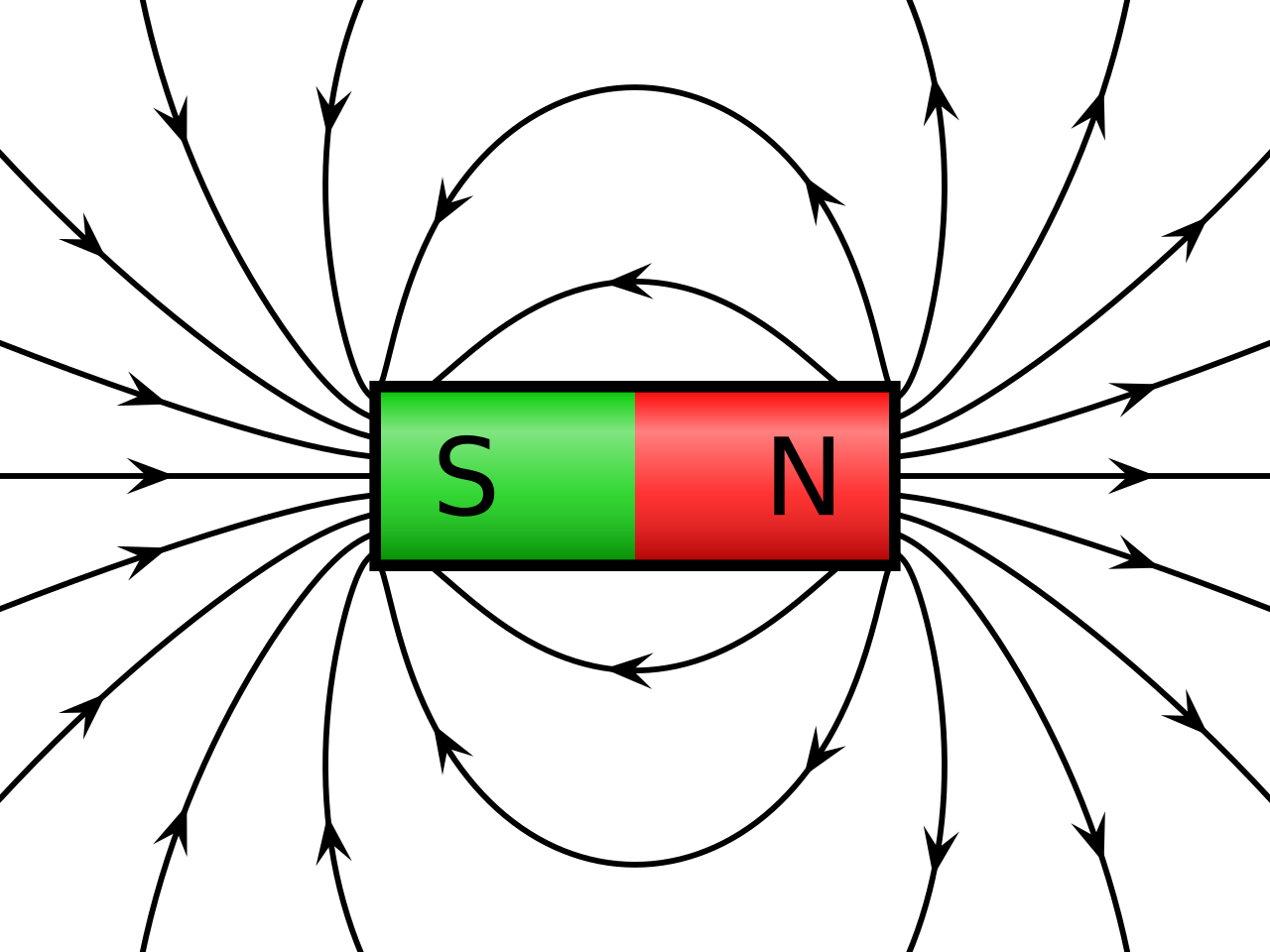
Magnetic field of a bar magnet: field lines emerge from the north pole and re-enter at the south pole outside the magnet, forming continuous closed loops. Image: Geek3, CC BY-SA 3.0, via Wikimedia Commons.
Concept context
Bar magnets, Earth's magnetism, and how different materials respond to an external magnetic field - diamagnetic, paramagnetic, and ferromagnetic behaviour.