🎯 Key Points
- A bar magnet behaves like a magnetic dipole; field lines emerge from the N pole and curve around outside to enter the S pole, continuing inside the magnet from S to N - closed loops with no start or end
- Magnetic monopoles do not exist - every magnet has both a N and S pole; cutting a bar magnet in half produces two smaller complete magnets, each with its own N and S pole
- Earth behaves like a giant magnetic dipole; its magnetic south pole lies near the geographic north, which is why a compass needle's N pole points toward geographic north (unlike poles attract)
- Materials respond to an external field as: diamagnetic (weakly repelled, e.g. bismuth, water), paramagnetic (weakly attracted, e.g. aluminium, sodium), ferromagnetic (strongly attracted, retains magnetism, e.g. iron, cobalt, nickel)
- Above the Curie temperature, a ferromagnetic material loses its ferromagnetic ordering and becomes simply paramagnetic, as thermal agitation disrupts the alignment of magnetic domains
The Bar Magnet as a Magnetic Dipole
- A bar magnet's magnetic moment m points from the S pole to the N pole inside the magnet; it can be modeled as an equivalent current-carrying solenoid with magnetic moment m = NIA
- Magnetic field lines form continuous closed loops: outside the magnet they run from N to S; inside the magnet they continue from S to N - the lines never start or end anywhere
- A bar magnet placed in a uniform external field B experiences torque τ = m × B, tending to align it with the field, and has potential energy U = −m·B, which is minimum (most stable) when the magnet is aligned with the field
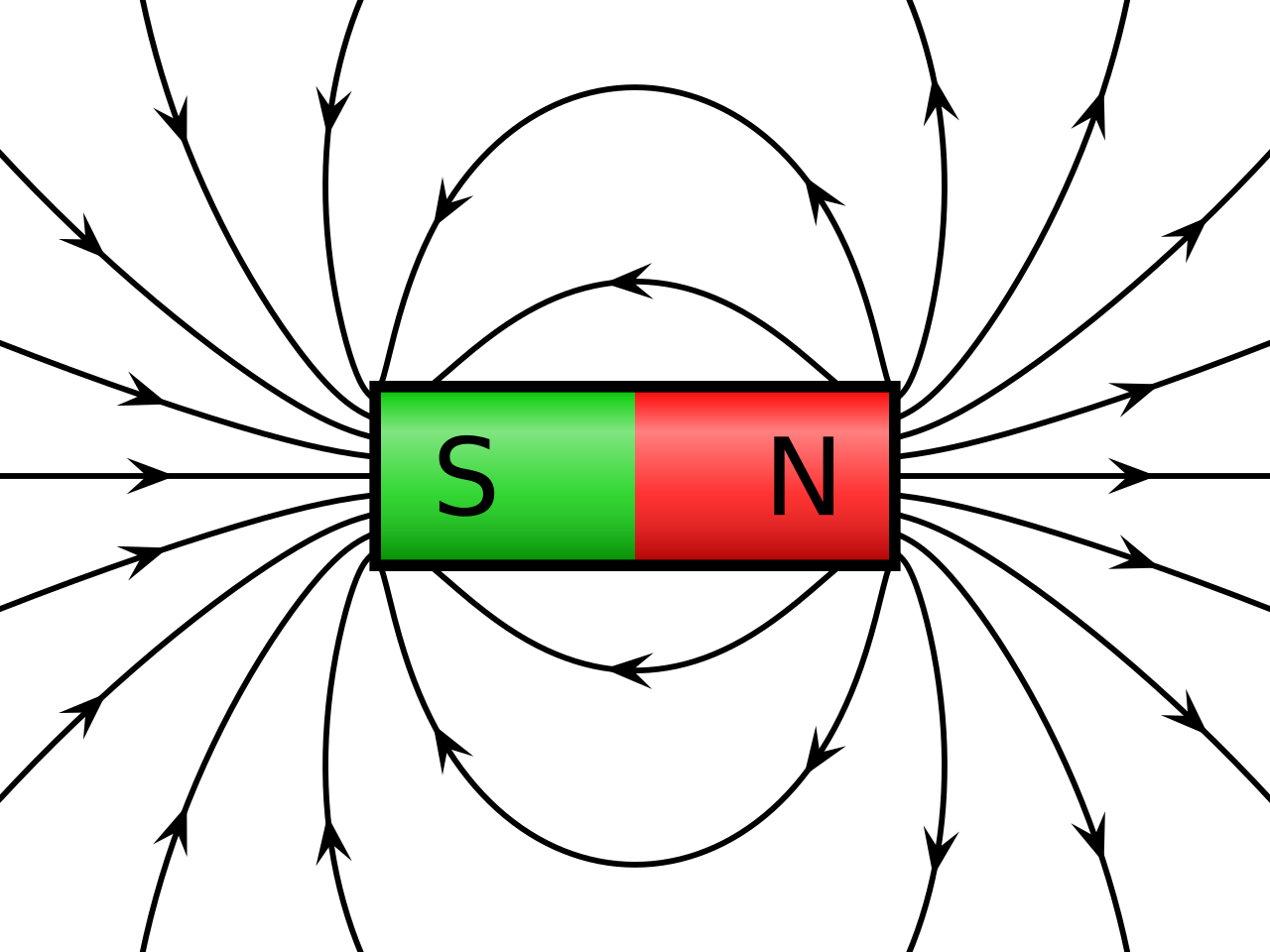
Magnetic field of a bar magnet: field lines emerge from the north pole and re-enter at the south pole outside the magnet, forming continuous closed loops. Image: Geek3, CC BY-SA 3.0, via Wikimedia Commons.
Earth's Magnetism
- The Earth behaves approximately like a giant bar magnet tilted about 11° from its rotation axis, with the field originating from convective currents in its molten iron-nickel outer core
- Magnetic declination: the angle between geographic north and magnetic north at a given location
- Magnetic inclination (dip): the angle the Earth's field makes with the horizontal - 0° at the magnetic equator and 90° at the magnetic poles
- Confusingly, the region near Earth's geographic North Pole is actually a magnetic SOUTH pole, since it attracts the N pole of a compass needle, and unlike poles attract
Classification of Magnetic Materials
- Diamagnetic: weakly repelled by an external field; magnetic susceptibility is small and negative; field lines are pushed out of the material; examples: bismuth, copper, water, and (notably) superconductors, which behave as perfect diamagnets
- Paramagnetic: weakly attracted by an external field; susceptibility is small and positive; magnetism disappears as soon as the external field is removed; examples: aluminium, sodium, platinum, oxygen
- Ferromagnetic: strongly attracted, with large positive susceptibility; retains magnetisation even after the external field is removed (called hysteresis); examples: iron, cobalt, nickel
- Ferromagnetism arises from the alignment of microscopic regions called domains, each acting like a tiny magnet; in an unmagnetised sample these domains point in random directions and cancel out, but an external field aligns them
Curie Temperature and Hysteresis
- The Curie temperature is the temperature above which a ferromagnetic material loses its ferromagnetic ordering and becomes simply paramagnetic, as thermal vibrations overcome the forces aligning the domains
- A hysteresis loop (B vs H) shows that magnetisation lags behind the applied field - the area enclosed by the loop represents energy lost as heat per cycle of magnetisation and demagnetisation
- Permanent magnets (e.g. steel, alnico) need a WIDE hysteresis loop (high retentivity); transformer cores (e.g. soft iron) need a NARROW loop to minimise hysteresis energy loss during repeated AC cycling
Magnetic Dipole Moment of a Current Loop and Torque on a Dipole
- A planar current loop of N turns, each carrying current I and enclosing area A, acts as a magnetic dipole with moment m = NIA, directed perpendicular to the loop's plane by the right-hand rule (unit: ampere-metre²)
- Placed in a uniform field B, the dipole feels a torque τ = m × B, of magnitude τ = mB sinθ - maximum when m is perpendicular to B and zero when m is aligned with B
- Its orientation potential energy is U = −m·B = −mB cosθ, minimum (stable) when m is parallel to B and maximum (unstable) when antiparallel
- On the axis of a short magnetic dipole the field is B = (μ₀/4π)(2m/r³); on its equatorial line it is B = (μ₀/4π)(m/r³) - half as large and oppositely directed - exactly mirroring the electric-dipole results
Gauss's Law for Magnetism
- The net magnetic flux through any closed surface is always zero: ∮B·dA = 0, because magnetic field lines are continuous closed loops with no beginning or end
- This is a direct statement that isolated magnetic monopoles do not exist - every field line that enters a closed surface must also leave it, so incoming and outgoing flux cancel exactly
- Contrast with Gauss's law for electricity, where the flux equals (enclosed charge)/ε₀ and is nonzero because isolated electric charges do exist
Magnetising Field H, Magnetisation M, and Permeability
- Magnetisation M: the net magnetic dipole moment per unit volume of a material, produced by the alignment of its atomic dipoles (unit: ampere/metre)
- Magnetising field (magnetic intensity) H: the part of the field due to free/external currents; inside a material the total field is B = μ₀(H + M)
- Magnetic susceptibility χ = M/H measures how readily a material magnetises - small and negative for diamagnetics, small and positive for paramagnetics, large and positive for ferromagnetics
- Relative permeability μ_r = 1 + χ, and permeability μ = μ₀μ_r; so B = μH inside a linear material
Curie's Law for Paramagnetism
- For a paramagnetic material the magnetisation is proportional to the applied field and inversely proportional to absolute temperature: M = C(B/T), where C is the Curie constant
- Equivalently the susceptibility follows χ = C/T - it falls as temperature rises, because thermal agitation increasingly disrupts dipole alignment
- For a ferromagnet above its Curie temperature Tc the Curie-Weiss law χ = C/(T − Tc) describes its now-paramagnetic behaviour
🚀 JEE Advanced Edge
Comparing the three material classes: Diamagnetic susceptibility is small, negative, and essentially independent of temperature. Paramagnetic susceptibility is small, positive, and DECREASES as temperature increases (thermal agitation disrupts alignment) - this temperature dependence is the key distinguishing test JEE uses between para- and dia-magnetism. Ferromagnetic susceptibility is large and positive, collapsing abruptly to ordinary paramagnetic behaviour above the Curie point.
Superconductors are perfect diamagnets, not just "very diamagnetic": Ordinary diamagnetism is extremely weak (χ ≈ −10⁻⁵), but a superconductor expels magnetic field lines entirely (the Meissner effect), with χ = −1 exactly. This qualitative jump - not just a stronger version of the same effect - is a favourite distinguishing fact in JEE conceptual questions.
Worked reasoning: Why does a paramagnetic substance lose its magnetisation the instant the external field is removed, while a ferromagnetic substance does not? In a paramagnetic material, each atomic dipole aligns only weakly and independently with the external field, so thermal motion randomises them again as soon as the field disappears. In a ferromagnetic material, neighbouring atomic moments within a domain are locked together by a strong internal "exchange interaction," so the domain's alignment persists even with no external field - this internal coupling, not the external field, is what produces retained magnetisation (retentivity).
Magnetic Field Lines and Their Properties
- Magnetic field lines are continuous closed loops, running from north to south outside the magnet and from south to north inside it.
- The tangent to a field line at any point gives the direction of the net magnetic field there.
- The number of lines per unit area (line density) is proportional to the magnitude of B; crowded lines mean a stronger field.
- Field lines never intersect, because the field can have only one direction at a point.
- Unlike electric field lines, magnetic field lines do not start or end on any point, reflecting the absence of isolated magnetic poles (monopoles).
The Bar Magnet and the Solenoid Analogy
- A current-carrying solenoid produces a field pattern identical to that of a bar magnet, with distinct north and south ends.
- The magnetic moment of a solenoid is m = N I A, where N is the number of turns, I the current, and A the cross-sectional area.
- The axial (far) field of a bar magnet is B = (mu naught divided by 4 pi) times (2m) divided by d cubed, matching that of a dipole.
- The equatorial field is B = (mu naught divided by 4 pi) times m divided by d cubed, and points opposite to the dipole moment.
- This analogy supports the view that magnetism arises from circulating currents (moving charges) at the atomic level.
Oscillating Bar Magnet in a Uniform Field
- A bar magnet free to rotate in a uniform field B experiences a restoring torque tau = minus m B sin theta, which for small angles gives simple harmonic motion.
- The time period of oscillation is T = 2 pi times square root of (I divided by (m B)), where I is the moment of inertia and m the magnetic moment.
- By measuring T, the value of the horizontal component of Earth's field or the magnet's magnetic moment can be determined.
- The potential energy of the dipole is U = minus m B cos theta, minimum when the moment aligns with the field (theta = 0, stable equilibrium).
- At theta = 180 degrees the energy is maximum, an unstable equilibrium.
Permanent Magnets and Electromagnets
- Permanent magnets retain magnetism; they are made from materials with high retentivity and high coercivity, such as steel and alnico.
- An ideal permanent-magnet material has a wide hysteresis loop, so it resists demagnetisation.
- Electromagnets use a soft iron core inside a current-carrying coil; they are magnetic only while current flows.
- Soft iron has high permeability, low retentivity, and low coercivity, so it magnetises and demagnetises easily (a narrow, tall hysteresis loop).
- Electromagnets are used in electric bells, cranes, loudspeakers, and telephone diaphragms; permanent magnets are used in compass needles and moving-coil meters.