🎯 Key Points
- YDSE fringe width β=λD/d; n-th bright fringe at y=nλD/d, n-th dark fringe at y=(2n−1)λD/2d
- Single slit diffraction: first minimum at sinθ=λ/a; central maximum is TWICE as wide as secondary maxima (unlike YDSE's equal-width fringes)
- Malus's Law: I=I₀cos²θ for light through a polariser/analyser pair
- Brewster's angle: tanθ_B=n - at this angle, reflected light is fully polarised and reflected+refracted rays are perpendicular
- Coherent sources need constant phase difference + same frequency; two independent bulbs are always incoherent
Two coherent slits S₁ and S₂ act as secondary sources; at each point on the screen, the path difference between light from S₁ and S₂ determines whether the waves arrive in phase (bright fringe) or out of phase (dark fringe), producing the characteristic alternating fringe pattern.
Huygens Principle
- Every point on a wavefront acts as a source of secondary wavelets
- New wavefront is the envelope of all secondary wavelets
- Explains reflection, refraction, and diffraction
Interference of Light
- Condition: coherent sources (same frequency and constant phase difference)
- Constructive: path difference = nλ (bright fringe)
- Destructive: path difference = (2n-1)λ/2 (dark fringe)
Young's Double Slit Experiment (YDSE)
- Fringe width: β = λD/d (D = screen distance, d = slit separation)
- Path difference for P at distance y from centre: Δ = yd/D
- Position of n-th bright fringe: yn = nλD/d
- Position of n-th dark fringe: yn = (2n-1)λD/2d
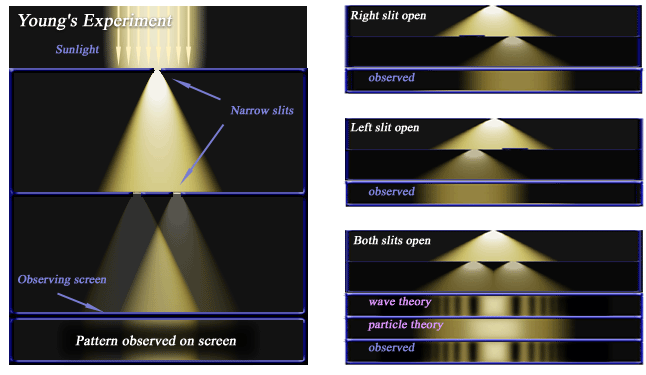
Young’s double slit: with both slits open the screen shows fringes, matching wave theory and not particle theory. Fringe width β = λD/d. Image: Inductiveload, CC BY-SA 3.0, via Wikimedia Commons.
Diffraction
- Single slit: first minimum at sinθ = λ/a (a = slit width)
- Central maximum width = 2λD/a
- Diffraction grating: d·sinθ = nλ (d = grating spacing)
- Resolving power of telescope: θ_min = 1.22λ/D
Polarization
- Transverse waves can be polarized; longitudinal (sound) cannot
- Malus Law: I = I₀·cos²(θ) (transmitted intensity through analyser)
- Brewster angle: tan(θ_B) = n₂/n₁ (reflected light is completely polarized)
- Polaroids used in sunglasses, LCD screens, 3D movies
Coherent and Incoherent Sources
- Coherent sources maintain a constant phase difference and emit the same frequency, essential for sustained, observable interference
- Two independent sources (like two separate bulbs) are incoherent because their phase relationship changes randomly; in YDSE, both slits are illuminated by the same source to ensure coherence
Intensity Distribution in Interference
- Resultant intensity: I = I₁ + I₂ + 2√(I₁I₂)·cos(δ), where δ is the phase difference
- If I₁ = I₂ = I₀: Imax = 4I₀ (constructive), Imin = 0 (destructive)
- Ratio of maximum to minimum intensity: Imax/Imin = (√I₁ + √I₂)² / (√I₁ - √I₂)²
Diffraction vs Interference
- Interference occurs between waves from two (or more) distinct coherent sources; diffraction occurs due to superposition of secondary wavelets from different parts of the same wavefront
- In single-slit diffraction, the central maximum is twice as wide as secondary maxima and is much brighter than the fringes seen in YDSE
Polarization by Scattering and Reflection
- Scattered light from the sky is partially polarized due to scattering by atmospheric molecules (basis of polarized sunglasses reducing glare)
- At Brewster's angle, reflected ray is completely polarized and the reflected and refracted rays are perpendicular to each other
Wavefront and its Types
- Wavefront: the locus of all points of a wave that are in the same phase; the direction of propagation is always perpendicular to the wavefront (along the rays)
- Spherical wavefront: produced by a point source (nearby)
- Cylindrical wavefront: produced by a linear (slit) source
- Plane wavefront: a spherical wavefront at very large distance from the source appears plane (e.g. light from the Sun or a distant star)
Reflection and Refraction using Huygens Principle
- Treating each point of a wavefront as a source of secondary wavelets and drawing the new envelope reproduces the laws of reflection and refraction
- Reflection: the geometry gives angle of incidence = angle of reflection, and the incident ray, reflected ray, and normal lie in one plane
- Refraction: because wave speed changes across the boundary, the wavefront bends, giving Snell's law n₁sinθ₁ = n₂sinθ₂ with n = c/v
- Frequency stays the same on refraction; wavelength changes as λ_medium = λ_vacuum/n, since v = fλ and speed changes
Fresnel Distance and Validity of Ray Optics
- A beam of width a travelling a distance z spreads by diffraction through an angle ≈ λ/a
- Fresnel distance zF = a²/λ is the distance over which the diffraction spread becomes comparable to the beam width itself
- For distances much smaller than zF, spreading is negligible and light effectively travels in straight lines - this is why ray (geometrical) optics is a valid approximation
- Beyond zF, diffraction dominates and the beam can no longer be treated as a ray
Resolving Power and Doppler Effect in Light
- Limit of resolution: two close objects are just resolved when the central maximum of one diffraction pattern falls on the first minimum of the other (Rayleigh criterion)
- Telescope: smallest resolvable angle θ_min = 1.22λ/D; a larger objective aperture D gives higher resolving power
- Microscope: smallest resolvable distance dmin = 1.22λ/(2n·sinβ); the term n·sinβ is the numerical aperture, increased using immersion oil
- Doppler effect in light: relative motion shifts the observed frequency; source receding gives a redshift (Δλ/λ = v/c for v ≪ c), source approaching gives a blueshift - used to measure the speeds of stars and galaxies
🚀 JEE Advanced Edge
YDSE with a thin film/glass slab inserted: Inserting a thin transparent sheet of thickness t and refractive index n in front of one slit introduces an extra path difference (n−1)t, shifting the entire fringe pattern by (n−1)tD/d - without changing the fringe width itself.
YDSE in a different medium: If the whole apparatus is immersed in a medium of refractive index n (instead of air), the wavelength inside that medium becomes λ/n, so fringe width becomes β'=β/n - fringes get closer together.
Worked problem: In a YDSE setup with d=1mm, D=1m, and λ=500nm, find the fringe width, then find the new fringe width if the apparatus is immersed in water (n=4/3). Approach: β=λD/d=(500×10⁻⁹×1)/10⁻³=0.5mm. In water: β'=β/n=0.5/(4/3)=0.375mm.
Superposition Principle and Path Difference
- The principle of superposition states that the resultant displacement at a point is the algebraic sum of the displacements due to individual waves.
- Constructive interference occurs when the path difference is an integral multiple of the wavelength: path difference = n(lambda).
- Destructive interference occurs when the path difference equals an odd multiple of half the wavelength: (n + 1/2)(lambda).
- Phase difference and path difference are related by phase difference = (2 pi / lambda) x path difference.
- The resultant intensity depends on the phase difference and can range between (a1 + a2) squared and (a1 - a2) squared for amplitudes a1 and a2.
Conditions for Sustained Interference
- The two sources must be coherent, that is, they must maintain a constant phase difference over time.
- The sources should emit light of the same frequency (and ideally the same wavelength).
- The amplitudes should be nearly equal so that dark fringes are truly dark and contrast is maximum.
- The sources must be narrow and close together to produce observable fringe widths.
- Two independent light sources cannot produce sustained interference because their phase difference fluctuates randomly and rapidly.
- In Young's experiment a single source split into two ensures coherence.
Malus' Law and Plane Polarised Light
- An unpolarised beam has vibrations in all directions perpendicular to propagation; a polaroid transmits vibrations along one axis only.
- Malus' law: when plane polarised light of intensity I0 passes through an analyser, the transmitted intensity is I = I0 cos squared (theta), where theta is the angle between the polarisation and analyser axis.
- When unpolarised light passes through a polaroid, the intensity is reduced to half (I0/2), independent of orientation.
- If the analyser axis is perpendicular to the polariser (theta = 90 degrees), no light is transmitted (crossed polaroids).
- Polarisation confirms that light is a transverse wave.
Brewster's Law and Polarising Angle
- When unpolarised light strikes a transparent surface at the polarising angle, the reflected light is completely plane polarised.
- Brewster's law: n = tan(ip), where ip is the polarising angle and n is the refractive index of the medium.
- At the polarising angle the reflected and refracted rays are mutually perpendicular.
- The reflected ray is polarised with vibrations perpendicular to the plane of incidence.
- Since n depends on wavelength, the polarising angle differs slightly for different colours.