🎯 Key Points
- P = (1/3)ρvrms²; average KE per molecule = (3/2)kBT - temperature IS a direct measure of average translational KE
- Degrees of freedom: monoatomic f=3, diatomic f=5 (moderate T), polyatomic f=6 (+2 per vibration mode)
- Equipartition: each degree of freedom contributes ½kBT; total energy/molecule = (f/2)kBT
- Cv=(f/2)R, Cp=Cv+R, γ=Cp/Cv - γ DECREASES as atomicity/degrees of freedom increases (monoatomic γ=5/3 highest)
- Speed order: vp < vavg < vrms (most probable < average < root-mean-square), all ∝ √(T/M)
- Mean free path λ ∝ 1/(n·d²) - increases as pressure/density drops, decreases as molecular size increases
Not all gas molecules move at the same speed - the Maxwell-Boltzmann distribution shows the spread, with the most probable speed vp slightly less than the average vavg, which is slightly less than the root-mean-square speed vrms used in the pressure formula.
Postulates of Kinetic Theory of Gases
- A gas consists of a very large number of identical molecules in random motion, separated by distances much larger than their own size
- Molecules exert negligible force on each other except during collisions (ideal gas assumption)
- Collisions between molecules, and with the walls of the container, are perfectly elastic, and of negligible duration
- Between collisions, molecules move in straight lines with constant velocity (Newtons laws apply)
- The molecules obey Maxwell-Boltzmann distribution of speeds; the density and distribution of molecules is assumed uniform
Pressure of an Ideal Gas from Kinetic Theory
- Kinetic theory derivation gives: P = (1/3)·ρ·vrms², where ρ is density of gas and vrms is the root mean square speed
- Equivalently: PV = (1/3)Nm·vrms², where N is number of molecules and m is mass of each molecule
- This can be written as PV = (2/3)E, where E is the total translational kinetic energy of all the gas molecules
- This kinetic theory result combined with the ideal gas equation PV = nRT leads directly to the interpretation of temperature
Kinetic Interpretation of Temperature
- Average kinetic energy per molecule = (3/2)kB·T, where kB is the Boltzmann constant (kB = 1.38 × 10⁻²³ J/K)
- This shows absolute temperature is a direct measure of the average translational kinetic energy of the molecules of a gas
- At absolute zero (T = 0 K), translational kinetic energy of molecules becomes zero (classically), which is why 0 K is the lowest possible temperature
- RMS speed: vrms = √(3kBT/m) = √(3RT/M), where M is the molar mass
Degrees of Freedom
- Degrees of freedom = number of independent ways a molecule can possess energy (independent coordinates needed to specify its position/configuration)
- Monatomic gas (e.g. He, Ar): 3 translational degrees of freedom only, f = 3
- Diatomic gas (e.g. O2, N2) at moderate temperature: 3 translational + 2 rotational, f = 5 (vibrational modes ignored at moderate T)
- Polyatomic (nonlinear) gas: 3 translational + 3 rotational + vibrational modes, f = 6 plus 2 per vibrational mode
Law of Equipartition of Energy
- In thermal equilibrium, energy is distributed equally among all the degrees of freedom, and each quadratic degree of freedom contributes (1/2)kBT of average energy per molecule
- Total average energy per molecule = (f/2)kBT, where f is the total number of degrees of freedom
- This is the basis used to compute the molar specific heats of gases from their molecular structure
Specific Heat Capacities of Gases
- Monatomic gas (f=3): Cv = (3/2)R, Cp = (5/2)R, so γ = Cp/Cv = 5/3 ≈ 1.67
- Diatomic gas (f=5, no vibration): Cv = (5/2)R, Cp = (7/2)R, so γ = 7/5 = 1.4
- Diatomic gas with vibration (f=7): Cv = (7/2)R, Cp = (9/2)R, γ = 9/7 ≈ 1.29
- Triatomic nonlinear/polyatomic gas (f=6, no vibration): Cv = 3R, Cp = 4R, γ = 4/3 ≈ 1.33
- γ decreases as the number of degrees of freedom (atomicity) increases
Mean Free Path
- Mean free path (λ) is the average distance a molecule travels between two successive collisions
- λ = 1/(√2·n·π·d²), where n is number density of molecules and d is molecular diameter
- Mean free path increases if density decreases (lower pressure) and decreases as molecular size/density increases
- This concept explains the basis of diffusion, viscosity, and thermal conductivity of gases
Maxwell Speed Distribution
- Molecules in a gas do not all move at the same speed, the Maxwell-Boltzmann distribution gives the fraction of molecules with speeds in a given range
- Root mean square speed: vrms = √(3RT/M) (largest of the three characteristic speeds)
- Average speed: vavg = √(8RT/πM) (mean of the speed distribution)
- Most probable speed: vp = √(2RT/M) (speed at the peak of the distribution curve)
- Relation: vp< vavg< vrms, in the approximate ratio √2 : √(8/π) : √3
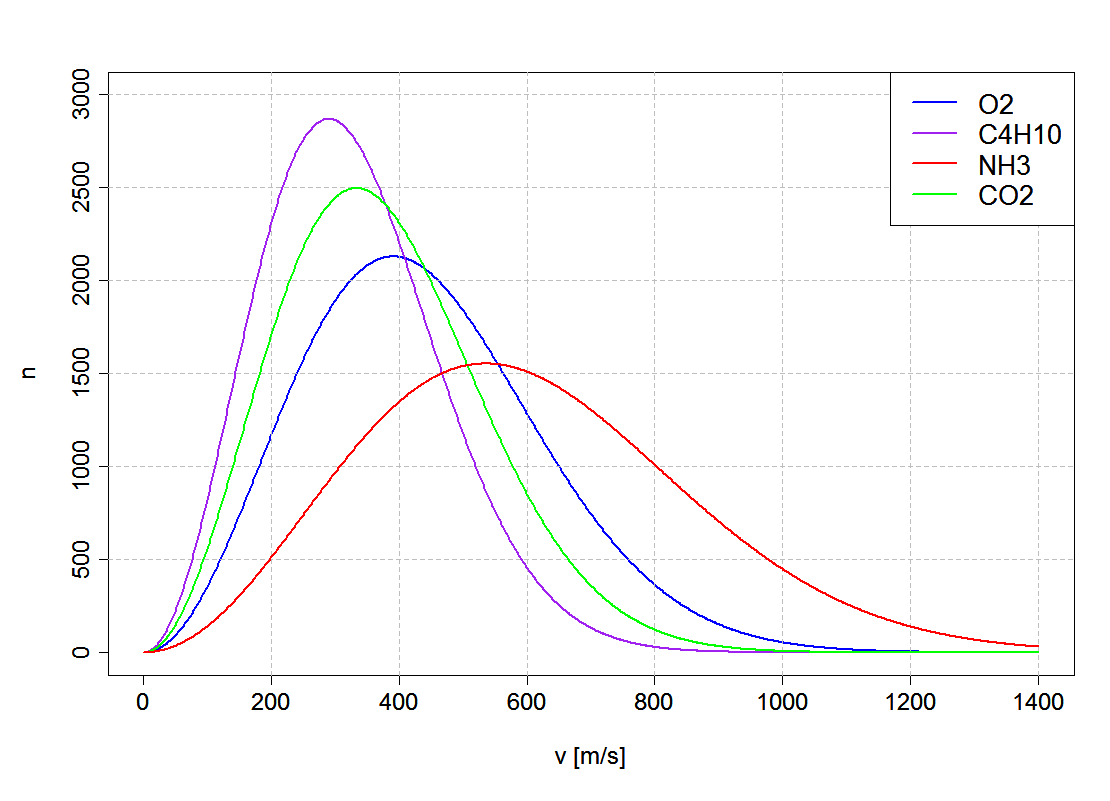
Maxwell−Boltzmann speed distribution: at a given temperature, lighter molecules have a broader distribution and a higher most-probable speed than heavier ones. Image: Kadykianus, CC BY-SA 4.0, via Wikimedia Commons.
Molecular Nature of Matter
- Matter is made of atoms and molecules; the atomic hypothesis (Dalton) explains the laws of chemical combination and the macroscopic behaviour of gases
- Gay-Lussac's law of combining volumes together with Avogadro's hypothesis (equal volumes of all gases at the same temperature and pressure contain equal numbers of molecules) established the molecular picture
- Intermolecular forces are weakly attractive at large separations and strongly repulsive at short range; the equilibrium separation gives matter its stability and its resistance to compression
- Molecules are tightly bound in solids (fixed positions), loosely bound and mobile in liquids, and nearly free in gases - kinetic theory applies most cleanly to gases where interactions are negligible except during collisions
Behaviour of Gases: Gas Laws and the Ideal Gas Equation
- Boyle's law: at constant temperature, PV = constant, so P ∝ 1/V
- Charles's law: at constant pressure, V/T = constant, so V ∝ T (T in kelvin)
- Gay-Lussac's (pressure) law: at constant volume, P/T = constant
- Avogadro's law: at the same P and T, equal volumes of all gases contain equal numbers of molecules
- Combining these gives the ideal gas equation: PV = nRT = Nk_BT, where n is the number of moles, N the number of molecules, R = 8.314 J/(mol·K) the universal gas constant, and kB = R/NA the Boltzmann constant
- A real gas behaves like an ideal gas at low pressure and high temperature, where molecular separations are large and intermolecular forces negligible
Avogadro's Number and the Mole
- One mole of any substance contains Avogadro's number NA = 6.022 × 10²³ particles
- One mole of any ideal gas occupies 22.4 litres at STP (0°C and 1 atm)
- The Boltzmann constant kB = R/NA = 1.38 × 10⁻²³ J/K links per-mole quantities to per-molecule quantities
- In terms of number density n = N/V, the ideal gas law per molecule reads P = n·kB·T
Specific Heat Capacity of Solids and Water
- In a solid each atom has 3 vibrational modes, each carrying both kinetic and potential energy, giving 6 quadratic degrees of freedom; equipartition then gives internal energy U = 3RT per mole and molar specific heat C = 3R ≈ 25 J/(mol·K)
- This is the Dulong-Petit law, obeyed well by most solids at ordinary temperatures (it fails at low temperature, where quantum effects reduce C below 3R)
- For water, treating each of its 3 atoms as contributing 3R gives molar specific heat ≈ 9R ≈ 75 J/(mol·K), in good agreement with experiment
- These predictions from the law of equipartition of energy are strong evidence for the kinetic-molecular model of matter
🚀 JEE Advanced Edge
Mixture of gases - effective γ and molar mass: For a mixture of n₁ moles of gas 1 and n₂ moles of gas 2, the effective Cv is the mole-weighted average: Cv(mix) = (n₁Cv₁+n₂Cv₂)/(n₁+n₂), and similarly for Cp - letting you find the mixture's effective γ even when the two gases have different atomicities (e.g., a He + O₂ mixture).
Vibrational degrees of freedom at high temperature: At very high temperatures, diatomic molecules gain 2 additional vibrational degrees of freedom (f=7 instead of 5), lowering γ from 7/5 toward 9/7 - a subtle point examiners use to test whether students just memorise f=5 for ALL diatomic gases regardless of temperature.
Worked problem: Find the ratio of RMS speeds of hydrogen (M=2) and oxygen (M=32) molecules at the same temperature. Approach: vrms ∝ 1/√M (same T, R cancel), so vrms(H₂)/vrms(O₂) = √(MO₂/MH₂) = √(32/2) = √16 = 4 - hydrogen molecules move 4× faster on average at the same temperature.
Ideal Gas Assumptions and Real Gas Deviations
- An ideal gas obeys PV = nRT exactly at all pressures and temperatures.
- Real gases obey it closely only at low pressure and high temperature, when molecules are far apart.
- Deviations arise because real molecules have finite size and exert intermolecular attractive forces.
- At high pressure the finite molecular volume matters; near condensation the attractions matter.
- The van der Waals equation corrects the ideal gas law for these two effects.
Types of Molecular Speeds
- The rms speed is vrms = square root of (3RT/M), the square root of the mean of the squared speeds.
- The average (mean) speed is vavg = square root of (8RT/(pi M)).
- The most probable speed is vmp = square root of (2RT/M), the peak of the Maxwell distribution.
- Their ratio is vmp : vavg : vrms = 1 : 1.13 : 1.22, so vrms is greater than vavg is greater than vmp.
- All three speeds are proportional to the square root of temperature and inversely to the square root of molar mass.
Dalton's Law of Partial Pressures
- In a mixture of non-reacting ideal gases, each gas exerts the pressure it would if it alone occupied the container.
- The total pressure equals the sum of the partial pressures: P = P1 plus P2 plus P3 and so on.
- This follows from kinetic theory because molecules of different gases contribute independently to the wall pressure.
- For a mixture, P = (n1 plus n2 plus ...) R T / V, treating all molecules together.
- The partial pressure of a component is proportional to its mole fraction in the mixture.
Brownian Motion and Diffusion
- Brownian motion is the ceaseless random zig-zag motion of tiny particles suspended in a fluid.
- It is caused by unbalanced collisions of fast-moving fluid molecules with the suspended particle.
- The motion is more vigorous for smaller particles, lower fluid viscosity and higher temperature.
- It gives direct visual evidence for the molecular nature of matter and molecular motion.
- Diffusion, the gradual mixing of gases, is likewise explained by molecular motion and is slowed by a short mean free path.