🎯 Key Points
- F=−kx → a=−ω²x is the defining condition of SHM; x=A sin(ωt+φ)
- Max velocity = Aω (at equilibrium, x=0); Max acceleration = Aω² (at extremes, x=±A)
- Total energy = ½mω²A² = constant; KE=½mω²(A²−x²), PE=½mω²x² - they continuously trade off
- Spring-mass: T=2π√(m/k); Simple pendulum: T=2π√(L/g) (independent of mass and amplitude, for small angles)
- Springs in series: 1/keq=1/k₁+1/k₂ (softer); in parallel: keq=k₁+k₂ (stiffer)
- Resonance: amplitude is maximum when driving frequency = natural frequency
In SHM, displacement and velocity are 90° out of phase (v is maximum when x=0, and zero when x is extreme), while acceleration is always exactly opposite in sign to displacement, consistent with a = −ω²x.
Conditions for SHM
- Restoring force proportional to displacement: F = -kx
- This gives: a = -ω²x (defining equation of SHM)
Displacement, Velocity, Acceleration
- x = A·sin(ωt + φ) (displacement)
- v = Aω·cos(ωt + φ) = ω√(A² - x²)
- a = -Aω²·sin(ωt + φ) = -ω²x
- Maximum v = Aω (at equilibrium); Maximum a = Aω² (at extreme)
Energy in SHM
- KE = ½mω²(A² - x²); PE = ½mω²x²
- Total E = ½mω²A² = constant (independent of x)
- At equilibrium: KE max, PE zero; At extremes: KE zero, PE max
Important Systems
- Spring-mass: T = 2π√(m/k); ω = √(k/m)
- Simple pendulum: T = 2π√(L/g) (valid for small angles)
- Seconds pendulum: T = 2 s, L ≈ 1 m
- Compound pendulum (physical pendulum): T = 2π√(I/mgd)
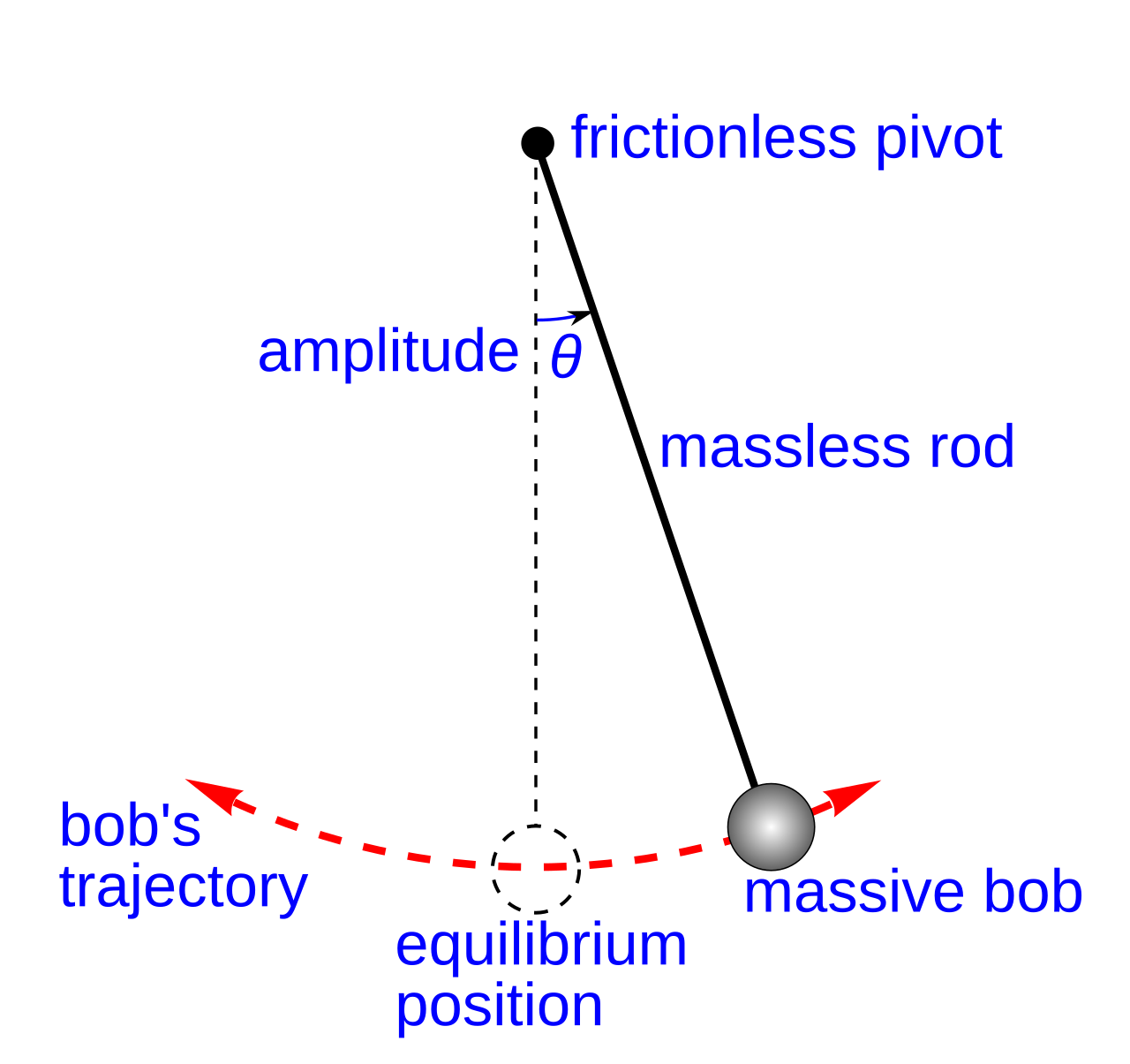
The idealised simple pendulum: for small θ the motion is SHM with T = 2π√(L/g), independent of the bob mass. Image: Chetvorno, Public Domain, via Wikimedia Commons.
Damped and Forced Oscillations
- Damped: amplitude decreases exponentially; underdamped, critically damped, overdamped
- Forced oscillations: driven by external periodic force
- Resonance: when driving frequency = natural frequency; amplitude is maximum
Phase and Reference Circle
- SHM can be visualised as the projection of uniform circular motion onto a diameter; angular velocity of the reference circle equals ω of the SHM
- Phase constant φ depends on initial position and velocity; determines starting point of motion at t = 0
- Two SHMs are in phase if their phase difference is 0 or 2nπ, and out of phase if the difference is π
Combining Springs
- Springs in series: 1/keq = 1/k₁ + 1/k₂ (effective spring constant decreases)
- Springs in parallel: keq = k₁ + k₂ (effective spring constant increases)
- Time period changes accordingly since T = 2π√(m/keq)
Angular SHM
- Torsional oscillations: restoring torque τ = -κθ, giving angular frequency ω = √(κ/I), where I is moment of inertia
- Time period of a torsional pendulum: T = 2π√(I/κ)
Periodic and Oscillatory Motion
- Periodic motion: any motion that repeats itself at regular intervals of time (planets orbiting, a rotating fan)
- Oscillatory (vibratory) motion: to-and-fro motion about a fixed mean position; every oscillation is periodic, but not every periodic motion is oscillatory
- Time period (T): time for one complete oscillation; frequency (ν) = 1/T (unit hertz, Hz)
- Angular frequency: ω = 2πν = 2π/T; it links the period to the SHM constants via ω = √(k/m)
- Any periodic function can be expressed as a combination of sine and cosine terms (basis of Fourier analysis)
Damped Oscillations: Quantitative Treatment
- With a damping force F = −bv proportional to velocity, the displacement is x = A·e−bt/2m·sin(ω't + φ)
- The amplitude decays exponentially as A·e−bt/2m; the damped angular frequency ω' = √(k/m − b²/4m²) is slightly less than the natural ω₀
- Mechanical energy also decays: E(t) = ½kA²·e−bt/m, i.e. energy falls off twice as fast as amplitude
- Underdamped: oscillates with slowly falling amplitude; critically damped: returns to rest fastest without oscillating; overdamped: returns slowly without oscillating
Other Examples of SHM
- Liquid column in a U-tube: displaced liquid of total length L oscillates with T = 2π√(L/2g)
- Ball rolling in a spherical bowl: for small displacements, T = 2π√(R/g), analogous to a simple pendulum of length R
- Vertical spring-mass with gravity: gravity only shifts the equilibrium position by mg/k; the period is still T = 2π√(m/k)
🚀 JEE Advanced Edge
Pendulum in an accelerating frame: A simple pendulum's period depends on the EFFECTIVE gravity, not just g. In a lift accelerating upward with a, T=2π√(L/(g+a)) (period decreases); accelerating downward, T=2π√(L/(g−a)) (period increases); in free fall (a=g), T→∞ (no oscillation, since there's no restoring force in free fall).
SHM of a floating/partially submerged body: A cylinder bobbing vertically in a fluid undergoes SHM with ω=√(ρ_fluid·g·A/m), where A is the cross-sectional area - derived by treating the buoyancy restoring force exactly like a spring force.
Worked problem: A particle in SHM has amplitude 5 cm and period 4 s. Find its velocity when displacement is 3 cm from the mean position. Approach: ω=2π/T=π/2 rad/s. v=ω√(A²−x²)=(π/2)√(25−9)=(π/2)(4)=2π ≈ 6.28 cm/s.
Period, Frequency and Angular Frequency
- Time period T: time for one complete oscillation, SI unit second (s)
- Frequency f: number of oscillations per second, f = 1/T, SI unit hertz (Hz)
- Angular frequency: omega = 2 pi f = 2 pi / T, unit rad/s
- For SHM omega relates to force constant and mass as omega = sqrt(k/m)
- Displacement is the distance from the mean (equilibrium) position; amplitude is its maximum value
The Simple Pendulum
- A point mass on a light inextensible string executes SHM for small angular displacements (theta less than about 10 degrees)
- Time period: T = 2 pi sqrt(l/g), where l is length and g is acceleration due to gravity
- Period is independent of mass and of amplitude (for small angles)
- Restoring torque arises from the component of gravity, giving effective restoring force mg sin(theta) approximately equal to mg theta
- Seconds pendulum has T = 2 s, so its length is nearly 1 m at the Earth's surface
- A longer pendulum or lower g gives a larger time period
Oscillations of a Spring and Force Constant
- A mass m attached to a spring of force constant k oscillates with T = 2 pi sqrt(m/k)
- Force constant k (spring constant) is the restoring force per unit extension, unit N/m; a stiffer spring has larger k
- Restoring force follows Hooke's law: F = -kx, directed toward the mean position
- Period is independent of gravity for a horizontal spring; for a vertical spring the equilibrium shifts but the period is unchanged
- Angular frequency omega = sqrt(k/m); larger mass lowers the frequency
Resonance
- Resonance occurs when the driving frequency equals the natural frequency of the oscillator
- At resonance the amplitude of a forced oscillation becomes maximum
- Damping limits the peak amplitude at resonance; smaller damping gives a sharper, taller resonance peak
- Examples: pushing a swing at its natural rhythm, tuning a radio circuit, Tacoma Narrows bridge oscillations
- Marching soldiers break step on bridges to avoid a resonant build-up of amplitude