🎯 Key Points
- v = fλ; transverse waves (light, string) vs longitudinal waves (sound) differ in displacement direction relative to propagation
- Closed pipe: only ODD harmonics (fn=(2n−1)v/4L); Open pipe & string: ALL harmonics (fn=nv/2L)
- Beat frequency = |f₁−f₂|; constructive interference at path difference nλ, destructive at (2n−1)λ/2
- Doppler: frequency increases when source/observer approach, decreases when receding - always use the general formula f'=f(v±vo)/(v∓vs) with correct signs
- Sound intensity level (dB) = 10 log₁₀(I/I₀); intensity follows inverse square law (I∝1/r²)
A standing wave forms from two identical waves travelling in opposite directions and interfering; nodes (always zero displacement) and antinodes (maximum displacement) stay fixed in place, unlike a travelling wave where the whole pattern moves.
Wave Properties
- v = fλ (wave speed = frequency × wavelength)
- Transverse waves: displacement perpendicular to propagation (light, strings)
- Longitudinal waves: displacement parallel to propagation (sound)
- Speed of sound in air: v ≈ 331 + 0.6T m/s (T in °C); v = √(γP/ρ) = √(γRT/M)
Superposition and Interference
- Constructive: path difference = nλ (reinforcement)
- Destructive: path difference = (2n-1)λ/2 (cancellation)
- Beats: fbeat = |f₁ - f₂| (frequency of amplitude variation)
Standing Waves
- String (both ends fixed): fn = n·v/2L (harmonics)
- Open pipe (both ends open): fn = n·v/2L (all harmonics present)
- Closed pipe (one end closed): fn = (2n-1)·v/4L (odd harmonics only)
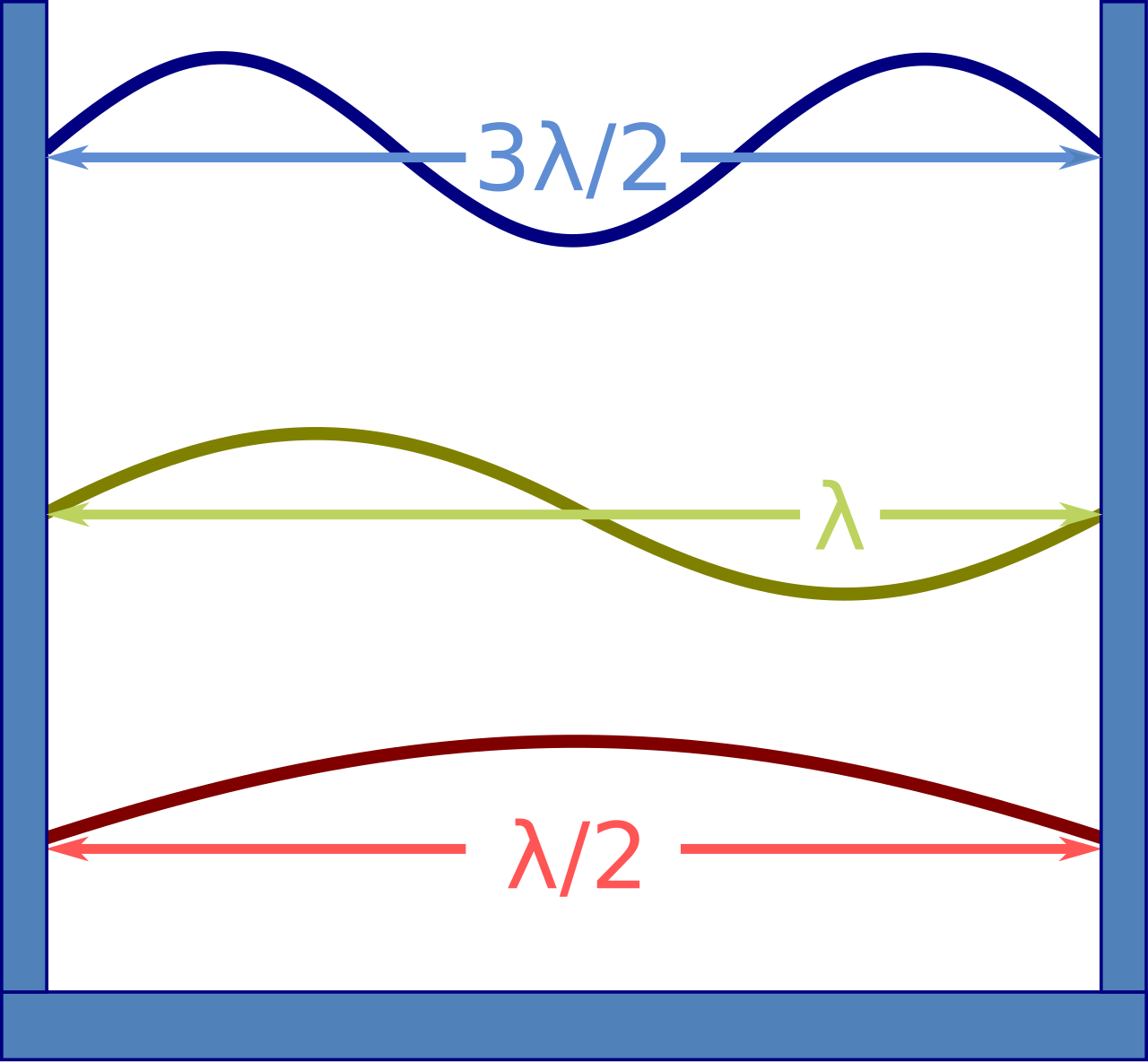
Standing waves on a string fixed at both ends: the fundamental spans λ/2, and higher harmonics (λ, 3λ/2) fit more half-wavelengths between the fixed ends (nodes). Image: Badseed, CC BY-SA 3.0, via Wikimedia Commons.
Doppler Effect
- f' = f·(v + vobserver)/(v - vsource) (observer moving toward source, source moving toward observer)
- Sign convention: + for motion toward; - for motion away
Sound Intensity
- Intensity level: L = 10·log₁₀(I/I₀) dB (I₀ = 10⁻¹² W/m²)
- Intensity ∝ 1/r² (inverse square law)
The Wave Equation
- General progressive wave: y(x,t) = A·sin(kx - ωt + φ), where k = 2π/λ is the wave number
- Wave speed: v = ω/k = fλ
- Principle of superposition: when two or more waves overlap, the resultant displacement is the vector sum of individual displacements
Doppler Effect: All Cases
- Source moving toward stationary observer: f' = f·v/(v - vs) (apparent frequency increases)
- Source moving away from stationary observer: f' = f·v/(v + vs) (apparent frequency decreases)
- Observer moving toward stationary source: f' = f·(v + vo)/v
- Observer moving away from stationary source: f' = f·(v - vo)/v
- Doppler effect in light: used in astronomy for redshift (receding sources) and blueshift (approaching sources)
Vibration of Strings: Harmonics in Detail
- Fundamental frequency of a stretched string: f₁ = (1/2L)√(T/μ), where T is tension and μ is mass per unit length
- Sonometer is used experimentally to verify the laws of vibrating strings (frequency inversely proportional to length, directly proportional to square root of tension)
- Resonance column / closed pipe method is used to measure speed of sound in air using end correction
Speed of a Wave: String and Sound
- Transverse wave on a stretched string: v = √(T/μ), where T is the tension and μ is the mass per unit length; speed depends only on the medium and tension, not on frequency
- Newton's formula for sound: assuming compressions/rarefactions are isothermal, v = √(P/ρ), which gives ≈ 280 m/s in air - about 15% too low
- Laplace correction: the compressions and rarefactions are actually adiabatic (too fast for heat exchange), so v = √(γP/ρ), giving ≈ 332 m/s, matching experiment
- Speed of sound is greatest in solids, less in liquids, and least in gases (v = √(E/ρ), where E is the relevant elastic modulus)
Reflection of Waves at Boundaries
- Rigid (fixed) boundary: the reflected wave undergoes a phase change of π (path change λ/2); a crest returns as a trough - this is why a string fixed at both ends has nodes at the ends
- Free (open) boundary: the reflected wave suffers no phase change; a crest returns as a crest - an antinode forms at an open end of a pipe
- Standing waves are produced by the superposition of the incident wave and its reflection travelling in the opposite direction
Characteristics of Musical Sound
- Pitch: the sensation determined mainly by frequency - higher frequency is perceived as higher pitch
- Loudness: depends on the intensity (and hence amplitude) of the wave, measured on the logarithmic decibel scale
- Quality (timbre): set by the number and relative strengths of overtones/harmonics present; it lets us distinguish a violin from a flute playing the same note
- Audible range for humans: about 20 Hz to 20,000 Hz; below is infrasonic, above is ultrasonic
🚀 JEE Advanced Edge
Doppler effect with wind or moving medium: When wind blows from source to observer at speed w, effective sound speed becomes (v+w) in the formula; when it blows from observer to source, use (v−w) - the wind shifts the speed of sound relative to the ground, distinct from source/observer motion.
Reflected Doppler (e.g. radar/SONAR, or sound off a moving wall): Treat the problem in two steps - first as observer-toward-moving-source for the wave hitting the wall, then as source-toward-stationary-observer for the reflected wave's return trip, multiplying the two Doppler shifts together for a wave that reflects off a moving object.
Worked problem: A train sounds a 500 Hz horn while approaching a stationary observer at 30 m/s (speed of sound = 330 m/s). Find the apparent frequency. Approach: f' = f·v/(v−vs) = 500×330/(330−30) = 500×330/300 = 550 Hz.
Transverse and Longitudinal Waves
- Transverse waves: particles vibrate perpendicular to the direction of propagation (e.g. waves on a string, light)
- Longitudinal waves: particles vibrate parallel to propagation, forming compressions and rarefactions (e.g. sound in air)
- Transverse mechanical waves need a medium with shear rigidity, so they travel through solids but not through gases or liquids in bulk
- Longitudinal waves can travel through solids, liquids and gases
- Both types transfer energy and momentum without net transport of the medium
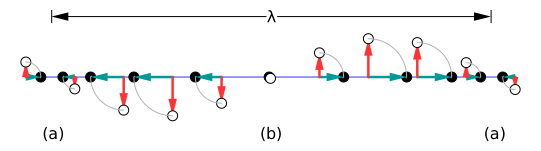
Transverse vs longitudinal waves: in a transverse wave the medium moves perpendicular to the direction of travel (crests and troughs); in a longitudinal wave it moves parallel (compressions and rarefactions). Image: MikeRun, CC BY-SA 4.0, via Wikimedia Commons.
Speed of Sound: Newton's Formula and Laplace's Correction
- Newton assumed sound propagation in air is isothermal: v = sqrt(P/rho), giving about 280 m/s, too low
- Laplace corrected this to an adiabatic process: v = sqrt(gamma P/rho), where gamma is the ratio of specific heats
- Corrected speed is about 331 m/s at 0 degrees C, matching experiment
- Speed of sound increases with temperature: v is proportional to sqrt(T) in kelvin
- Speed of sound in a gas is independent of pressure at constant temperature
Beats
- Beats arise from superposition of two sound waves of slightly different frequencies
- The listener hears a periodic rise and fall in loudness
- Beat frequency = |f1 - f2|, the difference of the two frequencies
- Beats are perceptible only when the frequency difference is small (less than about 10 Hz)
- Used to tune musical instruments and to measure an unknown frequency against a known one
Normal Modes of Air Columns (Organ Pipes)
- Closed pipe (one end closed): closed end is a displacement node, open end an antinode
- Closed pipe supports only odd harmonics; fundamental f = v/(4L), overtones in ratio 1:3:5
- Open pipe (both ends open): both ends are antinodes
- Open pipe supports all harmonics; fundamental f = v/(2L), overtones in ratio 1:2:3
- For the same length, an open pipe has twice the fundamental frequency of a closed pipe
- End correction slightly increases the effective length of the air column