83 practice questions on Ray Optics and Optical Instruments, sorted Easy → Hard. Try each one first, then open its answer page for the worked explanation. Want the full theory first? Read the Ray Optics and Optical Instruments notes.
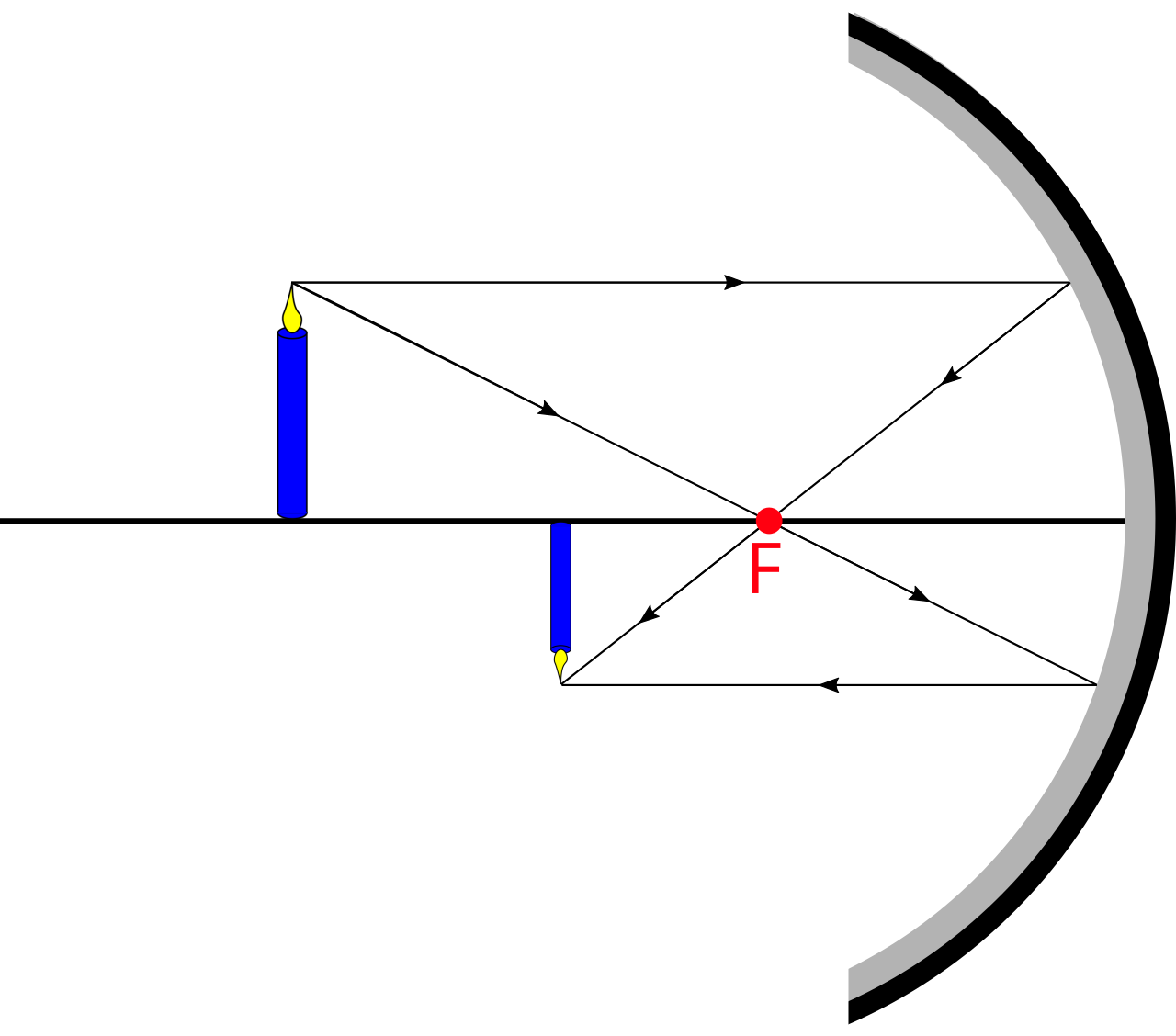
Concave mirror ray construction: a ray parallel to the axis reflects through F, and a ray through F reflects parallel, locating the inverted real image. Image: Maxmath12, CC0, via Wikimedia Commons.
Easy - 26 questions
Q1.
The refractive index of a transparent medium is 1.5. The speed of light in that medium is:
- A 3 × 10<sup>8</sup> m/s
- B 2 × 10<sup>8</sup> m/s
- C 1.5 × 10<sup>8</sup> m/s
- D 4.5 × 10<sup>8</sup> m/s
Show answer & explanation →
Q2.
The image formed by a convex mirror of an object placed in front of it is always:
- A virtual, erect and diminished
- B real, inverted and magnified
- C virtual, inverted and diminished
- D real, erect and same size
Show answer & explanation →
Q4.
When a ray of light passes from a denser medium into a rarer medium, it bends:
- A towards the normal
- B along the normal
- C away from the normal
- D perpendicular to the surface
Show answer & explanation →
Q5.
A real image differs from a virtual image in that a real image:
- A is always erect
- B is always diminished
- C cannot be photographed
- D can be formed on a screen
Show answer & explanation →
Q7.
Speed of light in vacuum is:
- A 3 x 10<sup>6</sup> m/s
- B 3 x 10<sup>8</sup> m/s
- C 3 x 10<sup>10</sup> m/s
- D 3 x 10<sup>12</sup> m/s
Show answer & explanation →
Q8.
Angle of incidence equals angle of reflection is:
- A Law of refraction
- B Law of reflection
- C Law of diffraction
- D Law of interference
Show answer & explanation →
Q9.
A concave mirror forms real images when the object is:
- A Between pole and focus
- B At focus
- C Beyond centre of curvature
- D Between focus and centre of curvature
Show answer & explanation →
Q12.
Refractive index of a medium equals:
- A Speed in vacuum / speed in medium
- B Speed in medium / speed in vacuum
- C Wavelength in vacuum / wavelength in medium
- D Both A and C
Show answer & explanation →
Q13.
Total internal reflection occurs when light travels from:
- A Denser to rarer medium beyond critical angle
- B Rarer to denser medium, at angles below the critical angle
- C Any medium to any other medium regardless of angle of incidence
- D Vacuum into any denser medium at the angle of incidence
Show answer & explanation →
Q14.
Optical fibre works on the principle of:
- A Refraction according to standard textbooks
- B Dispersion in general practice
- C Total internal reflection
- D Diffraction as frequently described
Show answer & explanation →
Q15.
A convex lens forms a virtual image when object is:
- A Beyond 2f, producing a diminished real image
- B Exactly at 2f, producing a same-size real image
- C Between f and 2f, producing a magnified real image
- D Within f (closer than focal length)
Show answer & explanation →
Q18.
The phenomenon of splitting white light into its component colors is called:
- A Reflection
- B Diffraction
- C Dispersion
- D Interference
Show answer & explanation →
Q19.
Virtual, erect, and same-sized image is formed by:
- A Concave mirror
- B Convex mirror
- C Plane mirror
- D Convex lens
Show answer & explanation →
Q21.
Which mirror is used in vehicle rear-view mirrors?
- A Plane mirror
- B Concave mirror
- C Convex mirror
- D Cylindrical mirror
Show answer & explanation →
Q22.
Snell's law states: n<sub>1</sub> sin(theta1) =
- A n<sub>2</sub> sin(theta2)
- B n<sub>2</sub> cos(theta2)
- C n<sub>1</sub> sin(theta2)
- D n<sub>2</sub> tan(theta2)
Show answer & explanation →
Q23.
Mirage (apparent water on road) is caused by:
- A Reflection of light off the hot road surface itself
- B Diffraction of light bending around dust particles in air
- C Total internal reflection in hot air near ground
- D Scattering of light by air molecules near the ground
Show answer & explanation →
Q24.
The lens formula is:
- A 1/f = 1/v - 1/u
- B 1/f = 1/v + 1/u
- C f = uv
- D 1/f = (n-1)(1/R<sub>1</sub> - 1/R<sub>2</sub>)
Show answer & explanation →
Q25.
A concave lens always forms what type of image?
- A Real, inverted, diminished
- B Virtual, erect, diminished
- C Real, erect, magnified
- D Virtual, inverted, magnified
Show answer & explanation →
Q26.
The sky appears blue because of:
- A Reflection of sunlight off the ocean surface below
- B Dispersion of sunlight through atmospheric water droplets
- C Scattering of shorter wavelength (blue) light
- D Selective absorption of red light by oxygen molecules
Show answer & explanation →
Medium - 23 questions
Q27.
A compound microscope has a total magnifying power of 200. If the objective produces a linear magnification of 25, the angular magnification of the eyepiece is:
Show answer & explanation →
Q28.
A magnifying glass (simple microscope) has focal length 5 cm. Its magnifying power when the final image is at the near point (25 cm) is:
Show answer & explanation →
Q29.
An astronomical telescope in normal adjustment has an objective of focal length 100 cm and an eyepiece of focal length 5 cm. Its magnifying power is:
Show answer & explanation →
Q30.
Object at 30 cm from concave mirror of f=10 cm. Image position:
- A At 15 cm (behind mirror)
- B At 15 cm (in front)
- C At 30 cm (in front)
- D At infinity
Show answer & explanation →
Q31.
Critical angle for glass-air interface if n<sub>glass</sub> = 1.5:
- A 30 degrees
- B 42 degrees
- C 45 degrees
- D 60 degrees
Show answer & explanation →
Q33.
A ray enters glass slab at 30 degrees to the normal. n<sub>glass</sub> = 1.5. Angle of refraction:
- A 19.5 degrees
- B 30 degrees
- C 45 degrees
- D 60 degrees
Show answer & explanation →
Q34.
Magnification of a concave mirror = +2. Image is:
- A Real, inverted, double size
- B Virtual, erect, double size
- C Real, erect, double size
- D Virtual, inverted, double size
Show answer & explanation →
Q35.
Lensmaker's equation: 1/f = (n-1)(1/R<sub>1</sub> - 1/R<sub>2</sub>). For plano-convex lens (R<sub>2</sub> = infinity), if n=1.5 and R<sub>1</sub>=20 cm, focal length:
- A 10 cm
- B 20 cm
- C 30 cm
- D 40 cm
Show answer & explanation →
Q36.
Diamond has high refractive index (n=2.4). Critical angle for diamond-air is:
- A 18.2 degrees
- B 24.6 degrees
- C 30 degrees
- D 40 degrees
Show answer & explanation →
Q37.
An object is 20 cm from a convex lens of f=15 cm. Image is:
- A Virtual, at 60 cm same side
- B Real, at 60 cm other side
- C Real, at 12 cm other side
- D Virtual, at 12 cm same side
Show answer & explanation →
Q38.
The angle of deviation at minimum deviation for a prism of apex angle A and refractive index n:
- A A(n-1), the thin-prism small-angle approximation
- B 2sin<sup>-1</sup>(n sin(A/2)) - A
- C n-1, omitting the apex angle dependence entirely
- D (n-1)/A, inverting the role of the apex angle
Show answer & explanation →
Q40.
For a converging mirror, if object moves from infinity toward focus, image moves from:
- A Focus to infinity
- B Focus to mirror
- C Infinity toward mirror (real)
- D Mirror to beyond center
Show answer & explanation →
Q41.
Resolving power of a microscope increases when:
- A Wavelength of light is increased
- B Numerical aperture decreases
- C Wavelength is decreased or NA increased
- D Magnification is reduced
Show answer & explanation →
Q42.
A convex mirror has focal length 15 cm. Object at 30 cm. Image position:
- A -10 cm (behind mirror)
- B 10 cm (behind mirror)
- C 30 cm in front
- D 60 cm behind mirror
Show answer & explanation →
Q43.
In a glass prism, dispersion occurs because:
- A Different wavelengths travel at different speeds in glass
- B Light simply bends once at the entry surface of the prism
- C Total internal reflection occurs inside the glass prism
- D The amplitude of the light wave varies with its wavelength
Show answer & explanation →
Q44.
An astronomical telescope has objective focal length 150 cm and eyepiece focal length 5 cm. Magnification:
Show answer & explanation →
Q45.
For presbyopia, the patient needs:
- A Concave lens
- B Convex lens for far vision
- C Bifocal lens (concave for far, convex for near)
- D Bifocal lens (concave for near, convex for far)
Show answer & explanation →
Q46.
If a concave mirror has focal length 20 cm and object is at 15 cm (inside focus). Image is:
- A Real at 60 cm, the result if the object were instead at 24 cm
- B Virtual behind mirror at 60 cm
- C Real at 12 cm, the result if the object were instead at 30 cm
- D No image formed, even though a virtual image always forms inside f
Show answer & explanation →
Q49.
Total deviation produced by two mirrors at angle theta between them when light undergoes two reflections:
- A theta
- B 180-theta
- C 180-2*theta
- D 2*(180-theta)
Show answer & explanation →
Hard - 34 questions
Q50.
A convex lens of glass (n = 1.5) has focal length 20 cm in air. When fully immersed in water (n = 1.33), its focal length becomes about:
- A 78 cm
- B 20 cm
- C 40 cm
- D 15 cm
Show answer & explanation →
Q51.
An equiconvex lens is made of glass (n = 1.5) with each surface of radius of curvature 20 cm. Its focal length is:
- A 40 cm
- B 10 cm
- C 20 cm
- D 15 cm
Show answer & explanation →
Q52.
An optical fibre has a core of refractive index 1.60 and cladding of refractive index 1.50. The critical angle at the core-cladding interface is about:
- A 41.8°
- B 48.6°
- C 61.0°
- D 69.6°
Show answer & explanation →
Q53.
Two thin convex lenses of focal lengths 10 cm and 20 cm are placed coaxially 5 cm apart. The focal length of the combination is:
- A 8 cm
- B 6.7 cm
- C 12.5 cm
- D 30 cm
Show answer & explanation →
Q54.
For a glass, n<sub>violet</sub> = 1.53, n<sub>red</sub> = 1.51 and n<sub>yellow</sub> = 1.52. The dispersive power of the glass is about:
- A 0.020
- B 0.038
- C 0.052
- D 0.077
Show answer & explanation →
Q55.
By the displacement method, an object and screen are fixed 100 cm apart. A convex lens forms a sharp image for two lens positions 40 cm apart. The focal length of the lens is:
- A 25 cm
- B 35 cm
- C 21 cm
- D 24 cm
Show answer & explanation →
Q56.
A concave mirror has radius 40 cm. Object at 60 cm. Find image (distance, nature, magnification):
- A v=-60cm, real, m=-1
- B v=-30cm, real, m=-1/2
- C v=+60cm, virtual, m=+1
- D v=-40cm, real, m=-2/3
Show answer & explanation →
Q57.
Light from a source travels through glass (n=1.5) and hits a glass-water (n=1.33) interface. Critical angle:
- A 62.5 degrees
- B 48.5 degrees
- C 41.8 degrees
- D No TIR possible
Show answer & explanation →
Q59.
A plano-convex lens of glass (n=1.5) has curved surface R=20 cm. Placed with flat surface in water (n=1.33). Focal length:
- A 40 cm
- B 80 cm
- C 120 cm
- D 160 cm
Show answer & explanation →
Q60.
For a thin prism of small angle A, deviation = (n-1)A. For two thin prisms of same glass material but different apex angles in contact with reversed orientation producing zero deviation. For white light dispersion:
- A Also zero in typical laboratory settings
- B Non-zero (chromatic effect remains)
- C Equal to deviation of each under usual circumstances
- D Depends on glass type according to most researchers
Show answer & explanation →
Q61.
In an achromatic doublet, two lenses of different materials are combined to eliminate chromatic aberration. Condition:
- A f<sub>1</sub> = f<sub>2</sub>
- B omega<sub>1</sub>/f<sub>1</sub> + omega<sub>2</sub>/f<sub>2</sub> = 0
- C omega<sub>1</sub> x f<sub>1</sub> = omega<sub>2</sub> x f<sub>2</sub>
- D omega<sub>1</sub> = omega<sub>2</sub>
Show answer & explanation →
Q62.
A fish in water (n=1.33) looking up at angle 90 degrees sees refracted image at what angle (apparent cone angle):
- A 90 degrees, as if light entered the water with no bending at all
- B 48.6 degrees (critical angle cone)
- C 45 degrees, a value unrelated to the actual critical angle of water
- D 60 degrees, a value unrelated to the actual critical angle of water
Show answer & explanation →
Q63.
A concave mirror with f=20 cm. At what distance should an object be placed so image is 3 times the object size and real?
- A 26.7 cm
- B 30 cm
- C 40 cm
- D 60 cm
Show answer & explanation →
Q64.
Apparent depth of an object at real depth d in a medium of refractive index n:
- A nd
- B d/n
- C d x n<sup>2</sup>
- D d/(n<sup>2</sup>)
Show answer & explanation →
Q65.
A person sees a fish that appears 12 cm deep in water (n=1.33). Actual depth of fish:
- A 9 cm
- B 12 cm
- C 16 cm
- D 24 cm
Show answer & explanation →
Q66.
For an equilateral prism (A=60 deg, n=sqrt(3)) in minimum deviation condition, angle of incidence:
- A 30 degrees
- B 45 degrees
- C 60 degrees
- D 75 degrees
Show answer & explanation →
Q67.
A lens forms image I of object O. If lens is cut along principal axis (top half removed), which happens?
- A Only lower half of image forms
- B Image disappears
- C Full image forms with half intensity
- D Image inverts
Show answer & explanation →
Q70.
A glass slab of thickness t and refractive index n is placed in path of light. Normal shift in image position:
- A t(1-1/n)
- B t(n-1)
- C t/n
- D t x (n-1)/n
Show answer & explanation →
Q71.
Critical angle for medium A (n=1.5) to medium B (n=1.2):
- A 53.1 degrees
- B 41.8 degrees
- C 30 degrees
- D No TIR since going to less dense
Show answer & explanation →
Q72.
A camera uses a converging lens. The image of a distant object forms at:
- A 2f from lens
- B f from lens
- C Between f and 2f
- D At the object position
Show answer & explanation →
Q73.
Which aberration causes different colors to focus at different points?
- A Spherical aberration
- B Coma
- C Chromatic aberration
- D Astigmatism
Show answer & explanation →
Q75.
A ray enters the flat face of a semicircular glass (n=1.5) at the center. Minimum angle of incidence for TIR at curved surface:
- A 38.6 degrees
- B 41.8 degrees
- C 48.2 degrees
- D 60 degrees
Show answer & explanation →
Q76.
An object is placed at the centre of curvature (2f) of a concave mirror. The image formed is:
- A at the focus
- B at 2f, real, inverted, and same size
- C at infinity
- D virtual and erect
Show answer & explanation →
Q77.
An object is placed 30 cm in front of a convex lens of focal length 20 cm. The image distance is:
- A 12 cm
- B 20 cm
- C 30 cm
- D 60 cm
Show answer & explanation →
Q81.
A prism of angle 60° and refractive index 1.5 is at minimum deviation. The angle of minimum deviation is about:
Show answer & explanation →
Q82.
The defect of vision called myopia (short-sightedness) is corrected using a:
- A concave (diverging) lens
- B convex (converging) lens
- C cylindrical lens
- D plane mirror
Show answer & explanation →
Q83.
For the object at 30 cm and convex lens of focal length 20 cm (image at 60 cm), the magnification is:
- A 2× erect
- B 2× inverted
- C 0.5× inverted
- D 1×
Show answer & explanation →