75 practice questions on States of Matter, sorted Easy → Hard. Try each one first, then open its answer page for the worked explanation. Want the full theory first? Read the States of Matter notes.
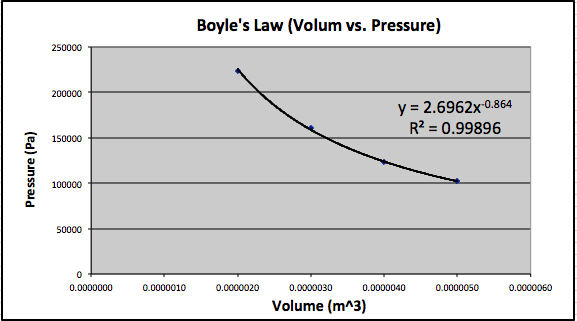
Boyle's law: at constant temperature the pressure of a fixed mass of gas is inversely proportional to its volume (P ∝ 1/V), so the P–V plot is a hyperbola — halving the volume doubles the pressure. Image: Reginaprice2013, CC BY-SA 3.0, via Wikimedia Commons.
Easy - 25 questions
Q1.
Which of the following correctly compares the most probable (u<sub>mp</sub>), average (u<sub>av</sub>) and root-mean-square (u<sub>rms</sub>) speeds of gas molecules?
- A u<sub>rms</sub> is largest, u<sub>mp</sub> is smallest
- B u<sub>mp</sub> is largest, u<sub>rms</sub> is smallest
- C all three speeds are exactly equal
- D u<sub>av</sub> is the largest of the three
Show answer & explanation →
Q2.
The normal boiling point of a liquid is the temperature at which its vapour pressure becomes equal to:
- A the critical pressure of the liquid
- B one standard atmosphere of pressure
- C half of the atmospheric pressure
- D zero external applied pressure
Show answer & explanation →
Q3.
The SI unit of the coefficient of viscosity of a liquid is:
- A J s mol<sup>-1</sup>
- B pascal per second
- C N s m<sup>-2</sup>
- D kg m s<sup>-1</sup>
Show answer & explanation →
Q4.
The rise of water in a narrow glass capillary tube is caused mainly by the liquid property known as:
- A the viscosity of the liquid
- B the density of the liquid
- C the vapour pressure of liquid
- D the surface tension of liquid
Show answer & explanation →
Q5.
The state of matter formed at very high temperature and consisting of ionised gas with free electrons and cations is called:
- A plasma
- B supercritical fluid
- C liquid crystal
- D Bose-Einstein condensate
Show answer & explanation →
Q6.
Which state of matter takes the shape of its container and has no fixed volume?
- A Solid
- B Liquid
- C Gas
- D Plasma
Show answer & explanation →
Q7.
According to the kinetic theory of gases, collisions between gas particles are assumed to be:
- A Perfectly inelastic
- B Perfectly elastic
- C Partially elastic
- D Random and energy losing
Show answer & explanation →
Q8.
Boyle Law relates which two variables at constant temperature?
- A Volume and temperature
- B Pressure and volume
- C Pressure and moles
- D Volume and moles
Show answer & explanation →
Q9.
Charles Law states that at constant pressure, the volume of a gas is directly proportional to its:
- A Mass as frequently described
- B Absolute temperature
- C Molar mass in most textbook accounts
- D Density during normal conditions
Show answer & explanation →
Q10.
What is the value of the universal gas constant R in litre atmosphere units?
- A 0.0821 L atm K<sup>-1</sup> mol<sup>-1</sup>
- B 8.314 L atm K<sup>-1</sup> mol<sup>-1</sup>
- C 1.987 L atm K<sup>-1</sup> mol<sup>-1</sup>
- D 22.4 L atm K<sup>-1</sup> mol<sup>-1</sup>
Show answer & explanation →
Q13.
Avogadro Law states that equal volumes of all gases at the same temperature and pressure contain equal numbers of:
- A Moles
- B Grams
- C Atoms only
- D Electrons
Show answer & explanation →
Q14.
Dalton Law of partial pressures applies to a mixture of gases that:
- A React chemically with each other
- B Do not react chemically with each other
- C Are all monoatomic
- D Have equal molar masses
Show answer & explanation →
Q15.
Graham Law of diffusion states that the rate of diffusion of a gas is inversely proportional to:
- A Its temperature as generally observed
- B The square root of its molar mass
- C Its pressure in typical laboratory settings
- D The square of its volume under usual circumstances
Show answer & explanation →
Q16.
Which gas diffuses faster: hydrogen or oxygen?
- A Oxygen, because it is heavier according to most researchers
- B Hydrogen, because it has lower molar mass
- C Both diffuse at the same rate in the majority of cases studied
- D Neither gas diffuses as widely reported
Show answer & explanation →
Q18.
The van der Waals equation introduces correction terms for:
- A Systematic errors in the absolute temperature scale used for the gas
- B Intermolecular attraction and finite molecular volume
- C Slight variation in the value of Avogadro's number with pressure
- D Gravitational effects acting on individual gas particles
Show answer & explanation →
Q19.
Critical temperature is defined as the temperature:
- A Below which a substance cannot exist in the gaseous state at all
- B Above which a gas cannot be liquefied by pressure alone
- C At which a gas spontaneously condenses regardless of the applied pressure
- D At which the vapour pressure of the substance drops to exactly zero
Show answer & explanation →
Q20.
Vapour pressure of a liquid increases with:
- A Decreasing temperature
- B Increasing temperature
- C Increasing surface tension
- D Increasing viscosity
Show answer & explanation →
Q21.
Surface tension of a liquid is best described as:
- A The resistance of a liquid to flow in standard practice
- B The force acting per unit length on the liquid surface
- C The pressure exerted by vapour above a liquid under most conditions encountered
- D The energy needed to boil a liquid as frequently observed in practice
Show answer & explanation →
Q22.
Viscosity of a liquid generally does what as temperature increases?
- A Increases
- B Decreases
- C Stays constant
- D Becomes negative
Show answer & explanation →
Q23.
At constant temperature, the pressure of a fixed mass of gas is inversely proportional to its volume. This statement is:
- A Charles’s law
- B Boyle’s law
- C Avogadro’s law
- D Dalton’s law
Show answer & explanation →
Medium - 25 questions
Q26.
Which of the following gases shows the maximum deviation from ideal behaviour?
- A H<sub>2</sub>
- B He
- C N<sub>2</sub>
- D NH<sub>3</sub>
Show answer & explanation →
Q27.
At constant temperature, if the volume of a fixed mass of gas is halved, its pressure:
- A It is halved
- B It is doubled
- C It stays the same
- D It becomes one-fourth
Show answer & explanation →
Q28.
What is the average kinetic energy of one mole of an ideal gas at 300 K (R = 8.314 J K<sup>-1</sup> mol<sup>-1</sup>)?
- A 5610 J
- B 2494 J
- C 1247 J
- D 3741 J
Show answer & explanation →
Q29.
In terms of the van der Waals constants a and b, the critical temperature of a gas is given by:
- A T<sub>c</sub> = 8a/27Rb
- B T<sub>c</sub> = a/Rb
- C T<sub>c</sub> = 27a/8Rb
- D T<sub>c</sub> = a/27Rb
Show answer & explanation →
Q30.
0.5 mol of a real gas occupies 5 L at 2 atm and 300 K. What is its compressibility factor Z (R = 0.0821 L atm K<sup>-1</sup> mol<sup>-1</sup>)?
Show answer & explanation →
Q31.
A sample of gas occupies 4 L at 2 atm pressure. What will its volume be at 4 atm, at constant temperature?
Show answer & explanation →
Q32.
A gas at 300 K has a volume of 600 mL. What is its volume at 600 K at constant pressure?
- A 300 mL
- B 600 mL
- C 1200 mL
- D 1800 mL
Show answer & explanation →
Q33.
A gas exerts a pressure of 1 atm at 300 K in a sealed rigid container. What is the pressure at 600 K?
- A 0.5 atm
- B 1 atm
- C 2 atm
- D 4 atm
Show answer & explanation →
Q35.
A mixture contains 2 mol N<sub>2</sub> and 3 mol O<sub>2</sub> at a total pressure of 10 atm. What is the partial pressure of O<sub>2</sub>?
- A 2 atm
- B 4 atm
- C 6 atm
- D 10 atm
Show answer & explanation →
Q37.
Using the density form of the ideal gas equation, PM = dRT, calculate the molar mass of a gas with density 1.96 g/L at 1 atm and 273 K (R = 0.0821 L atm K<sup>-1</sup> mol<sup>-1</sup>).
- A 22 g/mol
- B 32 g/mol
- C 44 g/mol
- D 64 g/mol
Show answer & explanation →
Q38.
Which of the following best explains why real gases deviate from ideal behavior at high pressure?
- A Molecules generally move faster as the pressure on the gas increases overall
- B The finite volume of gas molecules becomes significant compared to total volume
- C The temperature of the gas automatically falls as pressure is increased in most cases
- D Intermolecular attractive forces disappear largely once pressure becomes high
Show answer & explanation →
Q39.
In the van der Waals equation (P + an<sup>2</sup>/V<sup>2</sup>)(V - nb) = nRT, the constant b accounts for:
- A Intermolecular attraction
- B Effective volume occupied by gas molecules
- C Temperature correction
- D Pressure exerted by container walls
Show answer & explanation →
Q40.
A gas shows compressibility factor Z greater than 1 at very high pressure. This indicates that:
- A Attractive intermolecular forces dominate over repulsive forces at this pressure
- B The gas compresses more easily than an ideal gas would at the same pressure
- C The gas is harder to compress than an ideal gas due to molecular volume effects
- D The gas has fully liquefied into a dense, incompressible liquid phase
Show answer & explanation →
Q41.
Why does a liquid with strong intermolecular forces generally have higher viscosity?
- A Stronger intermolecular forces cause the liquid's molecules to move noticeably faster
- B Stronger forces increase resistance between flowing layers of liquid
- C Stronger intermolecular forces actually lower the liquid's surface tension
- D Stronger intermolecular forces increase the liquid's equilibrium vapour pressure
Show answer & explanation →
Q42.
Why do liquid droplets tend to be spherical in shape?
- A Gravity acting on the droplet pulls it into a perfectly spherical shape
- B Surface tension minimizes surface area for a given volume
- C The liquid's viscosity forces the droplet into a spherical shape over time
- D Vapour pressure acting uniformly on the surface pushes it into a sphere
Show answer & explanation →
Q43.
At constant pressure, the volume of a gas is directly proportional to its absolute temperature. This is:
- A Boyle’s law
- B Charles’s law
- C Gay-Lussac’s law
- D Graham’s law
Show answer & explanation →
Q44.
The value of the universal gas constant R in SI units is:
- A 0.0821 L atm/mol K
- B 8.314 J/mol K
- C 1.987 cal/mol K
- D 62.4 L mmHg/mol K
Show answer & explanation →
Q45.
By Dalton’s law, the total pressure of a mixture of non-reacting gases equals:
- A the product of the partial pressures
- B the sum of the partial pressures
- C the average of the partial pressures
- D the largest partial pressure
Show answer & explanation →
Q47.
The temperature above which a gas cannot be liquefied by applying pressure alone is the:
- A boiling temperature
- B critical temperature
- C Boyle temperature
- D inversion temperature
Show answer & explanation →
Q48.
By Graham’s law, the rate of diffusion of a gas is inversely proportional to the square root of its:
- A pressure
- B molar mass
- C temperature
- D volume
Show answer & explanation →
Q49.
The average kinetic energy of the molecules of an ideal gas depends only on its:
- A externally applied pressure
- B absolute temperature
- C overall molecular molar mass
- D total container volume
Show answer & explanation →
Q50.
Real gases deviate most from ideal behaviour under conditions of:
- A high temperature and low pressure
- B low temperature and high pressure
- C high temperature and high pressure
- D standard temperature and pressure
Show answer & explanation →
Hard - 25 questions
Q51.
A gas has van der Waals constants a = 3.6 atm L<sup>2</sup> mol<sup>-2</sup> and b = 0.04 L mol<sup>-1</sup>. Estimate its critical temperature (R = 0.0821 L atm K<sup>-1</sup> mol<sup>-1</sup>).
- A 162 K
- B 487 K
- C 325 K
- D 244 K
Show answer & explanation →
Q52.
At what temperature will O<sub>2</sub> molecules have the same root-mean-square speed as H<sub>2</sub> molecules possess at 300 K?
- A 600 K
- B 2400 K
- C 9600 K
- D 4800 K
Show answer & explanation →
Q53.
The most probable speed of the molecules of a gas at temperature T is u. If the temperature is raised to 4T, the new most probable speed becomes:
Show answer & explanation →
Q54.
For one mole of a van der Waals gas at low pressure, Z = 1 - a/(RTV). This relation indicates that under these conditions the gas is:
- A exactly ideal, with Z equal to one
- B more compressible than ideal, Z below one
- C not compressible under any condition
- D less compressible than ideal, Z above one
Show answer & explanation →
Q55.
Under identical conditions of temperature and pressure, the ratio of the rate of diffusion of CH<sub>4</sub> to that of SO<sub>2</sub> is:
- A 1 : 2
- B 4 : 1
- C 2 : 1
- D 1 : 4
Show answer & explanation →
Q56.
A 2 L flask contains 4 g of a gas at 27 degree C exerting a pressure of 2.05 atm. What is the molar mass of the gas (R = 0.0821 L atm K<sup>-1</sup> mol<sup>-1</sup>)?
- A 8 g/mol
- B 16 g/mol
- C 24 g/mol
- D 32 g/mol
Show answer & explanation →
Q57.
Two gases X and Y are allowed to effuse through a small hole. Gas X takes 30 seconds and gas Y takes 60 seconds to effuse the same volume. If the molar mass of Y is 64 g/mol, what is the molar mass of X?
- A 8 g/mol
- B 16 g/mol
- C 32 g/mol
- D 128 g/mol
Show answer & explanation →
Q58.
At a given temperature, the compressibility factor Z of a real gas is found to be less than 1. What does this suggest about the gas under these conditions?
- A Repulsive forces dominate, and the gas is harder to compress than ideal
- B Attractive forces dominate, making the gas more compressible than ideal
- C The gas obeys the ideal gas law exactly
- D The molar volume of the gas is larger than predicted by the ideal gas law
Show answer & explanation →
Q59.
A gas mixture of equal moles of H<sub>2</sub> and CH<sub>4</sub> is kept in a container fitted with a porous plug. After some time, the gas remaining in the container will be richer in:
- A H<sub>2</sub>, because it diffuses out faster in most cases
- B CH<sub>4</sub>, because H<sub>2</sub> diffuses out faster leaving CH<sub>4</sub> behind
- C Both will remain in equal proportion under typical conditions
- D Neither, since the mixture cannot separate according to standard textbooks
Show answer & explanation →
Q60.
For a van der Waals gas, the constant a is larger for gases that:
- A Have weaker intermolecular attraction and resist liquefaction strongly
- B Have stronger intermolecular attraction and are more easily liquefied
- C Simply have a smaller individual molecular size than other gases
- D Already behave nearly ideally at ordinary room temperature
Show answer & explanation →
Q61.
At the critical temperature of a substance, the distinction between liquid and gas phases disappears because:
- A The density of liquid and vapour phases become equal
- B The vapour pressure becomes zero in general practice
- C The surface tension becomes infinite as frequently described
- D The viscosity of the liquid becomes zero in most textbook accounts
Show answer & explanation →
Q62.
A balloon filled with He gas at 1 atm and 300 K has volume 5 L. If it rises to an altitude where pressure is 0.5 atm and temperature drops to 250 K, what is its new volume, assuming ideal behavior?
- A 4.17 L
- B 8.33 L
- C 10 L
- D 2.5 L
Show answer & explanation →
Q63.
Why does the rate of effusion measured for a real gas sometimes differ slightly from the value predicted by the ideal version of Graham Law?
- A Because the numerical value of Avogadro's number actually shifts for real gases during normal conditions as generally observed
- B Because real gas molecules have finite size and intermolecular forces not accounted for in the ideal derivation
- C Because real gases supposedly do not possess any measurable molar mass in typical laboratory settings under usual circumstances
- D Because the effusion phenomenon is said to apply mainly to liquids, not gases according to most researchers
Show answer & explanation →
Q64.
A mixture of N<sub>2</sub> and O<sub>2</sub> gases is kept in a closed vessel at constant temperature. If the partial pressure of N<sub>2</sub> is twice that of O<sub>2</sub> and total pressure is 3 atm, what is the partial pressure of O<sub>2</sub>?
- A 1 atm
- B 1.5 atm
- C 2 atm
- D 0.5 atm
Show answer & explanation →
Q65.
At high pressure, the van der Waals equation for a real gas reduces to (P + a/V<sup>2</sup>)(V - b) = RT approaching PV = RT + Pb. What does this approximation reveal about real gas behaviour at high pressure?
- A Real gases tend to behave more like ideal gases as pressure rises well above a few atmospheres under usual circumstances according to most studies
- B The finite volume of gas molecules (term b) becomes the dominant correction, while intermolecular attraction becomes comparatively less significant
- C Both the molecular volume and intermolecular attraction terms shrink to a similar, comparable size in the majority of documented cases as widely reported
- D Intermolecular attraction (term a) becomes the dominant correction, while molecular volume becomes comparatively less significant in standard reference material
Show answer & explanation →
Q66.
In the van der Waals equation, the constant "a" accounts for:
- A the finite molecular volume
- B the intermolecular attraction
- C the total molecular mass
- D the frequency of collisions
Show answer & explanation →
Q67.
The van der Waals constant "b" is a correction for:
- A the attractive forces present
- B the finite volume of molecules
- C the average kinetic energy
- D the absolute temperature
Show answer & explanation →
Q69.
A real gas showing Z < 1 is dominated by:
- A the finite molecular volume
- B the intermolecular attraction
- C a very high kinetic energy
- D an unusually low molar mass
Show answer & explanation →
Q71.
Gases A (M = 4) and B (M = 64) effuse through the same orifice. The ratio of their rates (A : B) is:
- A 2 : 1
- B 4 : 1
- C 16 : 1
- D 1 : 4
Show answer & explanation →
Q72.
The Boyle temperature is the temperature at which a real gas:
- A can no longer ever be liquefied
- B behaves almost ideally over a pressure range
- C suddenly collapses to zero volume
- D reaches its maximum possible pressure
Show answer & explanation →
Q73.
As temperature increases, the surface tension of a liquid:
- A increases steadily
- B decreases steadily
- C remains exactly constant
- D becomes zero abruptly
Show answer & explanation →
Q74.
The property of a liquid that measures its internal resistance to flow is its:
- A surface tension
- B viscosity
- C vapour pressure
- D density
Show answer & explanation →
Q75.
As temperature rises, the viscosity of a liquid generally:
- A increases sharply
- B decreases
- C stays unchanged
- D doubles each degree
Show answer & explanation →