🧪 Chemistry · Class 12 · NEET & JEE
p-Block Elements (Groups 15 to 18) - Practice Questions with Answers
75 free MCQs on p-Block Elements (Groups 15 to 18), each with its own worked answer and explanation. Covers the nitrogen family (Group 15), oxygen family (Group 16), halogens (Group 17), and noble gases (Group 18). One of the highest-weightage inorganic chapters in NEET and JEE - includes preparation and properties of HNO₃, H₂SO₄, interhalogens, and xenon com
Take the timed p-Block Elements (Groups 15 to 18) chapterwise test →75 practice questions on p-Block Elements (Groups 15 to 18), sorted Easy → Hard. Try each one first, then open its answer page for the worked explanation. Want the full theory first? Read the p-Block Elements (Groups 15 to 18) notes.
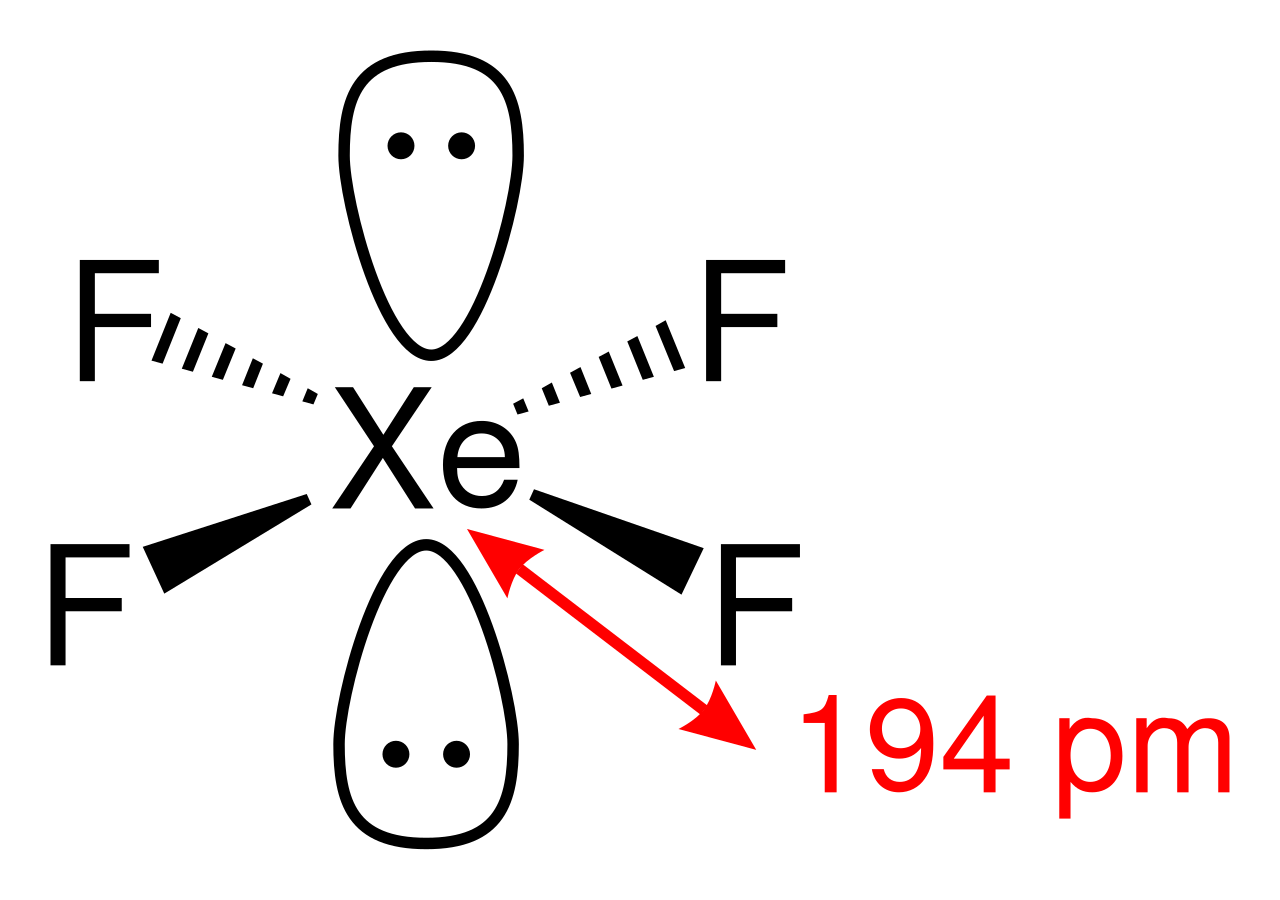
Xenon tetrafluoride (XeF4) has six electron domains around xenon — four Xe–F bonds plus two lone pairs. The lone pairs occupy opposite axial positions, leaving the four fluorine atoms in a square-planar shape (Xe–F ≈ 194 pm). Image: ChemSim, Public Domain, via Wikimedia Commons.
Easy - 25 questions
Q1.
The general valence shell electronic configuration of the Group 15 elements is:
- A ns<sup>2</sup>np<sup>3</sup>
- B ns<sup>2</sup>np<sup>4</sup>
- C ns<sup>2</sup>np<sup>2</sup>
- D ns<sup>2</sup>np<sup>5</sup>
Show answer & explanation →
Q2.
Laughing gas, used as a mild anaesthetic, is:
- A NO
- B N<sub>2</sub>O
- C NO<sub>2</sub>
- D N<sub>2</sub>O<sub>3</sub>
Show answer & explanation →
Q6.
Which Group 15 element forms the diatomic gas that makes up 78% of air?
- A Nitrogen (N<sub>2</sub>)
- B Oxygen
- C Phosphorus
- D Arsenic
Show answer & explanation →
Q9.
Which p-block element is a liquid at room temperature?
- A Bromine (Br<sub>2</sub>)
- B Chlorine
- C Iodine
- D Fluorine
Show answer & explanation →
Q10.
Which compound is responsible for the depletion of the ozone layer?
- A CFCs (chlorofluorocarbons)
- B CO<sub>2</sub>, the greenhouse gas mainly linked to global warming
- C SO<sub>2</sub>, the gas primarily responsible for acid rain formation
- D NO<sub>2</sub>, the brownish gas contributing to photochemical smog
Show answer & explanation →
Q11.
Which form of phosphorus is most reactive?
- A White phosphorus (P<sub>4</sub>)
- B Red phosphorus
- C Black phosphorus
- D Violet phosphorus
Show answer & explanation →
Q12.
Sulfuric acid (H<sub>2</sub>SO<sub>4</sub>) is produced industrially by:
- A Contact process
- B Haber process
- C Solvay process
- D Frasch process
Show answer & explanation →
Q13.
The most electronegative element in the p-block is:
- A Fluorine (F)
- B Chlorine (Cl)
- C Oxygen (O)
- D Nitrogen (N)
Show answer & explanation →
Q15.
Helium, neon, argon, krypton, xenon, and radon belong to which group?
- A Group 18 (noble gases)
- B Group 17 in many documented cases
- C Group 16 according to conventional understanding
- D Group 1 in routine practice
Show answer & explanation →
Q19.
Nitrogen gas is unreactive (inert) mainly because:
- A N≡N triple bond has very high bond dissociation energy (945 kJ/mol)
- B N<sub>2</sub> molecules contain no valence electrons available for bonding
- C Nitrogen atoms have an unusually large atomic radius for their period
- D N<sub>2</sub> is technically classified as a noble gas
Show answer & explanation →
Q20.
Which acid is called 'oil of vitriol'?
- A Concentrated H<sub>2</sub>SO<sub>4</sub>
- B HNO<sub>3</sub> in general practice
- C HCl as frequently described
- D H<sub>3</sub>PO<sub>4</sub> in most textbook accounts
Show answer & explanation →
Q21.
Aqua regia is a mixture of:
- A HNO<sub>3</sub> and HCl (1:3 ratio)
- B H<sub>2</sub>SO<sub>4</sub> and HNO<sub>3</sub> during normal conditions
- C HCl and H<sub>2</sub>SO<sub>4</sub> as generally observed
- D HNO<sub>3</sub> and H<sub>3</sub>PO<sub>4</sub> in typical laboratory settings
Show answer & explanation →
Q22.
Which element is commonly used as a disinfectant and in PVC production?
- A Chlorine
- B Fluorine
- C Bromine
- D Iodine
Show answer & explanation →
Q23.
Which Group 15 element is the most abundant gas in the atmosphere?
- A phosphorus
- B arsenic
- C nitrogen
- D bismuth
Show answer & explanation →
Medium - 25 questions
Q26.
In the brown ring test for nitrates, the brown ring is due to the complex:
- A [Fe(H<sub>2</sub>O)<sub>6</sub>]<sup>3+</sup>
- B [Fe(H<sub>2</sub>O)<sub>5</sub>NO]<sup>2+</sup>
- C [Fe(NO)<sub>2</sub>]<sup>2+</sup>
- D [Fe(H<sub>2</sub>O)<sub>5</sub>(OH)]<sup>2+</sup>
Show answer & explanation →
Q27.
The correct order of basic character of the Group 15 hydrides is:
- A PH<sub>3</sub> > NH<sub>3</sub> > AsH<sub>3</sub> > SbH<sub>3</sub> > BiH<sub>3</sub>
- B BiH<sub>3</sub> > SbH<sub>3</sub> > AsH<sub>3</sub> > PH<sub>3</sub> > NH<sub>3</sub>
- C NH<sub>3</sub> > PH<sub>3</sub> > AsH<sub>3</sub> > SbH<sub>3</sub> > BiH<sub>3</sub>
- D NH<sub>3</sub> > AsH<sub>3</sub> > PH<sub>3</sub> > SbH<sub>3</sub> > BiH<sub>3</sub>
Show answer & explanation →
Q29.
In the Haber process for manufacturing ammonia, the catalyst and promoter used are:
- A Iron with molybdenum
- B Vanadium(V) oxide only
- C Nickel with alumina
- D Platinum with rhodium
Show answer & explanation →
Q31.
The inert pair effect in p-block heavy elements results in:
- A Lower oxidation states being more stable (e.g., Pb<sup>2+</sup> more stable than Pb<sup>4+</sup>)
- B Higher oxidation states such as Pb<sup>4+</sup> becoming the preferred state
- C All oxidation states being equally stable with no preference shown
- D A complete absence of any preferred oxidation state for these elements
Show answer & explanation →
Q32.
Which oxide of nitrogen is responsible for photochemical smog?
- A NO<sub>2</sub> (nitrogen dioxide)
- B N<sub>2</sub>O (laughing gas)
- C NO (nitric oxide)
- D N<sub>2</sub>O<sub>5</sub>
Show answer & explanation →
Q33.
Preparation of HNO<sub>3</sub> by Ostwald process: the key oxidation step is:
- A 4NH<sub>3</sub> + 5O<sub>2</sub> → 4NO + 6H<sub>2</sub>O (catalysed by Pt/Rh)
- B N<sub>2</sub> + O<sub>2</sub> → 2NO occurring directly without a catalyst at this stage
- C NO + O<sub>2</sub> → NO<sub>2</sub>, the subsequent atmospheric oxidation step
- D 3NO<sub>2</sub> + H<sub>2</sub>O → 2HNO<sub>3</sub> + NO, the final absorption step in water
Show answer & explanation →
Q34.
Why is nitrogen able to form multiple oxides (N<sub>2</sub>O, NO, N<sub>2</sub>O<sub>3</sub>, NO<sub>2</sub>, N<sub>2</sub>O<sub>4</sub>, N<sub>2</sub>O<sub>5</sub>)?
- A Nitrogen has multiple stable oxidation states (-3 to +5) because of variable bonding with oxygen
- B Nitrogen possesses accessible d orbitals that allow octet expansion in typical laboratory settings
- C Nitrogen is generally the most reactive element in the entire periodic table under usual circumstances
- D Nitrogen forms mainly ionic bonds with oxygen in each of these oxides according to most researchers
Show answer & explanation →
Q35.
Phosphine (PH<sub>3</sub>) is a:
- A Toxic, foul-smelling gas used in semiconductor doping and as a fumigant
- B A sweet-smelling gas commonly used as a food flavouring agent
- C A chemically inert gas that does not react with common oxidisers
- D A dense liquid that condenses readily at room temperature
Show answer & explanation →
Q36.
The structure of PCl<sub>5</sub> in the gas phase is:
- A Trigonal bipyramidal (sp<sup>3</sup>d hybridisation)
- B Octahedral, using sp<sup>3</sup>d<sup>2</sup> hybridisation around phosphorus
- C Square planar, with phosphorus using dsp<sup>2</sup> hybridisation
- D Tetrahedral, using simple sp<sup>3</sup> hybridisation around phosphorus
Show answer & explanation →
Q37.
In PCl<sub>5</sub>, the axial P-Cl bonds are longer than equatorial P-Cl bonds because:
- A Axial bonds are perpendicular to 3 equatorial bond pairs (more repulsion, longer bond)
- B The chlorine atoms occupying axial positions are physically larger in the majority of cases studied
- C The phosphorus atom is somehow chemically different at each position as widely reported
- D The bond length difference arises mainly from the reaction temperature in standard practice
Show answer & explanation →
Q38.
H<sub>3</sub>PO<sub>3</sub> is diprotic (not triprotic) because:
- A One P-H bond is not ionisable (P directly bonded to H does not donate H+)
- B The molecule actually contains mainly two hydrogen atoms in total under most conditions encountered
- C It is classified as a weak acid rather than a strong one as frequently observed in practice
- D It contains three separate -OH groups, most of which ionise in many documented cases
Show answer & explanation →
Q39.
The bleaching action of Cl<sub>2</sub> is due to:
- A Nascent oxygen released from Cl<sub>2</sub> + H<sub>2</sub>O reaction oxidising the colour
- B The hydrochloric acid formed alongside the bleaching reaction
- C Cl<sub>2</sub> acting as a reducing agent that donates electrons to the dye
- D Cl<sub>2</sub> simply dissolving in water without any further chemical change
Show answer & explanation →
Q41.
The structure of XeF<sub>4</sub> is:
- A Square planar (2 lone pairs in octahedral arrangement)
- B Tetrahedral, with xenon using simple sp<sup>3</sup> hybridisation
- C Trigonal pyramidal, with one lone pair occupying an apical site
- D Linear, with the two lone pairs positioned at right angles
Show answer & explanation →
Q42.
Sulfuric acid is a dehydrating agent because:
- A It has a strong affinity for water and removes H and OH as water from other compounds
- B It is generally classified as a strong acid that largely ionises according to conventional understanding
- C It functions mainly as an oxidising agent in this particular role in routine practice
- D It is largely miscible with water in all proportions overall in most cases under typical conditions
Show answer & explanation →
Q43.
The Contact process for H<sub>2</sub>SO<sub>4</sub> uses which catalyst?
- A V<sub>2</sub>O<sub>5</sub> (vanadium pentoxide)
- B Pt gauze, the catalyst used instead in the Ostwald process
- C Fe, the catalyst used instead in the Haber process
- D MnO<sub>2</sub>, used instead as a catalyst in oxygen generation from KClO<sub>3</sub>
Show answer & explanation →
Q44.
Which allotrope of sulfur is most stable at room temperature?
- A Rhombic sulfur (alpha-sulfur)
- B Monoclinic sulfur according to standard textbooks
- C Plastic sulfur in general practice
- D Amorphous sulfur as frequently described
Show answer & explanation →
Q45.
Ozone (O<sub>3</sub>) acts as an oxidising agent because:
- A It decomposes to release nascent oxygen: O<sub>3</sub> → O<sub>2</sub> + [O]
- B It is thermodynamically more stable than ordinary O<sub>2</sub> gas
- C It readily forms stable compounds with the noble gases
- D It primarily functions as a reducing agent in most reactions
Show answer & explanation →
Q46.
Which reaction produces chlorine gas industrially (electrolytic process)?
- A Electrolysis of brine (NaCl solution) at the anode: 2Cl- → Cl<sub>2</sub> + 2e-
- B The thermal decomposition of solid sodium chloride at high temperature
- C The laboratory reaction of concentrated HCl with solid MnO<sub>2</sub>
- D The direct combustion of sodium metal in chlorine gas
Show answer & explanation →
Q47.
What is the hybridisation of xenon in XeF<sub>2</sub>?
- A sp<sup>3</sup>d (trigonal bipyramidal, linear molecule with 3 lone pairs)
- B sp<sup>3</sup>, giving a simple tetrahedral electron arrangement in most textbook accounts
- C sp<sup>2</sup>, giving a trigonal planar electron arrangement during normal conditions
- D sp<sup>3</sup>d<sup>2</sup>, giving an octahedral electron arrangement as generally observed
Show answer & explanation →
Q48.
Fuming sulfuric acid (oleum) is:
- A H<sub>2</sub>SO<sub>4</sub> with dissolved SO<sub>3</sub> (pyrosulfuric acid, H<sub>2</sub>S<sub>2</sub>O<sub>7</sub>)
- B Generally dilute aqueous H<sub>2</sub>SO<sub>4</sub> at low concentration
- C H<sub>2</sub>SO<sub>4</sub> existing largely as a gas under ordinary conditions
- D A direct mixture of concentrated H<sub>2</sub>SO<sub>4</sub> with concentrated HNO<sub>3</sub>
Show answer & explanation →
Q49.
Nitrogen pentoxide (N<sub>2</sub>O<sub>5</sub>) is the anhydride of:
- A HNO<sub>3</sub> (nitric acid)
- B HNO<sub>2</sub> (nitrous acid)
- C NO<sub>2</sub>
- D NH<sub>3</sub>
Show answer & explanation →
Hard - 25 questions
Q51.
Nitrogen shows a maximum covalency of 4 whereas phosphorus can extend it to 5 or 6 because:
- A nitrogen is more electronegative than phosphorus
- B nitrogen has a smaller atomic size than phosphorus
- C nitrogen has no d-orbitals in its valence shell
- D nitrogen forms stronger pi-bonds than phosphorus
Show answer & explanation →
Q52.
On heating, orthophosphorous acid (H<sub>3</sub>PO<sub>3</sub>) disproportionates to give:
- A H<sub>3</sub>PO<sub>2</sub> and P<sub>2</sub>O<sub>5</sub>
- B H<sub>4</sub>P<sub>2</sub>O<sub>7</sub> and H<sub>2</sub>O
- C P<sub>2</sub>O<sub>3</sub> and H<sub>2</sub>O
- D H<sub>3</sub>PO<sub>4</sub> and PH<sub>3</sub>
Show answer & explanation →
Q53.
When copper reacts with dilute nitric acid, the main nitrogen-containing gas evolved is:
- A NO
- B NO<sub>2</sub>
- C N<sub>2</sub>O
- D N<sub>2</sub>O<sub>5</sub>
Show answer & explanation →
Q54.
The correct order of bond angle in the hydrides of Group 16 is:
- A H<sub>2</sub>Te > H<sub>2</sub>Se > H<sub>2</sub>S > H<sub>2</sub>O
- B H<sub>2</sub>O > H<sub>2</sub>S > H<sub>2</sub>Se > H<sub>2</sub>Te
- C H<sub>2</sub>S > H<sub>2</sub>O > H<sub>2</sub>Se > H<sub>2</sub>Te
- D H<sub>2</sub>O > H<sub>2</sub>Se > H<sub>2</sub>S > H<sub>2</sub>Te
Show answer & explanation →
Q56.
Why does fluorine not exhibit positive oxidation states unlike other halogens?
- A F has the highest electronegativity and no d orbitals available for expansion of valence shell
- B Fluorine actually behaves chemically as a metal rather than as a non-metal in most textbook accounts
- C Fluorine is generally a far too large an atom to ever form higher oxidation states during normal conditions
- D Fluorine atoms are said to possess no lone pairs of electrons whatsoever as generally observed
Show answer & explanation →
Q57.
The photochemical smog formation involves which sequence?
- A NO<sub>2</sub> → NO + O; O + O<sub>2</sub> → O<sub>3</sub>; O<sub>3</sub> + hydrocarbons → PAN and other irritants
- B Atmospheric CO<sub>2</sub> absorbing sunlight and directly forming smog particles
- C SO<sub>2</sub> reacting with ozone to form the bulk of urban photochemical smog
- D Ammonia reacting with atmospheric water vapour to form smog droplets
Show answer & explanation →
Q58.
Which nitrogen compound catalytically destroys stratospheric ozone?
- A NO and NO<sub>2</sub> (NOx from supersonic aircraft)
- B N<sub>2</sub>O<sub>5</sub>, a stable nitrogen oxide that does not catalyse ozone breakdown
- C HNO<sub>3</sub>, the stable acid formed in the lower atmosphere from NOx
- D NH<sub>3</sub>, a basic gas with no catalytic effect on stratospheric ozone
Show answer & explanation →
Q59.
In the hybridisation of SF<sub>6</sub>, which orbital set does sulfur use?
- A sp<sup>3</sup>d<sup>2</sup> (one 3s, three 3p, two 3d orbitals)
- B sp<sup>3</sup>d, giving a trigonal bipyramidal geometry instead
- C sp<sup>3</sup>, giving a simple tetrahedral geometry instead
- D sp<sup>2</sup>, giving a trigonal planar geometry instead
Show answer & explanation →
Q60.
Why does OF<sub>2</sub> have F-O-F angle (103.2°) less than H<sub>2</sub>O (104.5°)?
- A F is more electronegative than H; bond pair electrons in O-F are pulled away from O more, reducing repulsion and decreasing angle
- B Fluorine is generally claimed to be a much more physically large atom than hydrogen overall as frequently observed in practice
- C The O-F bonds are claimed to be noticeably shorter in length than the O-H bonds found in water in many documented cases according to conventional understanding
- D The oxygen lone pairs are claimed to become physically larger in size once bonded to fluorine instead in routine practice overall
Show answer & explanation →
Q61.
The structure of H<sub>3</sub>PO<sub>4</sub> has:
- A P in +5 state with 3 P-OH (ionisable) and one P=O (not ionisable), making it triprotic
- B Mainly a single ionisable hydrogen among the four present in most cases under typical conditions
- C A direct P-H bond that does not contribute any ionisable proton according to standard textbooks
- D All four hydrogen atoms largely ionisable, making it tetraprotic in general practice
Show answer & explanation →
Q62.
The reaction 2SO<sub>2</sub> + O<sub>2</sub> ⇌ 2SO<sub>3</sub> in the Contact process is exothermic. To maximise yield:
- A Low temperature and high pressure (Le Chatelier), but kinetics require compromise at ~450°C and ~1-2 atm
- B Operating at the highest practical reactor temperature regardless of the resulting yield as frequently described
- C Maintaining a very low pressure throughout the entire reactor vessel times in most textbook accounts
- D Combining a high reactor temperature with a low operating pressure to maximise yield during normal conditions
Show answer & explanation →
Q63.
Xenon forms compounds with fluorine and oxygen because:
- A Xe has large atomic radius and low ionisation energy, making it accessible to attack by highly electronegative F
- B Xenon possesses readily accessible low-energy d orbitals it can use for bonding as generally observed in typical laboratory settings
- C Xenon actually behaves chemically as a metal under ordinary laboratory conditions under usual circumstances
- D Xenon reacts readily with the vast majority of elements on the periodic table according to most researchers
Show answer & explanation →
Q64.
In the reaction between Cl<sub>2</sub> and hot concentrated NaOH, the product is:
- A NaClO<sub>3</sub> (sodium chlorate) and NaCl
- B NaOCl and NaCl (cold dilute NaOH gives hypochlorite)
- C NaCl only
- D NaClO<sub>4</sub>
Show answer & explanation →
Q65.
The bond angle in SO<sub>2</sub> is 119° (close to 120°). This suggests:
- A sp<sup>2</sup> hybridisation of S with one lone pair in one sp<sup>2</sup> orbital; the lone pair causes slight compression from ideal 120°
- B sp<sup>3</sup> hybridisation of sulfur with two separate lone pairs occupying tetrahedral sites in the majority of cases studied
- C sp hybridisation of sulfur producing a perfectly linear electron-pair arrangement as widely reported in standard practice
- D A perfectly linear molecular geometry showing an exact 180 degree bond angle under most conditions encountered as frequently observed in practice
Show answer & explanation →
Q66.
Which p-block element exhibits the widest range of allotropes?
- A Carbon (diamond, graphite, graphene, fullerene, amorphous carbon, nanotubes...)
- B Sulfur, which forms mainly the rhombic and monoclinic crystal forms in many documented cases
- C Phosphorus, which forms mainly the white and red allotropic forms according to conventional understanding
- D Oxygen, which forms mainly the dioxygen and ozone allotropic forms in routine practice
Show answer & explanation →
Q67.
In concentrated H<sub>2</sub>SO<sub>4</sub>, the acid acts as a sulfonating agent because:
- A The electrophilic SO<sub>3</sub> (from equilibrium H<sub>2</sub>S<sub>2</sub>O<sub>7</sub> ⇌ SO<sub>3</sub> + H<sub>2</sub>SO<sub>4</sub>) attacks the aromatic ring
- B H<sub>2</sub>SO<sub>4</sub> generally ionises largely into H+ and sulfate ions in solution overall in most cases
- C H<sub>2</sub>SO<sub>4</sub> acts here mainly as a reducing agent toward the aromatic ring under typical conditions
- D A free H+ ion directly attacks the aromatic ring as the electrophile according to standard textbooks
Show answer & explanation →
Q68.
Why do noble gases have very high first ionisation energies?
- A Completely filled valence shells + high effective nuclear charge in their period
- B They are generally defined as chemically inert by convention in general practice
- C They possess no electrons available for removal as frequently described in most textbook accounts
- D They exist mainly as gases under standard conditions during normal conditions
Show answer & explanation →
Q69.
The dihedral angle in H<sub>2</sub>O<sub>2</sub> (approx 111°) compared to H<sub>2</sub>O<sub>2</sub> in crystal form (approx 90°) shows that:
- A Lone pair repulsion and crystal packing forces influence the conformation differently
- B H<sub>2</sub>O<sub>2</sub> acquires an aromatic delocalised structure once crystallised as generally observed
- C The crystalline form has an largely different chemical formula in typical laboratory settings
- D The O-O and O-H bond lengths change substantially upon crystallisation under usual circumstances
Show answer & explanation →
Q70.
The acid strength order of oxyacids of chlorine is:
- A HClO < HClO2 < HClO3 < HClO4
- B HClO4 < HClO3 < HClO2 < HClO
- C HClO = HClO4
- D All equal
Show answer & explanation →
Q71.
Why is PCl<sub>5</sub> hydrolysed in water but not SF<sub>6</sub>?
- A PCl<sub>5</sub> has an accessible P centre; SF<sub>6</sub>'s S is sterically shielded by 6 F atoms preventing water attack
- B SF<sub>6</sub> is actually an ionic compound that strongly resists hydrolysis in water according to most researchers
- C PCl<sub>5</sub> is supposedly thermodynamically more stable than SF<sub>6</sub> toward hydrolysis in the majority of cases studied
- D The difference arises mainly from the temperature of the water sample used as widely reported in standard practice
Show answer & explanation →
Q72.
The correct order of acidic strength of the hydrogen halides is:
- A HF > HCl > HBr > HI
- B HI > HBr > HCl > HF
- C HCl > HF > HBr > HI
- D HBr > HI > HCl > HF
Show answer & explanation →
Q73.
In the Ostwald process for nitric acid, ammonia is first oxidised over a catalyst of:
- A iron granules
- B platinum–rhodium gauze
- C vanadium pentoxide
- D finely divided nickel
Show answer & explanation →
Q75.
The first noble-gas compound to be prepared, XePtF₆, was formed from which noble gas?
- A helium
- B neon
- C argon
- D xenon
Show answer & explanation →