🎯 Key Points
- 10% Law (Lindemann): only ~10% of energy passes to the next trophic level; energy pyramid is ALWAYS upright (unlike pyramid of numbers, which can be inverted, e.g. in a tree ecosystem)
- GPP (gross primary productivity) = total photosynthesis; NPP = GPP − respiration (energy actually available to consumers)
- Nitrogen cycle has a gas phase (N₂ fixation/denitrification); Phosphorus cycle has NO gas phase (purely sedimentary, via rock weathering) - key distinguishing exam point
- India has 4 biodiversity hotspots: Himalaya, Western Ghats, Indo-Burma, Sundaland; in-situ conservation (national parks) keeps species in natural habitat, ex-situ (zoos, gene banks) removes them from it
- Population growth: Exponential (J-curve, unlimited resources) vs Logistic (S-curve, growth slows as population nears carrying capacity K)
Ecosystem Components
- Producers: photosynthesis (plants, algae, cyanobacteria)
- Consumers: herbivores, carnivores, omnivores
- Decomposers: bacteria and fungi; recycle nutrients
Energy Flow
Energy pyramid showing a simple food chain (producer to herbivore to carnivore) with energy decreasing roughly tenfold at each trophic level.
- 10% law (Lindemann): only 10% of energy transfers to next trophic level
- GPP = total photosynthesis; NPP = GPP - Respiration
- Pyramid of numbers, biomass, energy: energy pyramid always upright
Biogeochemical Cycles
- Carbon cycle: photosynthesis fixes CO2; respiration/decomposition releases; fossil fuels adding extra
- Nitrogen cycle: fixation → nitrification → assimilation → ammonification → denitrification
- Phosphorus cycle: weathering of rocks → plants → animals → decomposition (no gas phase)
Biodiversity
- India: mega-diverse country; 8.1% of world species; 4 hotspots (Himalaya, Western Ghats, Indo-Burma, Sundaland)
- In-situ: national parks, wildlife sanctuaries, biosphere reserves (Tiger reserves)
- Ex-situ: zoos, gene banks, botanical gardens, cryopreservation
Population Ecology
- Age distribution, natality, mortality, sex ratio
- Exponential growth (J-curve) vs logistic growth (S-curve; K = carrying capacity)
- Species interactions: mutualism, commensalism, parasitism, predation, competition
Productivity
- Primary productivity: the rate at which producers capture solar energy and fix it as organic matter (biomass); expressed as g m⁻² yr⁻¹ or kcal m⁻² yr⁻¹
- Gross primary productivity (GPP): the total rate of photosynthesis, i.e. total organic matter produced, including that later used up in respiration
- Net primary productivity (NPP): GPP minus respiratory losses (R); NPP = GPP − R; NPP is the biomass actually available to consumers (herbivores and decomposers)
- Secondary productivity: the rate of formation of new organic matter by consumers
- Productivity depends on the plant species, sunlight, water, nutrient availability and photosynthetic capacity; oceans, though vast, have low productivity per unit area yet contribute much of the global NPP
Decomposition
- Decomposition is the breakdown of complex organic matter (detritus - dead remains and faeces) into inorganic substances (CO₂, water and nutrients) by decomposers such as fungi and bacteria
- Fragmentation: detritivores (e.g. earthworms) break detritus into smaller particles, increasing surface area
- Leaching: water-soluble inorganic nutrients percolate down into the soil and get precipitated as unavailable salts
- Catabolism: bacterial and fungal enzymes degrade detritus into simpler inorganic compounds
- Humification: builds up dark, amorphous, decay-resistant humus that acts as a nutrient reservoir; Mineralisation: humus is further broken down to release inorganic nutrients
- Decomposition is an oxygen-requiring (aerobic) process; it is faster in warm, moist conditions and slower in cold, dry or anaerobic conditions
Food Chains and Food Webs
- A food chain is a linear sequence of organisms through which energy and nutrients pass as one organism eats another
- Grazing food chain (GFC): starts with green plants (producers) → herbivores → carnivores; e.g. grass → grasshopper → frog → snake
- Detritus food chain (DFC): starts with dead organic matter (detritus) → detritivores and decomposers; in most terrestrial ecosystems far more energy flows through the detritus food chain
- A food web is a network of interconnected food chains; it offers alternative pathways of energy flow and gives stability to the ecosystem
- Trophic levels: producers (T1), herbivores/primary consumers (T2), secondary consumers (T3), tertiary consumers (T4); the energy available decreases at each successive level (10% law)
Ecological Pyramids
- An ecological pyramid graphically represents the relationship between organisms at successive trophic levels, with producers at the base
- Pyramid of number: number of individuals per level; usually upright, but inverted in a tree ecosystem (one tree supports many insects and birds)
- Pyramid of biomass: amount of living matter per level; generally upright on land, but inverted in aquatic ecosystems (a small standing biomass of phytoplankton supports a larger biomass of consumers)
- Pyramid of energy: always upright, because energy is lost as heat at every transfer and can never increase at a higher level
- Limitations: pyramids assume a simple food chain (rare in nature), cannot accommodate a food web, and give no place to saprophytes/decomposers despite their key role
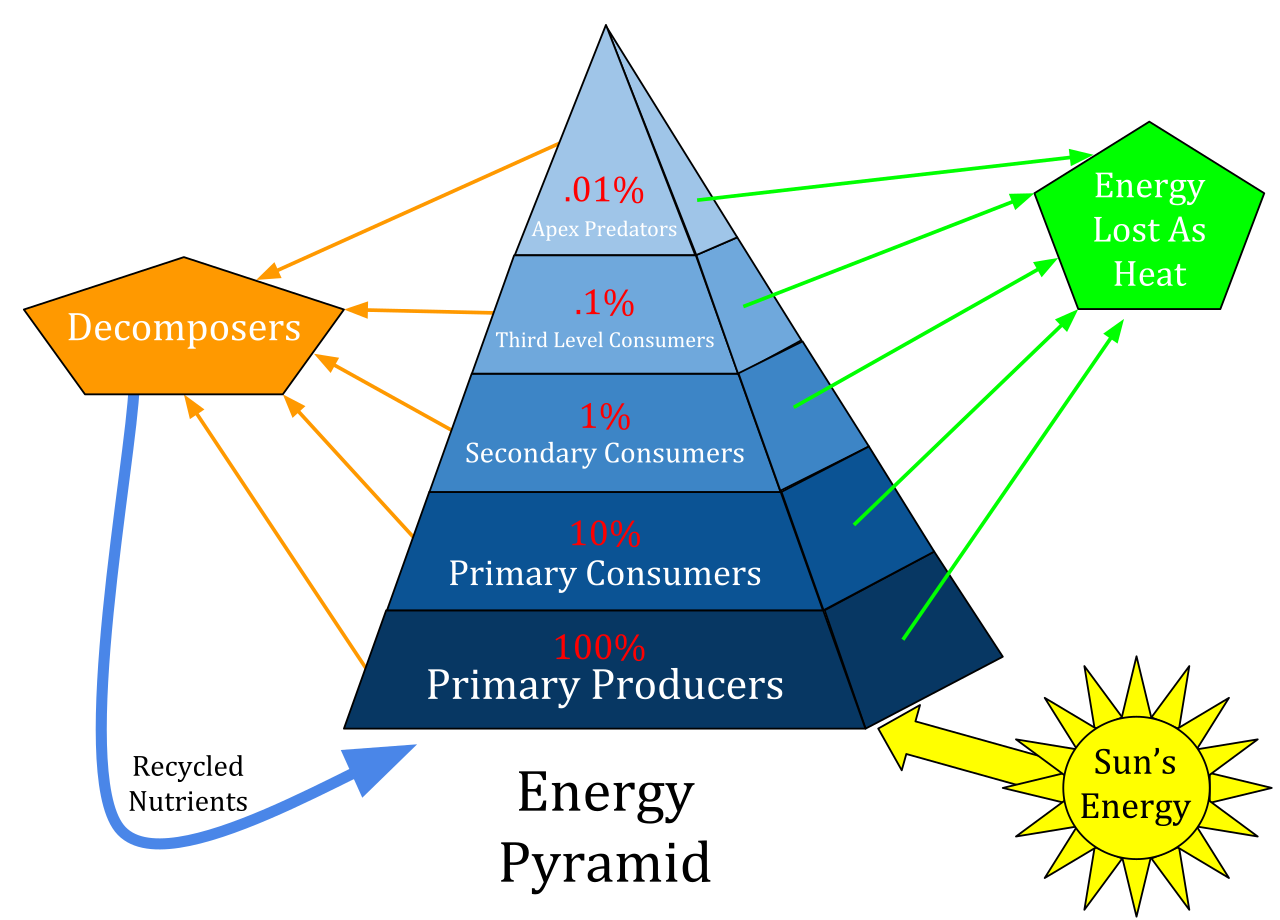
Pyramid of energy: only about 10% of the energy at each trophic level is passed on to the next (the 10% law), the rest being lost as heat, while decomposers recycle nutrients. Image: Swiggity.Swag.YOLO.Bro, CC BY-SA 4.0, via Wikimedia Commons.
Ecological Succession
- Ecological succession is the gradual and predictable change in the species composition of an area over time until a stable climax community (in equilibrium with the environment) is established
- Primary succession: begins on a bare area where no community existed before (e.g. bare rock, cooled lava, a newly formed pond); the first colonisers are the pioneer species (e.g. lichens on rock)
- Secondary succession: occurs where a community was lost but soil already exists (e.g. abandoned farmland, burnt or cleared land); it is much faster than primary succession
- Hydrarch succession: proceeds in wetter areas from hydric toward mesic (moderate) conditions; Xerarch succession: proceeds in dry areas from xeric toward mesic conditions - both converge on the mesic climax
- Succession leads to increasing species diversity, biomass and community complexity until the climax stage
🚀 NEET Advanced Edge
Why the energy pyramid is always upright but the biomass pyramid isn't always: Energy is progressively lost as heat at each trophic transfer (second law of thermodynamics), so total energy MUST decrease going up - there's no exception. Biomass, however, can invert in some aquatic ecosystems where producers (phytoplankton) have a much smaller standing biomass than the consumers they support at any given instant, because phytoplankton reproduce and get consumed so rapidly.
Why NPP, not GPP, is the figure that matters for food availability: GPP includes energy the plant itself burns in respiration - only NPP (GPP − respiration) is the energy actually stored as new biomass and available to be eaten by the next trophic level, making NPP the ecologically meaningful productivity figure.
Worked problem: A grassland fixes 20,000 kcal/m²/yr as GPP. If plant respiration consumes 4,000 kcal/m²/yr and the standard 10% law applies at each subsequent transfer, find the energy available to the tertiary consumer (3rd trophic level above producers). Approach: NPP = 20,000 − 4,000 = 16,000 kcal. Herbivore level: 16,000 × 10% = 1,600 kcal. Primary carnivore: 1,600 × 10% = 160 kcal. Secondary/tertiary carnivore: 160 × 10% = 16 kcal/m²/yr.
Structure and Function of an Ecosystem
- An ecosystem is a functional unit of nature where living organisms interact among themselves and with the surrounding physical environment.
- Its two basic aspects are structure (species composition and stratification) and function (energy flow and nutrient cycling).
- Vertical distribution of different species occupying different levels is called stratification; e.g., trees form the top layer, shrubs the middle, and herbs/grasses the bottom.
- Components are abiotic (climate, soil, inorganic nutrients) and biotic (producers, consumers, decomposers).
- Ecosystems may be natural (forest, grassland, desert, pond, lake) or man-made (crop fields, aquarium).
- Four key components in functioning: productivity, decomposition, energy flow, and nutrient cycling.
Nutrient Cycling: Carbon and Phosphorus Cycles
- Nutrient cycling (biogeochemical cycle) is the movement of nutrient elements through the biotic and abiotic components of an ecosystem.
- Cycles are of two types: gaseous (reservoir in atmosphere/hydrosphere, e.g., carbon, nitrogen) and sedimentary (reservoir in Earth's crust, e.g., phosphorus, sulphur).
- Carbon cycle: 71% of carbon is found dissolved in oceans; photosynthesis fixes atmospheric CO2 while respiration, decomposition, and burning of fossil fuels release it.
- Human activities like deforestation and burning of fossil fuels have significantly increased atmospheric CO2.
- Phosphorus cycle is sedimentary; the natural reservoir is rock phosphate. Unlike carbon, there is no respiratory release of phosphorus into the atmosphere.
- Weathering of rocks releases phosphate, absorbed by plants and passed to animals; decomposers return it to soil.
Ecosystem Services
- Ecosystem services are the products of ecosystem processes that benefit human beings.
- Examples include purifying air and water, mitigating floods and droughts, cycling nutrients, and pollinating crops.
- Healthy forest ecosystems provide oxygen, maintain wildlife, and preserve biodiversity.
- Robert Costanza and colleagues estimated the average price tag of nature's services at about US $33 trillion per year, nearly twice the global GNP at the time.
- Soil formation contributes about 50% of the total value of ecosystem services.
Sedimentation and Detritus Food Chain
- The detritus food chain (DFC) begins with dead organic matter (detritus) and is made up of decomposers (fungi and bacteria) that are also called saprotrophs.
- In a terrestrial ecosystem, a much larger fraction of energy flows through the detritus food chain than the grazing food chain.
- In an aquatic ecosystem, the grazing food chain (GFC) is the major conduit for energy flow.
- The two food chains are interconnected; organisms of the DFC may become prey for organisms of the GFC.
- Decomposers convert complex organic detritus into inorganic substances, releasing nutrients back to the environment.