🎯 Key Points
- rDNA technology core steps: cut gene + vector with the SAME restriction enzyme (so sticky ends match) → ligate → transform into host → select transformants
- PCR steps: Denaturation (DNA strands separate, ~94-96°C) → Annealing (primers bind, ~50-65°C) → Extension (Taq polymerase builds new strand, ~72°C); cycle repeats, doubling DNA each time
- Bt cotton: Cry protein from Bacillus thuringiensis is toxic ONLY when activated in the alkaline gut of insect larvae (harmless to humans, whose gut is acidic) - this pH-dependence is the key safety mechanism
- Blotting names by what's detected: Southern=DNA, Northern=RNA, Western=protein - a simple naming pattern worth memorising directly
- CRISPR-Cas9: guide RNA (gRNA) is complementary to the target DNA sequence and directs Cas9 nuclease to cut at that exact site - precision comes from base-pairing, not the enzyme itself
Tools of Biotechnology
- Restriction enzymes: cut DNA at specific palindromic sequences; create sticky ends or blunt ends
- DNA Ligase: joins DNA fragments; molecular glue
- Vectors: plasmids (Ti plasmid, pBR322) or viruses; carry foreign DNA into host
- PCR: amplifies DNA; needs DNA template, primers, Taq polymerase, dNTPs; 3 steps: denaturation → annealing → extension
Recombinant DNA Technology Steps
Recombinant DNA technology: a gene of interest and plasmid are cut by the same restriction enzyme, ligated into a recombinant plasmid, and introduced into a host cell.
- Isolate gene of interest
- Cut gene and vector with same restriction enzyme
- Ligate gene into vector (recombinant DNA)
- Introduce into host cell (transformation)
- Select transformants; express protein
Applications
- Medicine: insulin (E. coli), human growth hormone, interferons, hepatitis B vaccine, erythropoietin, gene therapy
- Agriculture: Bt crops (Cry proteins from Bacillus thuringiensis - insect resistant), Golden Rice (beta-carotene), herbicide-tolerant crops
- Forensics: DNA fingerprinting (VNTR/STR analysis); paternity testing, crime investigation
Modern Techniques
- CRISPR-Cas9: precise gene editing; guide RNA directs Cas9 nuclease to cut DNA
- Gel Electrophoresis: separates DNA by size in agarose gel under electric field
- Southern blotting: DNA detection; Northern: RNA; Western: protein
- ELISA: detects antigens/antibodies; used in HIV diagnosis, pregnancy tests
Principles of Biotechnology
- Biotechnology rests on two core techniques: genetic engineering (altering the chemistry of genetic material, DNA/RNA, to introduce it into a host and change its phenotype) and chemical engineering / bioprocess engineering (maintaining a sterile, contamination-free ambience to grow only the desired microbe or cell in large quantities for a useful product)
- Traditional breeding could not stop unwanted genes coming along; genetic engineering allows an isolated, desired gene to be introduced without accompanying genes, using rDNA technology, gene cloning and gene transfer
- The first recombinant DNA was constructed by Stanley Cohen and Herbert Boyer (1972) by linking an antibiotic-resistance gene into a plasmid of Salmonella typhimurium, showing a plasmid could act as a vector to multiply foreign DNA in a host
- A piece of DNA becomes able to multiply only if it is part of a replicon (a sequence with an origin of replication); a vector supplies this origin
Restriction Enzymes: Nomenclature and Action
- Restriction endonucleases are the "molecular scissors" of rDNA technology; they recognise and cut DNA at specific sequences within its length, unlike exonucleases which remove nucleotides from the ends
- Naming example: in EcoRI, "E" = genus Escherichia, "co" = species coli, "R" = strain RY13, and "I" = the order (first) in which it was isolated from that bacterium
- Each enzyme inspects DNA and binds a specific palindromic sequence - a base sequence that reads the same on both strands in the 5'→3' direction (e.g. GAATTC / CTTAAG)
- By cutting the two strands a little away from the centre between the same bases on opposite strands, they leave single-stranded overhangs called sticky ends, which form hydrogen bonds with complementary ends and are sealed by DNA ligase
Cloning Vectors and Their Features
- Origin of replication (ori): the sequence from which replication starts; it also controls copy number of the linked DNA
- Selectable marker: a gene (usually for antibiotic resistance, e.g. ampicillin/tetracycline resistance in pBR322) that helps identify and eliminate non-transformants, keeping only cells that took up the vector
- Cloning sites: recognition sites for restriction enzymes where foreign DNA is inserted
- Insertional inactivation: if foreign DNA is inserted within a marker gene (e.g. within the tetracycline-resistance gene of pBR322, or the lacZ gene), that gene is inactivated, allowing recombinants to be told apart from non-recombinants; the lacZ system uses blue-white colony selection (recombinants stay white)
- Vectors for plants and animals: the Agrobacterium tumefaciens Ti plasmid (disarmed of its tumour-causing genes) and retroviruses are used as natural gene-delivery vectors
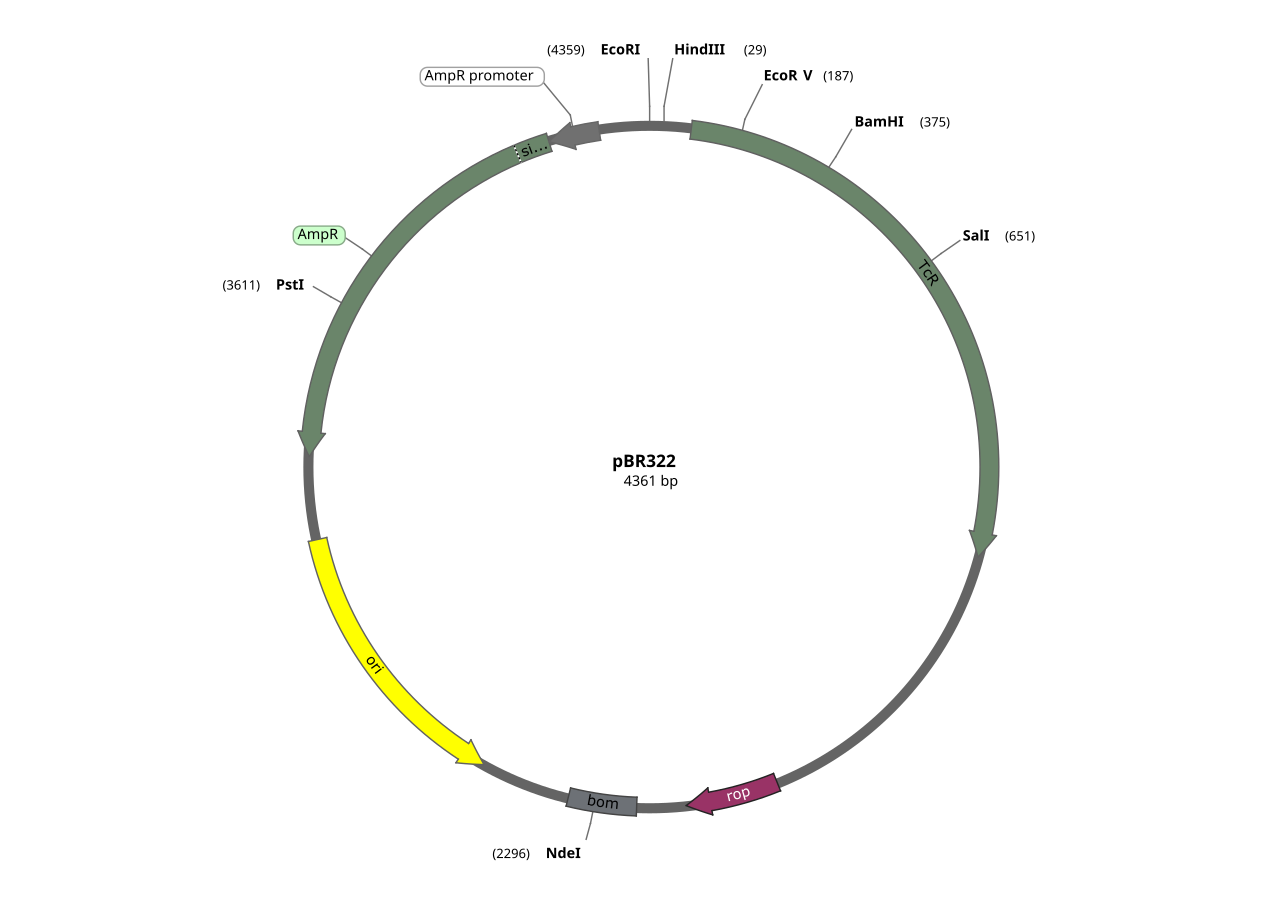
The cloning vector pBR322, showing its two selectable markers (AmpR and TcR), the origin of replication (ori) and the single restriction sites used to insert foreign DNA. Image: Rob Hurt, CC BY-SA 4.0, via Wikimedia Commons.
Competent Host and Introducing rDNA
- DNA is hydrophilic and cannot pass through the cell membrane, so the host must first be made competent to take up DNA
- Chemical method: treating bacteria with a specific divalent cation such as calcium (CaCl₂) increases membrane pore efficiency, then a brief heat shock (42 °C) followed by cooling forces the recombinant DNA in
- Micro-injection: recombinant DNA is directly injected into the nucleus of an animal cell
- Biolistics / gene gun: cells are bombarded with high-velocity micro-particles of gold or tungsten coated with DNA (used mainly for plant cells)
- Disarmed pathogen vectors: a modified, non-pathogenic vector (like the Ti plasmid) delivers the DNA when it infects the host cell
Bioreactors and Downstream Processing
- A bioreactor provides the optimal conditions (temperature, pH, substrate, salts, vitamins, oxygen) to convert raw materials into useful products by cells/enzymes, and can process large volumes (100–1000 litres)
- Stirred-tank reactor: usually cylindrical or with a curved base; an agitator mixes the contents and ensures uniform oxygen availability; it also has an oxygen delivery/sparging system, a foam control system, and temperature and pH control systems, plus sampling ports
- Sparged stirred-tank reactor: air is bubbled (sparged) through to increase the oxygen transfer surface
- Downstream processing: after the product is formed it is subjected to separation and purification, then a suitable preservative may be added (formulation); the product must pass thorough clinical trials and quality control before it is marketed
🚀 NEET Advanced Edge
Why the SAME restriction enzyme must cut both vector and gene of interest: A given restriction enzyme always produces the same overhang sequence at its cut site, so cutting both the plasmid and the foreign gene with the identical enzyme guarantees their sticky ends are complementary and can be sealed by DNA ligase - using two different enzymes would produce incompatible ends that cannot be ligated.
Why PCR needs a heat-stable polymerase specifically: Each cycle requires heating to ~94-96°C to separate the DNA strands, which would denature (destroy) a normal polymerase - Taq polymerase, isolated from the thermophilic bacterium Thermus aquaticus (found in hot springs), survives these repeated heating cycles, which is precisely why it (and not a standard enzyme) made PCR practical.
Worked reasoning: Starting with a single DNA template molecule, how many copies exist after 5 complete PCR cycles (assuming each cycle exactly doubles the DNA)? Approach: Copies = 2ⁿ where n = number of cycles = 2⁵ = 32 copies.
Isolation of Genetic Material (DNA)
- To cut DNA with restriction enzymes, it must first be in pure form, free from other macromolecules.
- Cells are broken open by treating with enzymes: lysozyme for bacteria, cellulase for plant cells, and chitinase for fungal cells.
- RNA is removed by ribonuclease and proteins by protease.
- Purified DNA precipitates out as fine threads on the addition of chilled ethanol.
- The precipitated DNA can be seen as a collection of fine threads in the suspension.
Separation and Isolation of DNA Fragments
- DNA fragments cut by restriction enzymes are separated by gel electrophoresis.
- Since DNA is negatively charged, fragments move towards the anode (positive electrode) through a medium/matrix of agarose (a natural polymer from sea weeds).
- Fragments separate according to size: smaller fragments move farther.
- Separated DNA is stained with the dye ethidium bromide and visualised as bright orange bands under UV radiation.
- The separated bands are cut out and extracted from the gel in a process called elution.
Amplification of Gene of Interest using PCR
- PCR (Polymerase Chain Reaction) synthesises multiple copies of the gene of interest in vitro using two sets of primers and the enzyme DNA polymerase.
- It has three repeated steps: denaturation (separating DNA strands by heat), annealing (primers bind), and extension (polymerase extends the primers).
- A thermostable DNA polymerase (Taq polymerase), isolated from Thermus aquaticus, is used because it remains active during high-temperature denaturation.
- The amplified fragment, if desired, can then be used to ligate with a vector for cloning.
- Repeated cycles amplify the segment almost a billion times.

The polymerase chain reaction (PCR): each cycle of denaturation (strands separate), annealing (primers bind) and extension (Taq polymerase builds new strands) doubles the DNA, amplifying it exponentially. Image: Enzoklop, CC BY-SA 3.0, via Wikimedia Commons.
Insertion of rDNA into Host and Obtaining the Product
- Recombinant DNA is introduced into a host cell that has been made competent to take up DNA.
- Methods to force DNA into cells include micro-injection (into the nucleus) and the gene gun / biolistics method (bombarding cells with gold or tungsten particles coated with DNA).
- Disarmed pathogen vectors, when allowed to infect the cell, transfer the recombinant DNA into the host.
- After cloning, cultures are used to extract the desired protein; scaling up is done in bioreactors.
- Downstream processing includes separation, purification, formulation with preservatives, and clinical trials/quality control before the product is marketed.