⚛️ Physics · Class 12 · NEET & JEE
Atoms - Practice Questions with Answers
83 free MCQs on Atoms, each with its own worked answer and explanation. Thomson's plum-pudding model, Rutherford's nuclear model from alpha-scattering, Bohr's postulates and hydrogen spectrum, spectral series (Lyman to Pfund), Rydberg formula, and limitations of each model.
Take the timed Atoms chapterwise test →83 practice questions on Atoms, sorted Easy → Hard. Try each one first, then open its answer page for the worked explanation. Want the full theory first? Read the Atoms notes.
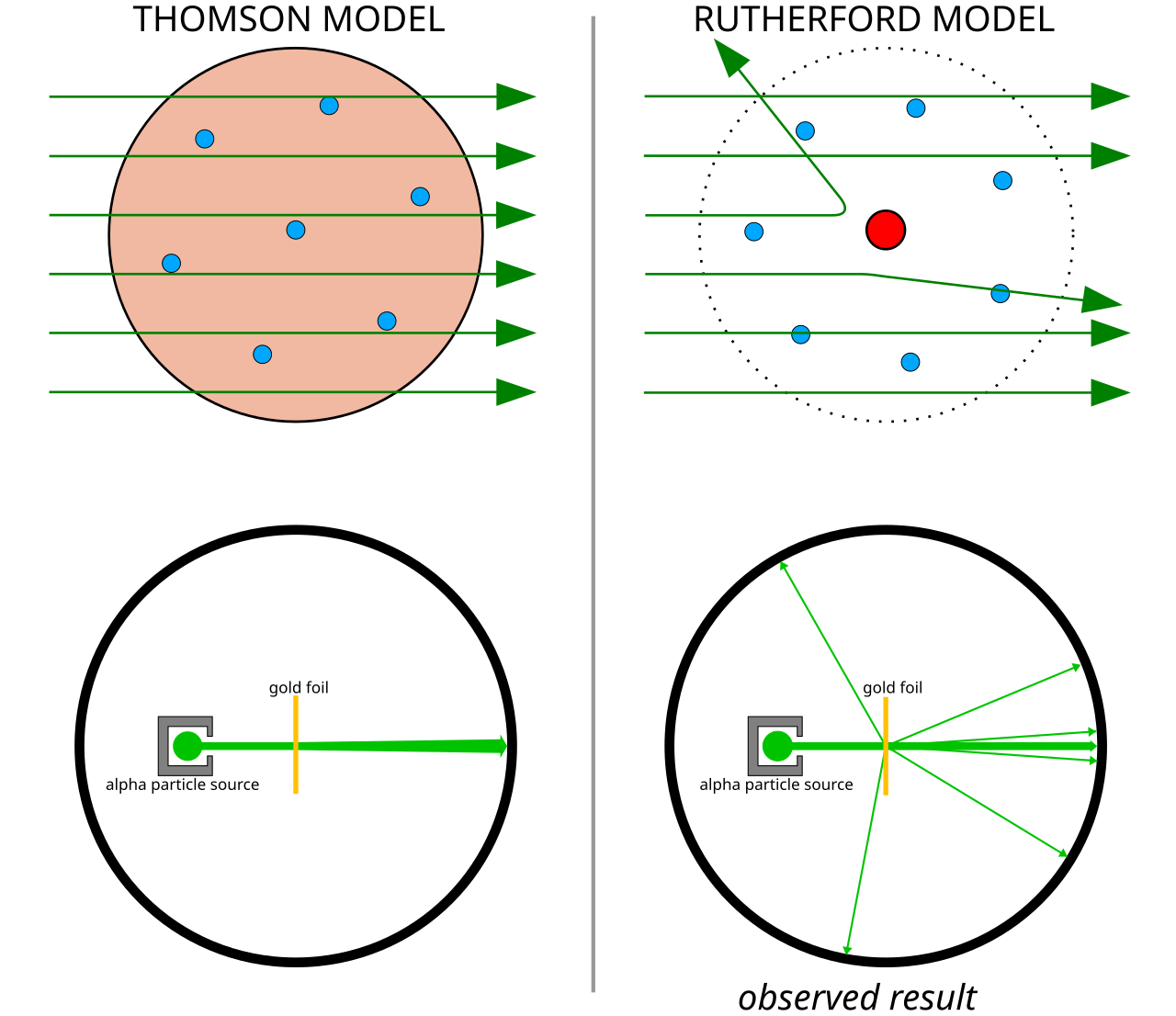
The Geiger–Marsden alpha-scattering result: a few alpha particles bounce back at large angles, which rules out Thomson’s diffuse model and demands a tiny, massive, positively charged nucleus. Image: Kurzon, CC BY 3.0, via Wikimedia Commons.
Easy - 25 questions
Q1.
In Rutherford scattering, an alpha particle directed almost head-on toward the nucleus experiences its largest deflection because:
- A The repulsive force acts along its initial path
- B The nucleus has no electric charge
- C The electron cloud attracts it strongly
- D The atom has a uniform charge distribution
Show answer & explanation →
Q2.
For an electron in the nth Bohr orbit of hydrogen, how does its orbital period T vary with n?
- A T is proportional to n
- B T is proportional to n<sup>3</sup>
- C T is proportional to n<sup>2</sup>
- D T is proportional to 1/n
Show answer & explanation →
Q3.
What minimum energy must a hydrogen atom in its ground state absorb to reach the n = 2 state?
- A 3.40 eV
- B 12.09 eV
- C 10.20 eV
- D 13.60 eV
Show answer & explanation →
Q4.
In the Bohr model, which quantity of the electron remains fixed for a particular stationary orbit?
- A Its kinetic energy for all orbits
- B Its speed for all orbits
- C Its distance from the nucleus for all orbits
- D Its angular momentum for that orbit
Show answer & explanation →
Q5.
A hydrogen atom in the n = ∞ state represents:
- A An ionised hydrogen atom
- B An electron in the ground state
- C A fully bound excited atom
- D An electron at the nucleus
Show answer & explanation →
Q6.
Energy of hydrogen electron in nth orbit:
- A -13.6 n<sup>2</sup> eV
- B -13.6/n eV
- C -13.6/n<sup>2</sup> eV
- D +13.6/n<sup>2</sup> eV
Show answer & explanation →
Q8.
Rutherford's gold foil experiment showed that:
- A Atoms are mostly empty with a tiny dense nucleus
- B Electrons are embedded in uniform positive charge
- C Nucleus contains only neutrons
- D Atoms have no empty space
Show answer & explanation →
Q9.
Heisenberg's uncertainty principle states that:
- A Energy and time cannot both be known to arbitrary precision simultaneously
- B Position and momentum cannot both be known precisely
- C Velocity of a particle can never be measured by any method
- D The mass and charge of a particle are inherently uncertain quantities
Show answer & explanation →
Q11.
Lyman series of hydrogen spectrum lies in the:
- A Visible region
- B Infrared region
- C Ultraviolet region
- D X-ray region
Show answer & explanation →
Q12.
X-rays are produced when:
- A Slow electrons gently strike a metal target at low speed
- B Fast electrons suddenly decelerate hitting a metal target
- C Protons are accelerated and strike a heavy metal target
- D Ultraviolet light is incident on a metal surface
Show answer & explanation →
Q13.
The tiny, dense, positively charged core of an atom is the:
- A nucleus
- B electron
- C proton cloud
- D outer shell
Show answer & explanation →
Q14.
In an atom, electrons revolve around the nucleus in:
- A orbits
- B straight lines
- C random scatter
- D the nucleus itself
Show answer & explanation →
Q15.
The model in which electrons move in fixed circular orbits was proposed by:
- A Niels Bohr
- B John Dalton
- C J. J. Thomson
- D Isaac Newton
Show answer & explanation →
Q18.
Rutherford’s alpha-particle scattering experiment led to the discovery of the:
- A nucleus
- B electron
- C neutron
- D photon
Show answer & explanation →
Q24.
The emission spectrum of hydrogen consists of discrete:
- A lines
- B continuous bands
- C colours only
- D smooth regions
Show answer & explanation →
Medium - 25 questions
Q26.
A hydrogen atom in its ground state absorbs a photon of energy 12.09 eV. To which principal quantum number does the electron move?
- A n = 2
- B n = 3
- C n = 4
- D n = 5
Show answer & explanation →
Q27.
A hydrogen-like He<sup>+</sup> ion undergoes a transition from n = 2 to n = 1. Using R = 1.097 × 10<sup>7</sup> m<sup>-1</sup>, what is the approximate wavelength of the emitted radiation?
- A 121.6 nm
- B 91.2 nm
- C 30.4 nm
- D 243.0 nm
Show answer & explanation →
Q28.
The orbital period of an electron in the first Bohr orbit of hydrogen is 1.52 × 10<sup>-16</sup> s. What is its orbital period in the n = 3 orbit?
- A 4.56 × 10<sup>-16</sup> s
- B 1.37 × 10<sup>-15</sup> s
- C 9.12 × 10<sup>-15</sup> s
- D 4.10 × 10<sup>-15</sup> s
Show answer & explanation →
Q29.
An alpha particle of kinetic energy 5.0 MeV approaches a gold nucleus head-on. Taking Z = 79 and e<sup>2</sup>/(4πε<sub>0</sub>) = 1.44 MeV fm, what is the distance of closest approach?
- A 45.5 fm
- B 22.8 fm
- C 91.0 fm
- D 114 fm
Show answer & explanation →
Q30.
A hydrogen atom emits radiation when an electron falls from n = 4 to n = 2. What is the energy of the emitted photon?
- A 1.51 eV
- B 2.55 eV
- C 3.40 eV
- D 10.20 eV
Show answer & explanation →
Q32.
The energy levels of hydrogen-like atoms (atomic number Z):
- A En = -13.6 Z/n eV
- B En = -13.6 Z²/n² eV
- C En = -13.6 n/Z eV
- D En = -13.6/nZ eV
Show answer & explanation →
Q34.
Wave nature of electrons was confirmed by:
- A The photoelectric effect, which instead confirmed the particle nature of light
- B Davisson-Germer electron diffraction experiment
- C Rutherford alpha-particle scattering off thin gold foil
- D Thomson's experiment measuring the electron's charge-to-mass ratio
Show answer & explanation →
Q36.
Electron in orbit has:
- A Zero angular momentum
- B Angular momentum = nh/2π
- C Angular momentum = h/2π only
- D Any value of angular momentum
Show answer & explanation →
Q37.
In Bohr’s model, the angular momentum of an orbiting electron is quantised in units of:
- A h/2π
- B h itself
- C 2πh
- D h squared
Show answer & explanation →
Q39.
Using E<sub>n</sub> = −13.6/n² eV, the ground-state (n = 1) energy of hydrogen is:
- A −13.6 eV
- B −3.4 eV
- C 0 eV
- D +13.6 eV
Show answer & explanation →
Q41.
As n increases, the energy levels of hydrogen become:
- A closer together
- B farther apart
- C exactly equal
- D negatively infinite
Show answer & explanation →
Q42.
The Balmer series of the hydrogen spectrum lies in the ___ region:
- A visible
- B ultraviolet
- C infrared
- D microwave
Show answer & explanation →
Q43.
The Lyman series of the hydrogen spectrum lies in the ___ region:
- A ultraviolet
- B the visible
- C the infrared
- D the radio
Show answer & explanation →
Q44.
The Paschen series of the hydrogen spectrum lies in the ___ region:
- A infrared
- B visible
- C ultraviolet
- D X-ray
Show answer & explanation →
Q45.
The energy needed to remove the electron from the ground state of hydrogen (its ionisation energy) is:
- A 13.6 eV
- B 3.4 eV
- C 1.51 eV
- D 0 eV
Show answer & explanation →
Q47.
According to Bohr, an electron in a stationary orbit does not ___ energy:
- A radiate
- B ever have
- C ever gain
- D ever carry
Show answer & explanation →
Q49.
In hydrogen, the transition from n = 3 to n = 2 produces a line in the ___ series:
- A Balmer
- B Lyman
- C Paschen
- D Brackett
Show answer & explanation →
Q50.
The number of neutrons in a nucleus equals the mass number minus the:
- A atomic number
- B electron count
- C photon count
- D neutron count
Show answer & explanation →
Hard - 33 questions
Q51.
A hydrogen atom in the n = 3 state is just ionised by absorbing a photon. What is the approximate wavelength of this photon? Take h = 6.6 × 10<sup>-34</sup> J s and c = 3 × 10<sup>8</sup> m s<sup>-1</sup>.
- A 410 nm
- B 656 nm
- C 820 nm
- D 1216 nm
Show answer & explanation →
Q52.
For hydrogen, compare the photon frequencies produced by transitions n = 6 to n = 2 and n = 3 to n = 2. What is the ratio ν<sub>6→2</sub>/ν<sub>3→2</sub>?
Show answer & explanation →
Q53.
The de Broglie wavelength of an electron in the third Bohr orbit of hydrogen is approximately what value? Take the Bohr radius a<sub>0</sub> = 0.529 × 10<sup>-10</sup> m.
- A 9.97 × 10<sup>-10</sup> m
- B 6.28 × 10<sup>-10</sup> m
- C 3.32 × 10<sup>-10</sup> m
- D 1.59 × 10<sup>-9</sup> m
Show answer & explanation →
Q54.
The speed of an electron in the n = 3 orbit of He<sup>+</sup> is compared with that of an electron in the n = 2 orbit of hydrogen. What is the ratio v<sub>He+</sub>/v<sub>H</sub>?
Show answer & explanation →
Q55.
An electron in hydrogen is initially in the n = 2 state. It absorbs a photon of energy 2.856 eV. Which final state is reached?
- A n = 3
- B n = 4
- C n = 5
- D n = 6
Show answer & explanation →
Q56.
De Broglie wavelength of a thermal neutron at temperature T:
- A h/sqrt(2mKT)
- B h/sqrt(mkT)
- C h/sqrt(3mkT)
- D h × sqrt(2mkT)
Show answer & explanation →
Q57.
Rydberg formula for hydrogen: 1/lambda = R(1/n<sub>1</sub>² - 1/n<sub>2</sub>²). Rydberg constant R =
- A 1.097 × 10⁷ m⁻¹
- B 1.097 × 10⁻⁷ m
- C 6.626 × 10⁻³⁴ J·s
- D 3 × 10⁸ m/s
Show answer & explanation →
Q58.
Bohr radius a₀ in terms of fundamental constants:
- A hbar/(m<sub>e</sub> c)
- B 4pi eps<sub>0</sub> hbar²/(m<sub>e</sub> e²)
- C e²/(m<sub>e</sub> c²)
- D m<sub>e</sub> e²/(4pi eps<sub>0</sub> hbar²)
Show answer & explanation →
Q59.
Quantization of angular momentum in Bohr model arises from:
- A Classical mechanics alone, with little quantum assumption needed
- B De Broglie standing wave condition: n lambda = 2 pi r
- C Conservation of energy alone, with little wave condition imposed
- D Coulomb force balance between the electron and the nucleus alone
Show answer & explanation →
Q60.
Zeeman effect is the splitting of spectral lines in:
- A Electric field
- B Magnetic field
- C Pressure
- D Temperature
Show answer & explanation →
Q62.
In Rutherford scattering, the impact parameter b for deflection by angle theta:
- A b = Z e²/(4pi eps<sub>0</sub> × 2E) × cot(theta/2)
- B b = h/(mv), the de Broglie wavelength formula for the alpha particle
- C b = a₀/n², the Bohr radius formula for an atomic orbit
- D b = r/theta, a simple ratio with no dependence on charge or energy
Show answer & explanation →
Q63.
Fine structure of hydrogen spectral lines arises from:
- A The recoiling motion of the atomic nucleus during emission as frequently observed in practice
- B Spin-orbit coupling (interaction of electron spin with orbital magnetic field)
- C Ordinary Zeeman splitting from an externally applied magnetic field in many documented cases
- D The gravitational attraction between the electron and the nucleus according to conventional understanding
Show answer & explanation →
Q64.
The de Broglie wavelength of a 1 kg ball moving at 1 m/s is negligible because:
- A Planck's constant is actually a very large number in SI units in routine practice overall
- B Planck constant h = 6.63×10⁻³⁴ J·s is extremely small making lambda = h/mv = 6.63×10⁻³⁴ m
- C The mass of one kilogram is itself enormously large on an atomic scale in most cases
- D The velocity of one metre per second is unusually small for this formula under typical conditions
Show answer & explanation →
Q66.
The line emitted in the n = 2 to n = 1 transition of hydrogen lies in the ___ region:
- A ultraviolet
- B the visible
- C the infrared
- D the radio
Show answer & explanation →
Q68.
In the Rydberg formula 1/λ = R(1/n₁² − 1/n₂²), the constant R is the ___ constant:
- A Rydberg
- B Planck
- C Boltzmann
- D gravitational
Show answer & explanation →
Q69.
The kinetic energy of the electron in a hydrogen atom is ___ the magnitude of its total energy:
- A equal to
- B half of
- C double
- D one third of
Show answer & explanation →
Q70.
The potential energy of the electron in a hydrogen atom is ___ its total energy:
- A twice its value, negative
- B half of its value
- C equal to its value
- D one third of its value
Show answer & explanation →
Q72.
The frequency of the radiation emitted by an atom is proportional to the ___ between the two levels:
- A energy difference
- B physical distance
- C time interval
- D mass difference
Show answer & explanation →
Q73.
A key limitation of Bohr’s model is that it fails to explain the spectra of ___ atoms:
- A multi-electron
- B hydrogen
- C single-electron
- D one-electron ion
Show answer & explanation →
Q74.
The angular momentum of the electron in the ground state of hydrogen (n = 1) is:
- A h/2π
- B h itself
- C exactly zero
- D 2h
Show answer & explanation →
Q75.
The de Broglie explanation of Bohr’s quantisation requires the orbit circumference to hold a whole number of ___ wavelengths:
- A electron (de Broglie)
- B the photon type
- C the visible-light type
- D the sound-wave type
Show answer & explanation →
Q76.
In the Bohr model of hydrogen, the radius of the n = 2 orbit (Bohr radius 0.53 Å) is:
- A 0.26 Å
- B 1.06 Å
- C 2.12 Å
- D 0.53 Å
Show answer & explanation →
Q77.
The energy of the electron in the n = 2 level of hydrogen (E₁ = −13.6 eV) is:
- A −13.6 eV
- B −6.8 eV
- C −3.4 eV
- D −1.51 eV
Show answer & explanation →
Q80.
In the Bohr model, the speed of the electron is inversely proportional to n. In the n = 2 orbit the speed is:
- A half that of the ground state
- B double that of the ground state
- C one quarter of the ground state
- D the same as the ground state
Show answer & explanation →
Q81.
The Balmer series of the hydrogen spectrum lies mainly in the:
- A visible region
- B ultraviolet region
- C infrared region
- D X-ray region
Show answer & explanation →
Q83.
The shortest wavelength (series limit) of the Lyman series of hydrogen (1/R ≈ 91.2 nm) is:
- A 91.2 nm
- B 121.6 nm
- C 365 nm
- D 656 nm
Show answer & explanation →