🔬 Biology · Class 11 · NEET
Cell: The Unit of Life - Practice Questions with Answers
75 free MCQs on Cell: The Unit of Life, each with its own worked answer and explanation. Cell theory, prokaryotic vs eukaryotic cells, organelles and their functions. Foundation of all biology.
Take the timed Cell: The Unit of Life chapterwise test →75 practice questions on Cell: The Unit of Life, sorted Easy → Hard. Try each one first, then open its answer page for the worked explanation. Want the full theory first? Read the Cell: The Unit of Life notes.
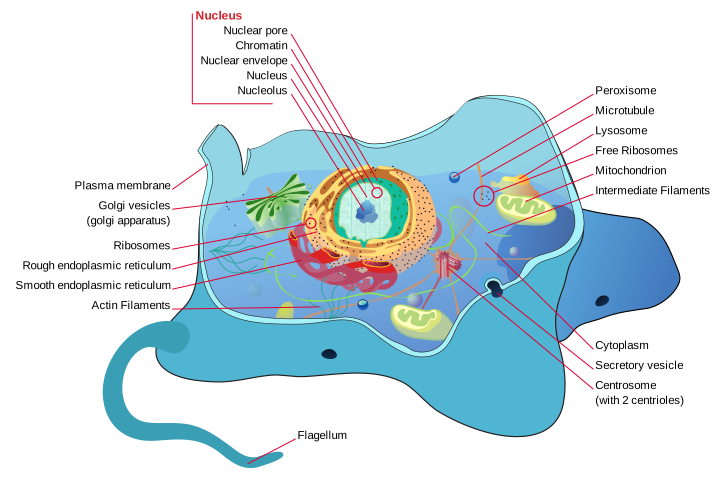
Animal cell structure with major organelles labeled. Image: LadyofHats (Mariana Ruiz), Public Domain, via Wikimedia Commons.
Easy - 25 questions
Q1.
Who first observed and coined the term 'cell'?
- A Robert Brown
- B Robert Hooke
- C Theodor Schwann
- D J.E. Purkinje
Show answer & explanation →
Q3.
The genetic material in a bacterial cell lies in a region called the:
- A Nucleus
- B Nucleolus
- C Nucleoid
- D Vacuole
Show answer & explanation →
Q4.
The jelly-like fluid that fills the cell and holds the organelles is the:
- A Nucleoplasm
- B Stroma
- C Matrix
- D Cytoplasm
Show answer & explanation →
Q6.
Who proposed the cell theory?
- A Hooke and Darwin
- B Schleiden and Schwann
- C Mendel and Morgan
- D Watson and Crick
Show answer & explanation →
Q10.
Which organelle is called the post office of the cell?
- A Ribosome
- B Nucleus
- C Golgi apparatus
- D Mitochondria
Show answer & explanation →
Q11.
The fluid mosaic model describes the structure of:
- A Cell wall
- B Plasma membrane
- C Nuclear membrane
- D Endoplasmic reticulum
Show answer & explanation →
Q12.
Lysosomes are called the suicide bags because:
- A They engulf and destroy invading bacteria through phagocytic digestion
- B Their enzymes can destroy the cell if released
- C They store a small circular loop of extranuclear genetic material
- D They synthesize and secrete cytotoxic compounds into the cytoplasm
Show answer & explanation →
Q14.
Chloroplasts are found in:
- A All cells, including bacteria and fungi
- B Only animal cells and never in plants
- C Only plant cells and algae
- D Only certain photosynthetic bacteria species
Show answer & explanation →
Q16.
Osmosis is the movement of water from:
- A Regions of higher solute concentration toward regions of lower solute concentration
- B Lower solute to higher solute concentration (i.e., across semi-permeable membrane)
- C Any arbitrary region of the cell to any neighboring region without restriction
- D Regions of high hydrostatic pressure to regions of low pressure exclusively
Show answer & explanation →
Q17.
Which organelle contains digestive enzymes in animal cells?
- A Ribosome
- B Lysosome
- C Golgi apparatus
- D Vacuole
Show answer & explanation →
Q19.
Plasmolysis occurs when a plant cell is placed in:
- A Hypotonic solution
- B Isotonic solution
- C Hypertonic solution
- D Distilled water
Show answer & explanation →
Q22.
Which of these organelles is NOT found in animal cells?
- A Mitochondria
- B Ribosome
- C Chloroplast
- D Golgi body
Show answer & explanation →
Q23.
The nuclear membrane is present in:
- A Prokaryotes only
- B Eukaryotes only
- C Both prokaryotes and eukaryotes
- D Neither
Show answer & explanation →
Medium - 25 questions
Q26.
'Omnis cellula e cellula' - that new cells arise from pre-existing cells - was given by:
- A Rudolf Virchow
- B M.J. Schleiden
- C Theodor Schwann
- D Gregor Mendel
Show answer & explanation →
Q27.
The two semi-autonomous organelles of a cell are:
- A Nucleus and the ribosome
- B Golgi body and the lysosome
- C Mitochondria and chloroplast
- D Vacuole and the peroxisome
Show answer & explanation →
Q28.
In the ribosome names 70S and 80S, 'S' stands for:
- A Its size in nanometres
- B Svedberg sedimentation unit
- C The number of subunits
- D Its total surface area
Show answer & explanation →
Q29.
Which organelle is most abundant in cells actively secreting proteins?
- A Smooth ER
- B Peroxisome
- C Lysosome
- D Rough ER
Show answer & explanation →
Q30.
The middle lamella that cements adjacent plant cells is made mainly of:
- A Calcium pectate
- B Cellulose
- C Lignin
- D Chitin
Show answer & explanation →
Q31.
Which theory best explains the origin of mitochondria and chloroplasts?
- A Cell theory
- B Endosymbiont theory
- C Germ theory
- D Fluid mosaic model
Show answer & explanation →
Q32.
The process by which cells engulf foreign particles is called:
- A Pinocytosis
- B Exocytosis
- C Phagocytosis
- D Osmosis
Show answer & explanation →
Q33.
Centrioles are involved in:
- A Translating mRNA into polypeptide chains at the ribosome
- B Formation of spindle fibers in cell division
- C Capturing light energy to drive carbon fixation reactions
- D Assembling fatty acid chains into membrane phospholipids
Show answer & explanation →
Q34.
The nucleolus is responsible for:
- A Unwinding and duplicating the chromosomal DNA double helix
- B Translating mRNA transcripts into completed polypeptide chains
- C rRNA synthesis and ribosome assembly
- D Coordinating chromosome segregation during mitotic division
Show answer & explanation →
Q35.
Active transport requires:
- A A concentration gradient mainly
- B No energy
- C ATP (energy) and carrier proteins
- D Mainly a semi-permeable membrane
Show answer & explanation →
Q37.
Turgor pressure in plant cells is generated by:
- A Active transport of ions across the plasma membrane
- B Entry of water into vacuole by osmosis
- C Cell wall rigidity resisting outward expansion
- D ATP hydrolysis powering membrane pumps
Show answer & explanation →
Q38.
Na+/K+ pump is an example of:
- A Passive transport
- B Active transport (primary)
- C Simple diffusion
- D Facilitated diffusion
Show answer & explanation →
Q39.
Peroxisomes function in:
- A Generating ATP through oxidative phosphorylation across an inner membrane
- B Assembling amino acids into polypeptides at membrane-bound ribosomes
- C Breaking down hydrogen peroxide (catalase enzyme)
- D Packaging and modifying lipids for export via the Golgi apparatus
Show answer & explanation →
Q40.
The unit membrane model proposes that all membranes have a:
- A Single phospholipid layer
- B Protein-lipid-protein trilayer
- C Fluid mosaic of lipids and proteins
- D Only protein layer
Show answer & explanation →
Q42.
Plasmodesmata are:
- A Pores in plant cell wall connecting adjacent cells
- B Pores in nuclear membrane regulating mRNA export to the cytoplasm
- C Gap junction channels formed in the membranes of adjacent animal cells
- D Membrane bridges linking mitochondria for direct exchange of matrix contents
Show answer & explanation →
Q43.
The Fluid Mosaic Model was proposed by:
- A Hooke
- B Watson and Crick
- C Singer and Nicolson
- D Schleiden and Schwann
Show answer & explanation →
Q45.
Which cell structure maintains osmotic balance in Amoeba?
- A Mitochondria
- B Contractile vacuole
- C Ribosome
- D Nucleus
Show answer & explanation →
Q47.
Gap junctions in animal cells are analogous to plant:
- A Tight junctions
- B Plasmodesmata
- C Cell walls
- D Desmosomes
Show answer & explanation →
Q50.
Pinocytosis differs from phagocytosis in that:
- A It uses ATP to power vesicle formation
- B It involves engulfing liquids, not solids
- C It occurs mainly in plant and fungal cells
- D It moves material outward, out of the cell
Show answer & explanation →
Hard - 25 questions
Q51.
Peripheral membrane proteins differ from integral proteins in that they:
- A Span the whole lipid bilayer
- B Are permanently embedded in it
- C Form channels for transport
- D Are loosely bound to the surface
Show answer & explanation →
Q52.
Which observation best supports the endosymbiotic origin of mitochondria?
- A They are bound by a single membrane
- B They completely lack their own DNA
- C They have 70S ribosomes and circular DNA
- D They are found only in plant cells
Show answer & explanation →
Q53.
Cytoplasmic streaming (cyclosis) refers to:
- A Movement of chromosomes in mitosis
- B The streaming of cytoplasm within a cell
- C Exchange of gases across the membrane
- D Breakdown of glucose for energy
Show answer & explanation →
Q54.
The bacterial nucleoid differs from a eukaryotic chromosome because it:
- A Is a linear, tightly coiled DNA
- B Is enclosed by a nuclear membrane
- C Is circular DNA without histones
- D Is split among many chromosomes
Show answer & explanation →
Q55.
A polyribosome (polysome) is:
- A Several ribosomes translating one mRNA
- B A single ribosome carrying extra rRNA
- C A broken ribosome that cannot function
- D A ribosome permanently bound to the nucleus
Show answer & explanation →
Q56.
The Z-scheme in photosynthesis describes:
- A The sequential transfer of electrons along the mitochondrial respiratory chain
- B Cyclic electron flow restricted entirely to Photosystem I alone
- C Non-cyclic electron transport in light reactions
- D The semi-conservative copying of the genome prior to cell division
Show answer & explanation →
Q57.
Transmembrane proteins in the fluid mosaic model span:
- A Only the outer leaflet
- B Only the inner leaflet
- C Both phospholipid layers completely
- D Between the cell wall and membrane
Show answer & explanation →
Q58.
KDEL sequence on a protein indicates it should be:
- A Secreted out of cell
- B Targeted to lysosomes
- C Retained in the ER lumen
- D Sent to mitochondria
Show answer & explanation →
Q60.
The signal hypothesis (Blobel) explains how:
- A Nuclear proteins enter the nucleus through pores
- B Secretory proteins are directed to the rough ER
- C Mitochondrial proteins are imported through TOM complexes
- D All organelle proteins are targeted using one universal signal
Show answer & explanation →
Q61.
Autophagy is the process of:
- A Equal partitioning of cytoplasm and organelles between two daughter cells
- B Self-digestion of organelles by lysosomes
- C Unwinding and copying of the genome ahead of mitotic division
- D Secretion of newly synthesized proteins out of the cell via vesicle fusion
Show answer & explanation →
Q62.
The voltage across cell membrane (resting potential) is maintained by:
- A ATP hydrolysis alone, independent of any ion movement across the membrane
- B Na+/K+ ATPase pump and selective ion permeability
- C Voltage-gated calcium channels opening transiently during depolarization
- D Passive protein channels alone, without any active pumping mechanism
Show answer & explanation →
Q63.
Matrix of the mitochondria contains:
- A The cytochrome electron transport chain embedded along the cristae membrane
- B Krebs cycle enzymes, mitochondrial DNA, and ribosomes
- C Free water with no dissolved enzymes or genetic material whatsoever
- D ATP synthase complexes alone, projecting from the inner membrane surface
Show answer & explanation →
Q64.
Glycosylation of proteins occurs in the:
- A Nucleus, where transcription factors are modified before translation
- B Mitochondria, during oxidative phosphorylation of matrix proteins
- C Rough ER and Golgi apparatus
- D Ribosome, immediately as the polypeptide chain emerges
Show answer & explanation →
Q65.
Which technique separates cell organelles by density?
- A PCR, used to amplify specific DNA sequences
- B Gel electrophoresis, separating molecules by charge and size
- C Centrifugation (ultracentrifuge)
- D Chromatography, separating molecules by their chemical properties
Show answer & explanation →
Q66.
Apoptosis differs from necrosis in that apoptosis:
- A Triggers a strong local inflammatory response from surrounding tissue
- B Occurs as sudden, uncontrolled cell death following membrane rupture
- C Is programmed, orderly cell death without inflammation
- D Spreads damage and destroys neighboring healthy tissue
Show answer & explanation →
Q67.
The proton gradient across inner mitochondrial membrane drives:
- A Replication of the circular mitochondrial genome within the matrix
- B ATP synthesis by ATP synthase (chemiosmosis)
- C Translation of mitochondrially-encoded proteins on matrix ribosomes
- D Equal segregation of mitochondria between dividing daughter cells
Show answer & explanation →
Q68.
Which protein is responsible for maintaining chromosome condensation during mitosis?
- A Histone
- B Condensin
- C Tubulin
- D Actin
Show answer & explanation →
Q69.
Which cellular structure is the site of the electron transport chain?
- A Inner mitochondrial membrane
- B Outer mitochondrial membrane
- C Mitochondrial matrix
- D Endoplasmic reticulum
Show answer & explanation →
Q70.
SDS-PAGE separates proteins by:
- A Charge only
- B Size (molecular weight)
- C Isoelectric point
- D Amino acid composition
Show answer & explanation →
Q71.
Thylakoid membranes in chloroplasts are the site of:
- A Carbon fixation occurring during the Calvin cycle stage
- B Light reactions (photo-phosphorylation)
- C Fatty acid synthesis occurring within the chloroplast stroma
- D Amino acid synthesis occurring within the chloroplast stroma
Show answer & explanation →
Q72.
Clathrin-coated vesicles are involved in:
- A Exocytosis of secretory vesicles fusing with the plasma membrane
- B Receptor-mediated endocytosis
- C Engulfment and lysosomal digestion of the cell's own organelles
- D Equal separation of duplicated chromosomes during mitotic division
Show answer & explanation →
Q73.
The fluid mosaic model proposed that membrane lipids can:
- A Flip rapidly and frequently between the inner and outer leaflets of the bilayer
- B Move laterally within the bilayer (lateral diffusion) but rarely flip
- C Remain permanently fixed in one position without any lateral movement
- D Diffuse rapidly across the bilayer's hydrophobic core within milliseconds
Show answer & explanation →
Q74.
What is the function of the signal recognition particle (SRP)?
- A Initiates unwinding of the DNA double helix at the origin of replication
- B Directs ribosome-mRNA complex to rough ER
- C Enzymatically cleaves the signal peptide once translocation is complete
- D Catalyzes correct folding of nascent polypeptides within the ER lumen
Show answer & explanation →
Q75.
Voltage-gated ion channels open in response to:
- A Concentration gradient
- B Changes in membrane potential
- C Ligand binding
- D Temperature only
Show answer & explanation →