🎯 Key Points
- F=ma (Second Law); action-reaction pairs act on DIFFERENT bodies, never cancel each other on the same body (Third Law)
- Static friction (fs ≤ μ_s N) adjusts to prevent sliding; kinetic friction (fk = μ_k N) is constant once sliding, and μ_k < μ_s
- Centripetal force F=mv²/r always points toward the centre - it's not a new force, just the net result of existing forces (tension, gravity, normal, friction)
- Banking angle: tan θ = v²/rg - designed so friction isn't needed at the design speed
- Impulse J = FΔt = Δp; momentum is conserved when net external force is zero
Newton's Laws
- First Law: An object remains at rest or in uniform motion unless acted on by an external force (inertia)
- Second Law: F = ma (net force = mass × acceleration)
- Third Law: Every action has an equal and opposite reaction
Friction
Free-body diagram of a block on an incline: weight (mg) resolves into mg sinθ along the slope and mg cosθ into the slope, balanced by the normal force N and friction f.
- Static friction: fs ≤ μ_s·N (maximum just before sliding)
- Kinetic friction: fk = μ_k·N (constant during sliding, μ_k < μ_s)
- Angle of friction: tan(λ) = μ
Circular Motion
- Centripetal acceleration: a = v²/r = ω²r
- Centripetal force: F = mv²/r (directed toward centre)
- Banking angle: tan(θ) = v²/rg
- Critical speed at top of loop: v = √(rg)
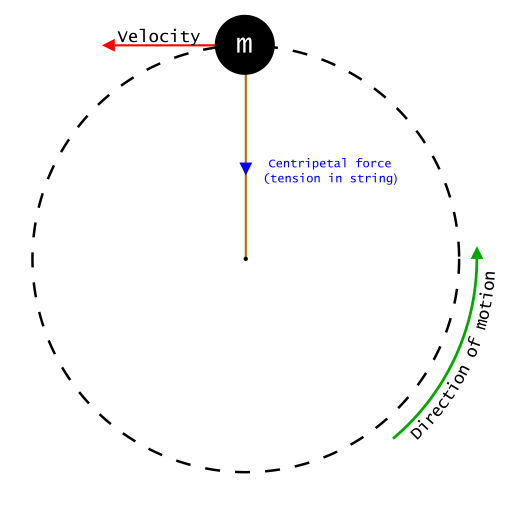
Uniform circular motion: velocity is always tangent to the circle while the centripetal acceleration (and net force) points toward the centre, constantly changing the direction of motion. Image: Public Domain, via Wikimedia Commons.
Impulse and Momentum
- Impulse J = F·Δt = Δp (change in momentum)
- Conservation of momentum: if ΣFext = 0, then Σp = constant
Free Body Diagrams (FBD) - The Method
- Isolate ONE body and draw only the forces acting ON it: weight mg (always downward), normal reaction N (perpendicular to the contact surface), tension T (along the string, away from the body), applied force, and friction f (along the surface, opposing relative motion/tendency).
- Choose convenient axes (for inclines, take axes ALONG and PERPENDICULAR to the slope), then write ΣF = ma separately along each axis.
- Never include forces the body exerts on others - an action-reaction pair acts on two DIFFERENT bodies, so the two never appear in the same FBD.
- Solve the resulting simultaneous equations for the unknowns (acceleration, tension, normal force, etc.).
Connected Bodies: Pulley, Lift, and Chain
- Bodies on a table joined over a pulley: for a hanging mass m₁ pulling a mass m₂ on a smooth horizontal surface, a = m₁g/(m₁ + m₂) and tension T = m₁m₂g/(m₁ + m₂).
- Atwood machine (two masses over a pulley): a = (m₁ − m₂)g/(m₁ + m₂); T = 2m₁m₂g/(m₁ + m₂).
- Apparent weight in a lift: N = m(g + a) when accelerating up, N = m(g − a) when accelerating down; N = mg at rest or constant velocity; N = 0 (weightlessness) in free fall (a = g).
- Inextensible string: all connected bodies share the same magnitude of acceleration, and tension is uniform in a massless string over a frictionless pulley.
Friction on an Inclined Plane
- On an incline of angle θ, the weight resolves into mg sinθ (down the slope) and mg cosθ (into the surface), so N = mg cosθ.
- Angle of repose (α): the maximum incline angle at which a block just stays at rest → tan α = μ_s. If θ ≤ angle of repose, the block does not slide.
- Block sliding DOWN a rough incline: acceleration a = g(sinθ − μ_k cosθ).
- Block pushed UP a rough incline (friction acts down-slope): retardation a = g(sinθ + μ_k cosθ).
Banking of Roads (With Friction)
- For a frictionless banked road, the safe speed is fixed: v = √(rg tanθ), i.e. tanθ = v²/(rg).
- With friction (coefficient μ), a RANGE of safe speeds is allowed: vmax = √[rg(tanθ + μ)/(1 − μ tanθ)] and vmin = √[rg(tanθ − μ)/(1 + μ tanθ)].
- On a flat (unbanked) road, the turn relies on friction alone: vmax = √(μ rg).
Pseudo Forces in Non-Inertial Frames
- Newton's laws hold directly only in inertial frames (non-accelerating). In an accelerating (non-inertial) frame, they can still be applied by adding a pseudo force = −m·aframe on every body, opposite to the frame's acceleration.
- Example: inside a car accelerating forward with acceleration a, a passenger feels a backward pseudo force ma; a hanging pendulum settles at tanφ = a/g from the vertical.
- Pseudo force explains the "apparent weight" in a lift and the outward "centrifugal force" felt in the rotating frame of a turning vehicle - it is a bookkeeping force, not a real interaction.
🚀 JEE Advanced Edge
Pseudo force in non-inertial frames: When analysing motion from inside an accelerating frame (like a lift or accelerating car), add a pseudo force = −ma_frame (opposite to the frame's acceleration) to make Newton's laws apply in that frame. This is the fastest way to solve "apparent weight in a lift" or "pendulum hanging in an accelerating car" problems without switching to the ground frame.
Connected bodies / Atwood machine with pulleys: For two masses connected over a pulley, write F=ma for EACH mass separately (using the SAME tension T and SAME magnitude of acceleration a, since the string is inextensible), then solve the two equations simultaneously: a = (m₁−m₂)g/(m₁+m₂) for a simple Atwood machine.
Worked problem: A block of mass 2 kg on a rough incline (θ=30°, μ=0.5) - will it slide? Approach: Compare tan θ to μ: tan(30°)≈0.577 > μ=0.5? No, actually tan(30°)=0.577 > 0.5, so since tan θ > μ, gravity's component down the slope EXCEEDS the maximum available static friction, and the block DOES slide. (If tan θ ≤ μ, it would stay put.)
Conservation of Linear Momentum
- When the net external force on a system is zero, its total linear momentum remains constant: this follows directly from Newton's second law.
- For an isolated two-body system, m1u1 + m2u2 = m1v1 + m2v2, so any momentum lost by one body is gained by the other.
- Recoil of a gun: the forward momentum of the bullet equals the backward momentum of the gun, so the gun recoils.
- Explosion of a stationary bomb: the fragments fly off with momenta that add vectorially to zero.
- Momentum conservation holds during collisions and explosions even when kinetic energy is not conserved.
Equilibrium of Concurrent Forces
- A particle is in equilibrium when the vector sum of all forces acting on it is zero, so its acceleration is zero.
- For coplanar forces, equilibrium requires the sum of components along both the x and y axes to be zero separately.
- Lami's theorem: for three concurrent forces in equilibrium, each force is proportional to the sine of the angle between the other two.
- The three forces in equilibrium can be represented in magnitude and direction by the three sides of a triangle taken in order.
- Equilibrium may be static (body at rest) or dynamic (body moving with constant velocity).
Aristotle's Fallacy
- Aristotle's view (the fallacy): an external force is always needed to keep a body moving, and a body comes to rest on its own once that force is removed.
- Why it is wrong: the applied force is really only balancing the hidden force of friction or air resistance. On a perfectly frictionless surface, no force is needed to keep a body moving at constant velocity.
- Galileo's correction: a body moving on a smooth horizontal plane would continue forever at constant velocity if no friction acted, which is the seed of the law of inertia.
- This leads directly to Newton's first law: a body stays at rest or in uniform motion unless acted on by a net external force.
Inertia and Its Types
- Inertia is the inherent property of a body to resist any change in its state of rest or of uniform motion; it is measured by mass.
- Inertia of rest: a body at rest tends to stay at rest, e.g. dust flies off when a carpet is beaten.
- Inertia of motion: a moving body tends to keep moving, e.g. a passenger lurches forward when a bus stops suddenly.
- Inertia of direction: a body resists change in its direction of motion, e.g. mud flies off tangentially from a spinning wheel.
- Greater mass means greater inertia; this is the basis of Newton's first law, also called the law of inertia.
Common Forces in Mechanics
- Weight is the gravitational force mg acting vertically downward on a body.
- The normal reaction N is the contact force exerted by a surface perpendicular to it.
- Tension is the pulling force transmitted along a string or rope; for an ideal massless string it is the same throughout.
- The spring force obeys Hooke's law, F = -kx, directed so as to restore the spring to its natural length.
- Contact forces (normal and friction) arise from electromagnetic interactions between surfaces, while weight is a non-contact (field) force.