🎯 Key Points
- Galvanic cell: chemical → electrical energy (spontaneous, ΔG < 0); Electrolytic cell: electrical → chemical energy (non-spontaneous, forced)
- Anode = oxidation always; Cathode = reduction always (true for BOTH cell types - only the polarity sign flips between them)
- EMF = E°cathode − E°anode; positive EMF means spontaneous as written
- Nernst equation: E = E° − (0.0592/n)log Q at 25°C - links cell potential to non-standard concentrations
- ΔG° = −nFE°cell; also ΔG° = −RT ln K, linking electrochemistry directly to thermodynamics and equilibrium
- Faraday's First Law: mass deposited ∝ charge passed; 1 Faraday = 96500 C = charge of 1 mole electrons
- Molar conductivity increases with dilution; Kohlrausch's law allows calculating Λ°m of weak electrolytes from strong electrolyte data
Types of Electrochemical Cells
- Galvanic (Voltaic) cell: Chemical energy to electrical energy (e.g., Daniell cell)
- Electrolytic cell: Electrical energy to chemical energy (e.g., electroplating)
Galvanic Cell
In a Daniell cell, electrons flow externally from the zinc anode (oxidation) through the voltmeter to the copper cathode (reduction), while the salt bridge completes the circuit.
- Anode: Negative electrode; oxidation occurs here
- Cathode: Positive electrode; reduction occurs here
- EMF of cell = E°cathode - E°anode
- Daniell cell: Zn|ZnSO₄||CuSO₄|Cu; E° = 1.10 V
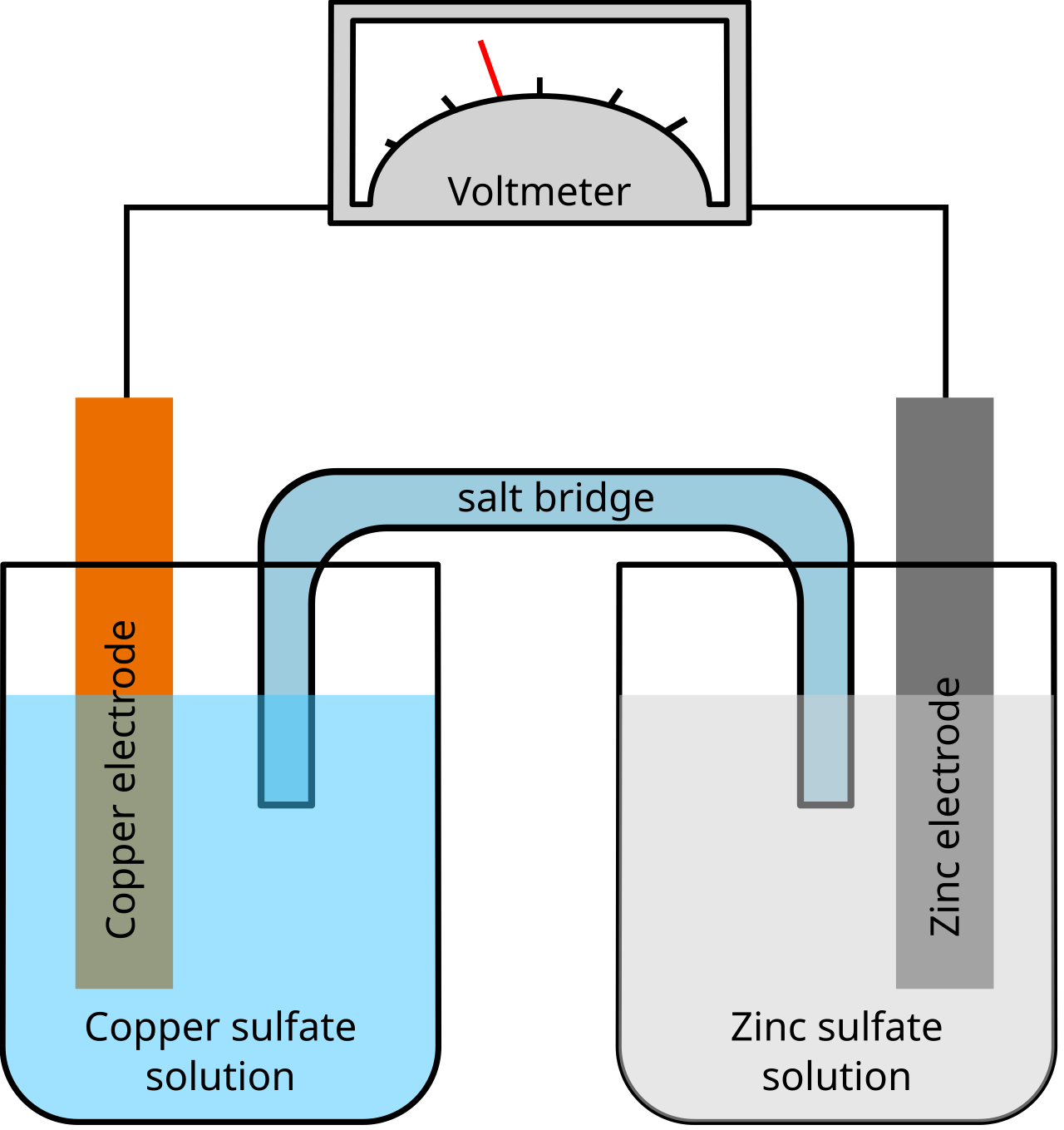
A Daniell (galvanic) cell: zinc is oxidised at the anode (Zn → Zn2+ + 2e−) and copper ions are reduced at the copper cathode (Cu2+ + 2e− → Cu). The salt bridge maintains electrical neutrality and completes the circuit, while the voltmeter reads the cell EMF. Image: Gringer, CC BY-SA 3.0, via Wikimedia Commons.
Standard Electrode Potential
Measured against Standard Hydrogen Electrode (SHE = 0 V). Higher value = greater tendency to be reduced.
- Zn²⁺/Zn = -0.76 V
- Cu²⁺/Cu = +0.34 V
- F₂/F⁻ = +2.87 V (strongest oxidising agent)
Nernst Equation
E = E° - (0.0592/n) × log Q (at 25°C). This lets you calculate the actual cell potential under non-standard concentrations, and explains why concentration cells (same electrode, different ion concentrations on each side) can generate a voltage even with E° = 0.
Relation to thermodynamics: ΔG° = −nFE°cell, and since ΔG° = −RT ln K, we get E°cell = (RT/nF) ln K - a spontaneous cell (E° > 0) always corresponds to a reaction with K > 1 (products favoured at equilibrium).
Faraday's Laws
- First Law: Mass deposited is proportional to charge passed (m = ZQ = ZIt, where Z is the electrochemical equivalent)
- Second Law: For the same charge, mass deposited is proportional to equivalent weight
- 1 Faraday = 96500 C = charge of 1 mole of electrons
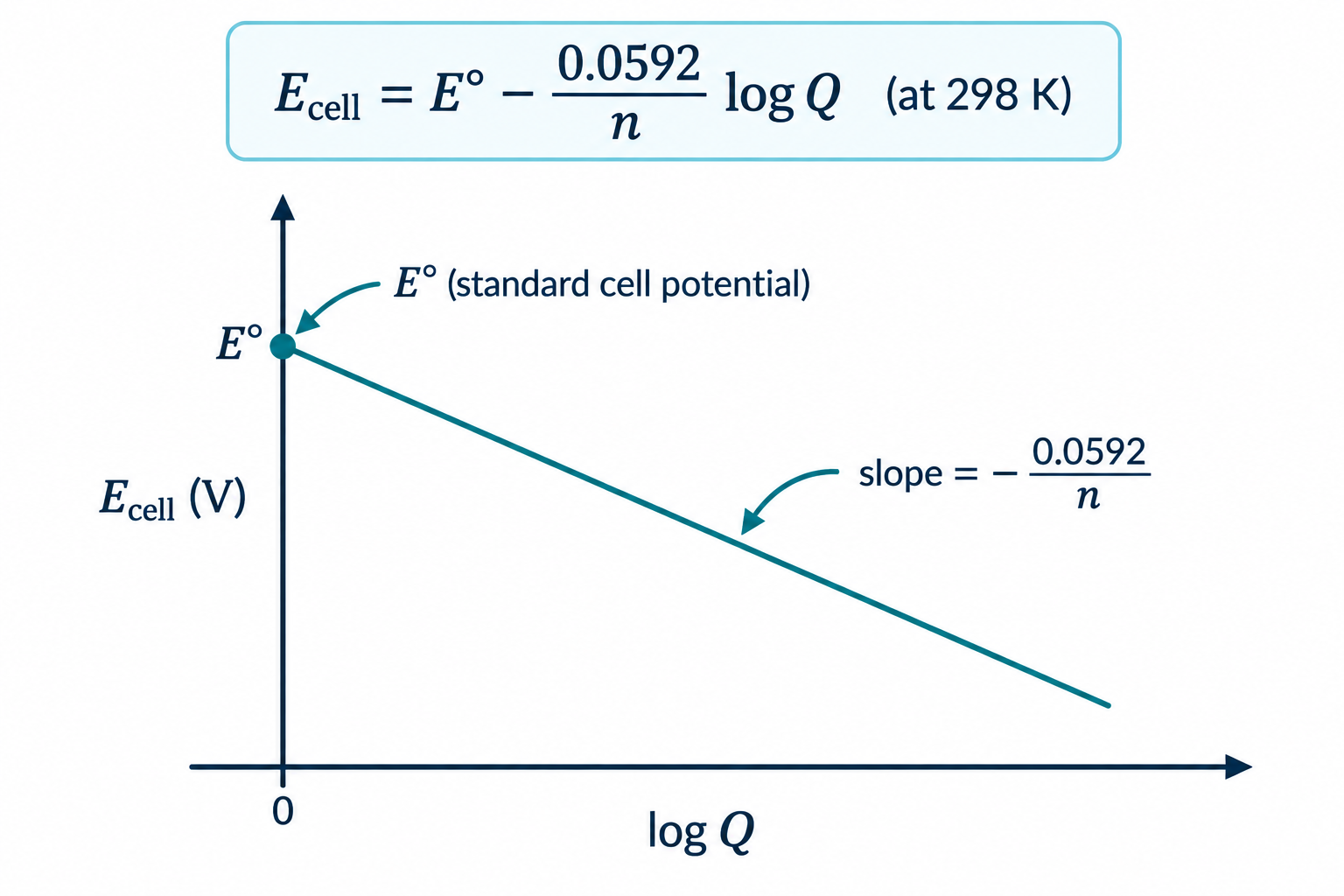
The Nernst equation as a graph: Ecell falls linearly as log Q rises, starting from E° (at log Q = 0) with slope −0.0592/n at 298 K.
Conductance and Molar Conductivity
- Conductivity (κ) increases with dilution for both strong and weak electrolytes (more ions per unit volume become more mobile as concentration drops, even though total ion count decreases)
- Molar conductivity (Λm) = κ/c also increases on dilution; for strong electrolytes it increases slightly and linearly (Λm vs √c), reaching a limiting value Λ°m at infinite dilution; for weak electrolytes it increases sharply near infinite dilution since more of the weak electrolyte dissociates
- Kohlrausch's Law of independent migration of ions: Λ°m of an electrolyte = sum of the limiting molar conductivities of its individual ions. This lets you calculate Λ°m for a WEAK electrolyte (which can't be measured directly by extrapolation, since it keeps dissociating further even at very low concentration) using data from strong electrolytes that share its ions.
Batteries and Corrosion
- Primary batteries (non-rechargeable): dry cell (Zn-C), mercury cell
- Secondary batteries (rechargeable): lead-acid battery (car batteries), nickel-cadmium cell, lithium-ion battery
- Fuel cells: H₂-O₂ fuel cell directly converts chemical energy of a fuel into electricity continuously (as long as reactants are supplied), with water as the only by-product - used in spacecraft and increasingly in vehicles
- Corrosion (rusting) is an electrochemical process: iron acts as an anode (oxidised to Fe²⁺), atmospheric O₂ + moisture acts as the cathode region (reduced to OH⁻), and the Fe²⁺/OH⁻ combine and are further oxidised to hydrated Fe₂O₃ (rust). Prevention methods include galvanisation (Zn coating, sacrificial anode) and painting.
Quick Tips
- OIL RIG: Oxidation Is Loss, Reduction Is Gain (of electrons)
- Cathode: always reduction; Anode: always oxidation - true for both galvanic and electrolytic cells
- Higher E° = better oxidising agent (greater tendency to be reduced)
Cell Representation (Cell Notation)
- Anode is written on the LEFT, cathode on the RIGHT: Anode | Anode solution || Cathode solution | Cathode
- A single vertical bar (|) marks a phase boundary (electrode/solution); the double bar (||) represents the salt bridge
- Example (Daniell cell): Zn(s) | Zn²⁺(aq) || Cu²⁺(aq) | Cu(s)
- Concentrations/pressures are shown in brackets, e.g. Zn²⁺(1 M); for gas electrodes an inert electrode like Pt is included, e.g. Pt | H₂(1 bar) | H⁺(1 M)
Electrochemical Series and Its Applications
Arranging electrodes in order of increasing standard reduction potential (E°) gives the electrochemical (activity) series. Applications:
- Predicting displacement: A metal higher in the series (more negative E°) displaces a metal below it from its salt solution (e.g. Zn displaces Cu from CuSO₄)
- Reaction with acids: Metals with negative E° (above hydrogen, e.g. Zn, Fe) liberate H₂ from dilute acids; metals below hydrogen (Cu, Ag, Au) do not
- Oxidising/reducing strength: Higher E° = stronger oxidising agent (F₂ strongest); lower/more negative E° = stronger reducing agent (Li strongest)
- Predicting cell feasibility: A cell is spontaneous only if the calculated E°cell = E°cathode − E°anode is positive
Products of Electrolysis
- Molten electrolyte: Only the ions of the compound are present. Molten NaCl gives Na at the cathode and Cl₂ at the anode
- Aqueous electrolyte: Water can also be oxidised/reduced, so the product depends on electrode potentials and overpotential. Aqueous NaCl (brine) gives H₂ at the cathode (not Na) and Cl₂ at the anode (overpotential favours Cl₂ over O₂)
- Aqueous CuSO₄ with Pt electrodes: Cu deposits at the cathode; O₂ evolves at the anode (water oxidised)
- Aqueous CuSO₄ with Cu electrodes: Cu deposits at cathode while the Cu anode dissolves - the basis of electro-refining of copper
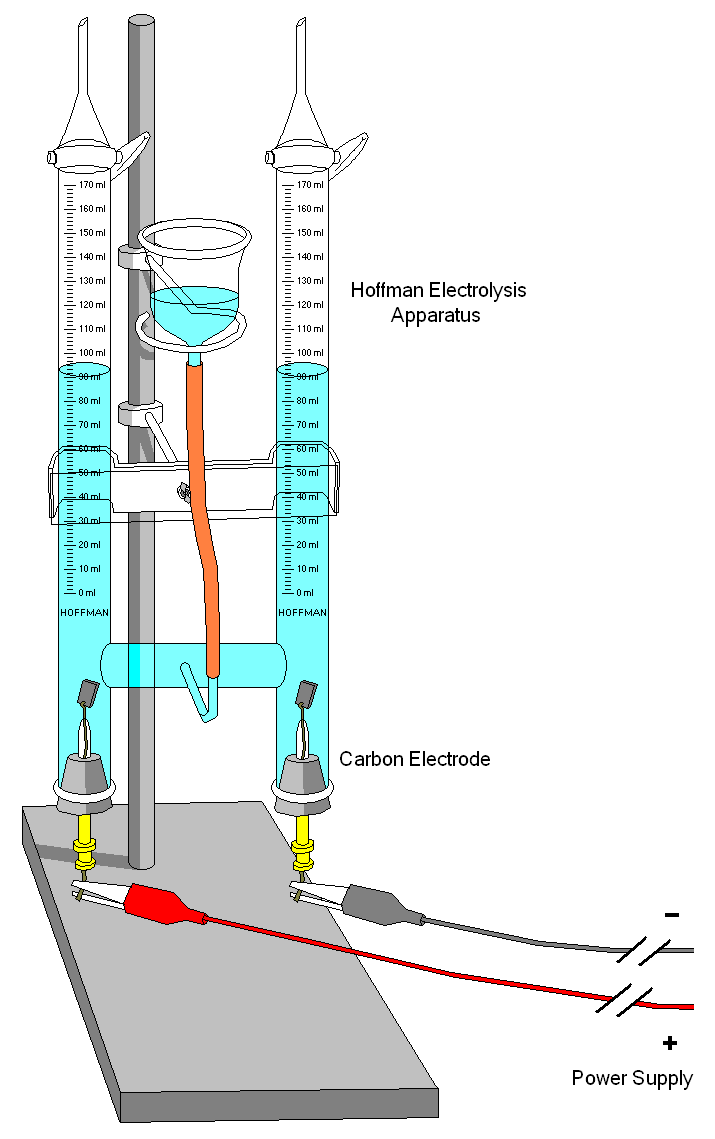
Electrolysis in a Hoffman apparatus: an external power supply drives a non-spontaneous redox reaction, forcing oxidation at the anode (+) and reduction at the cathode (−). Electrolysing acidified water gives hydrogen and oxygen in a 2:1 volume ratio. Image: Ivan Akira, CC BY-SA 3.0, via Wikimedia Commons.
Degree of Dissociation from Conductivity
- For a weak electrolyte, the degree of dissociation α = Λm / Λ°m (ratio of molar conductivity at that concentration to its value at infinite dilution)
- The dissociation constant then follows Ostwald's dilution law: Ka = cα² / (1 − α) = c Λm² / [Λ°m (Λ°m − Λm)]
- This gives an experimental route to Ka of weak acids/bases purely from conductance measurements
Electrode Reactions in Batteries and Fuel Cells
- Lead storage battery (secondary): Anode Pb, cathode PbO₂, electrolyte H₂SO₄. On discharge both electrodes form PbSO₄; charging reverses this
- H₂–O₂ fuel cell (alkaline): Anode H₂ + 2OH⁻ → 2H₂O + 2e⁻; Cathode O₂ + 2H₂O + 4e⁻ → 4OH⁻; overall 2H₂ + O₂ → 2H₂O with high efficiency (~70%) and water as the only product
- Mercury cell (primary): Gives a steady voltage (~1.35 V) throughout its life because the overall reaction involves no ions whose concentration changes
🚀 JEE Advanced Edge
Concentration cells: Two half-cells of the SAME metal/ion but different concentrations generate an EMF purely from the concentration difference: E = (0.0592/n) log(C₂/C₁). The more concentrated side acts as the cathode (reduction, ions deposit) as the cell tries to equalise concentrations.
Electrolysis selectivity: When multiple species can be reduced/oxidised at an electrode, the one with the more favourable (less negative for reduction, less positive for oxidation) electrode potential is discharged preferentially - this is why electrolysis of brine gives H₂ at the cathode (not Na, despite Na⁺ being present) and Cl₂ at the anode under normal conditions, due to overpotential effects.
Worked problem: Calculate the EMF of the cell Zn|Zn²⁺(0.1M)||Cu²⁺(1M)|Cu given E°cell = 1.10 V. Approach: n=2 for this reaction. Q = [Zn²⁺]/[Cu²⁺] = 0.1/1 = 0.1. E = 1.10 − (0.0592/2)log(0.1) = 1.10 − (0.0296)(−1) = 1.10 + 0.0296 ≈ 1.13 V.
Gibbs Energy and Cell EMF
- The electrical work a galvanic cell can do is linked to its EMF: ΔG = -nFEcell, where n is the number of moles of electrons transferred and F is the Faraday constant (96500 C per mole of electrons)
- Under standard conditions this becomes ΔG° = -nFE°cell, connecting thermodynamics with electrochemistry
- A positive Ecell means negative ΔG, so a spontaneous cell reaction; a negative Ecell means the reaction is non-spontaneous in that direction
- Because ΔG is an extensive property, its value depends on n, but Ecell (an intensive property) does not change if you multiply the balanced equation by a factor
- Maximum electrical work obtainable from the cell equals -ΔG (Wmax = -nFEcell)
Equilibrium Constant from Cell Potential
- At equilibrium the cell can do no more work, so Ecell = 0 and the reaction quotient Q equals the equilibrium constant Kc
- Combining the Nernst equation with ΔG° = -RT ln K gives E°cell = (RT/nF) ln Kc, which at 298 K simplifies to E°cell = (0.059/n) log Kc
- A large positive E°cell therefore corresponds to a very large K, meaning the reaction goes almost to completion
- This lets you calculate equilibrium constants of redox reactions purely from standard electrode potentials
- Also links the three quantities together: ΔG°, E°cell and K are all measures of the feasibility and extent of the same reaction
Salt Bridge and Its Functions
- A salt bridge is a U-tube containing an inert electrolyte such as KCl, KNO3 or NH4NO3 set in a jelly of agar-agar, connecting the two half-cells of a galvanic cell
- It completes the electrical circuit by allowing ions to flow internally while the electrons flow through the external wire
- It maintains electrical neutrality in both half-cells: anions move toward the anode compartment and cations toward the cathode compartment to balance the charge built up by the electrode reactions
- Ions of the salt bridge are chosen so their transport numbers (mobilities of cation and anion) are nearly equal, which minimises the liquid junction potential
- Without a salt bridge, charge accumulation would quickly stop the flow of current and the cell EMF would fall to zero
Galvanic Cell vs Electrolytic Cell
- A galvanic (voltaic) cell converts chemical energy into electrical energy from a spontaneous redox reaction; an electrolytic cell uses external electrical energy to drive a non-spontaneous reaction
- In a galvanic cell the anode is negative and the cathode is positive; in an electrolytic cell the anode is positive and the cathode is negative (connected to the battery terminals)
- In both types, oxidation always occurs at the anode and reduction at the cathode
- A galvanic cell has Ecell positive and ΔG negative; an electrolytic cell requires an applied voltage greater than the cell's back-EMF to proceed
- Typical uses: galvanic cells power batteries; electrolytic cells are used in electrolysis, electroplating and metal refining