🎯 Key Points
- Aldehydes have ≥1 H on carbonyl carbon; ketones have 2 alkyl/aryl groups - aldehydes are generally more reactive to nucleophilic addition (less steric hindrance, more electrophilic carbon)
- Tollens'/Fehling's test: positive ONLY for aldehydes (silver mirror / brick-red precipitate respectively)
- Iodoform test: positive for any CH₃CO- group (methyl ketones) or ethanol/acetaldehyde-type structures, not just aldehydes generally
- Cannizzaro reaction needs NO alpha-H (non-enolisable aldehyde) - self redox: one molecule oxidised to acid, another reduced to alcohol
- Carboxylic acids are stronger acids than phenols/alcohols due to greater resonance stabilisation of the carboxylate ion (charge spread over 2 oxygens equally)
- Clemmensen (Zn(Hg)/HCl) and Wolff-Kishner (N₂H₄/KOH) both reduce C=O fully to CH₂, useful when other reducible groups must survive each respective acidic/basic condition
Aldehydes (R-CHO) and Ketones (R-CO-R')
Contain the carbonyl group (C=O). Aldehydes have at least one H on the carbonyl carbon; ketones have two alkyl or aryl groups.
Distinguishing Tests
- Tollens' test (Ag mirror): positive for aldehydes only
- Fehling's test (brick-red ppt): positive for aldehydes only (not aromatic)
- Iodoform test (yellow ppt with I₂/NaOH): positive for CH₃CO- group (methyl ketones and acetaldehyde)
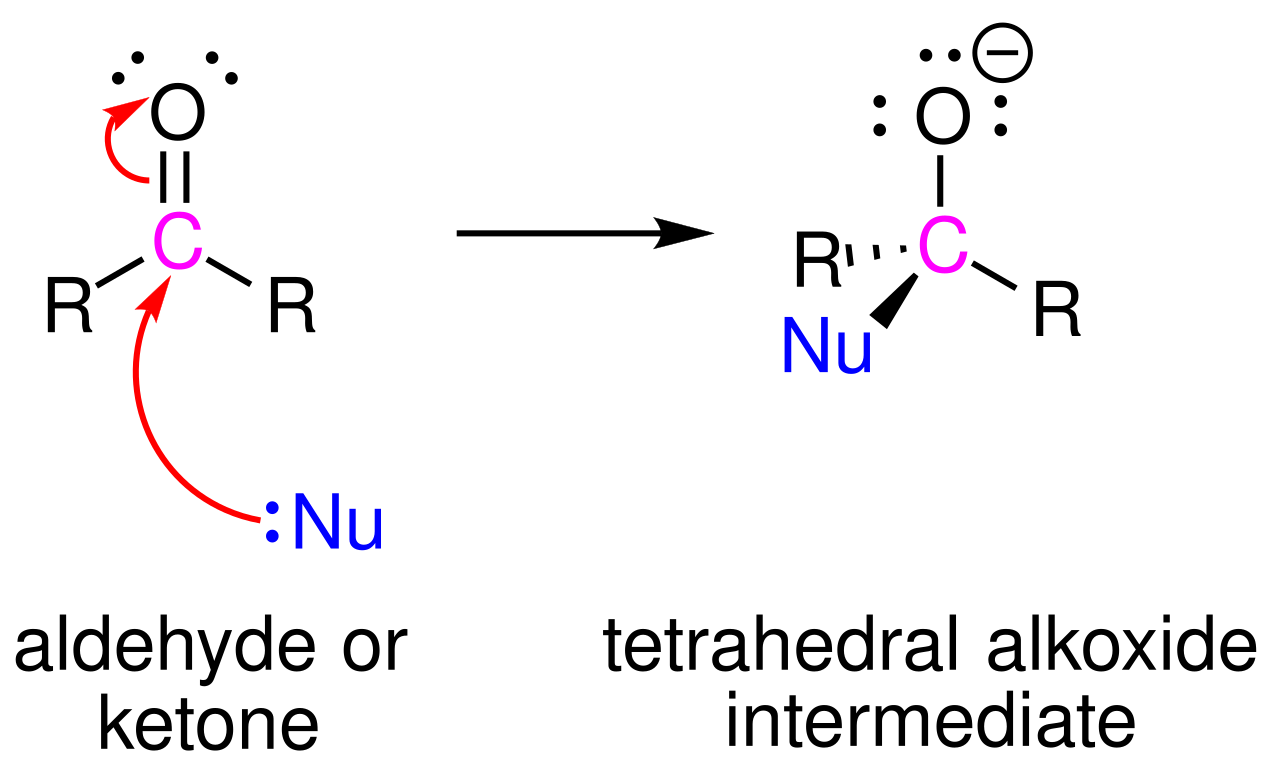
The carbonyl carbon of an aldehyde or ketone is electron-poor (δ+) because oxygen draws the π electrons toward itself. A nucleophile attacks this carbon, the C=O π bond breaks onto oxygen, and a tetrahedral alkoxide intermediate forms — the first step of nucleophilic addition. Image: Unknown author, CC BY 4.0, via Wikimedia Commons.
Carboxylic Acids (R-COOH)
- Stronger acids than alcohols and phenols due to resonance in carboxylate ion (RCOO⁻)
- Reactions: esterification, amide formation, reduction (LiAlH₄ to 1° alcohol)
- Derivatives: acid chlorides (RCOCl), acid anhydrides, esters (RCOOR'), amides (RCONH₂)
- Decarboxylation: RCOOH → RH + CO₂ (heating with soda lime)
Nomenclature
- Aldehydes: replace -e of alkane with -al (methanal/HCHO, ethanal/CH₃CHO); -CHO carbon is always C-1
- Ketones: replace -e with -one, number to give the C=O the lowest locant (propanone, pentan-2-one)
- Carboxylic acids: replace -e with -oic acid (methanoic/formic, ethanoic/acetic acid); -COOH carbon is C-1
- Common names retained: acetaldehyde, acetone, benzaldehyde, acetophenone, formic/acetic/benzoic acid
Preparation of Aldehydes and Ketones
- Rosenmund reduction: acyl chloride + H₂ over Pd/BaSO₄ → aldehyde (BaSO₄ poisons the catalyst to stop over-reduction to alcohol)
- Stephen reaction: nitrile + SnCl₂/HCl then H₃O⁺ → aldehyde (via imine); alternatively DIBAL-H reduces nitriles/esters to aldehydes
- Gattermann-Koch reaction: benzene + CO + HCl (anhyd. AlCl₃/CuCl) → benzaldehyde
- Etard reaction: toluene + CrO₂Cl₂ → benzaldehyde (via chromium complex, then hydrolysis)
- Ozonolysis of alkenes and hydration of alkynes (Markovnikov, dil. H₂SO₄/HgSO₄ → ketone; ethyne → acetaldehyde)
- Ketones from acyl chlorides with dialkylcadmium (R₂Cd), or aromatic ketones by Friedel-Crafts acylation
Aldol and Cross-Aldol Condensation
- Aldol: aldehydes/ketones with α-hydrogen self-condense in dilute base to a β-hydroxy carbonyl (aldol), which on heating dehydrates to an α,β-unsaturated carbonyl
- Cross-aldol: between two different carbonyl compounds both bearing α-H gives a mixture of four products (of limited use)
- A useful cross-aldol uses one partner with NO α-H (e.g. benzaldehyde, HCHO) so it can only act as the electrophile, giving a clean product
- Contrast with Cannizzaro: only for aldehydes with NO α-H
Preparation and Special Reactions of Carboxylic Acids
- Preparation: oxidation of 1° alcohols/aldehydes, hydrolysis of nitriles/esters/amides, from Grignard reagent + CO₂ (dry ice) then H₃O⁺, oxidation of alkylbenzenes to benzoic acid
- Hell-Volhard-Zelinsky (HVZ) reaction: carboxylic acid with α-H + Cl₂/Br₂ in presence of red P → α-halo carboxylic acid (a key route to α-amino/α-hydroxy acids)
- Formation of derivatives: acid chlorides (SOCl₂/PCl₅), anhydrides, esters (Fischer esterification), amides
- Reduction: LiAlH₄ or B₂H₆ reduces -COOH to 1° alcohol (not reduced by NaBH₄)
- HVZ does not work on formic acid or aromatic acids like benzoic acid (no α-H)
🚀 JEE Advanced Edge
Relative reactivity of carbonyl compounds to nucleophilic addition: HCHO > other aldehydes > ketones, governed by both steric factors (smaller groups = less hindrance to nucleophile approach) and electronic factors (alkyl groups donate electron density via +I effect, reducing the carbonyl carbon's electrophilicity). Aromatic aldehydes/ketones are LESS reactive than aliphatic ones because the ring donates electron density into the carbonyl via resonance.
Acidity order of substituted acetic acids: Cl-CH₂-COOH > CH₃COOH, and trichloroacetic acid > dichloroacetic acid > chloroacetic acid > acetic acid - each additional electron-withdrawing Cl atom further stabilises the carboxylate anion via induction, making the acid progressively stronger.
Worked problem (Cannizzaro): Benzaldehyde (C₆H₅CHO, no alpha-H) is treated with concentrated NaOH. Identify the products. Approach: Since benzaldehyde has no alpha hydrogen, it cannot undergo Aldol condensation, so it undergoes Cannizzaro instead: 2 C₆H₅CHO + NaOH → C₆H₅COONa (sodium benzoate) + C₆H₅CH₂OH (benzyl alcohol) - one molecule is oxidised, the other reduced, in a 1:1 ratio.
Nucleophilic Addition Reactions and Reactivity Order
- The carbonyl carbon is electrophilic (partial positive) and is attacked by a nucleophile, which adds to give a tetrahedral alkoxide intermediate that is then protonated.
- Addition of HCN gives cyanohydrins; addition of NaHSO3 gives crystalline bisulphite addition products useful for purification.
- Alcohols add to give hemiacetals and acetals (with ketones, ketals) in presence of dry HCl.
- Ammonia derivatives (hydroxylamine, hydrazine, phenylhydrazine, 2,4-DNP) add and then lose water to give oximes, hydrazones and phenylhydrazones.
- Reactivity toward nucleophilic addition is aldehydes > ketones due to less steric hindrance and smaller electron-donating effect (+I) in aldehydes.
- Among aldehydes, reactivity decreases as the size and number of alkyl groups increase (HCHO > CH3CHO).
Cannizzaro Reaction
- Aldehydes that have no alpha-hydrogen undergo self oxidation-reduction (disproportionation) when treated with concentrated alkali.
- One molecule is oxidised to the carboxylate salt and the other is reduced to the alcohol.
- Example: two molecules of HCHO with concentrated NaOH give sodium formate and methanol.
- Benzaldehyde with concentrated NaOH gives sodium benzoate and benzyl alcohol.
- The reaction is used to distinguish aldehydes without alpha-hydrogen from those that undergo aldol condensation.
- A crossed Cannizzaro reaction uses two different aldehydes without alpha-hydrogen, one commonly HCHO acting as the reducing partner.
Acidity of Carboxylic Acids
- Carboxylic acids are acidic because the carboxylate ion is resonance stabilised, with the negative charge shared equally over two oxygen atoms.
- They are stronger acids than phenols and alcohols but weaker than mineral acids like HCl.
- Electron-withdrawing groups (like -Cl, -NO2) increase acidity by stabilising the carboxylate ion; chloroacetic acid is stronger than acetic acid.
- The effect is greater when the electron-withdrawing group is closer to the -COOH group and when more such groups are present.
- Electron-donating groups (like -CH3) decrease acidity, so acetic acid is weaker than formic acid.
- Aromatic carboxylic acids are generally slightly stronger than the corresponding aliphatic acids; ring substituents shift acidity accordingly.
Physical Properties of Aldehydes, Ketones and Carboxylic Acids
- Aldehydes and ketones are polar and have higher boiling points than comparable hydrocarbons and ethers due to dipole-dipole attractions, but lower than alcohols since they lack O-H hydrogen bonding among themselves.
- Lower aldehydes and ketones are miscible with water because their carbonyl oxygen forms hydrogen bonds with water; solubility falls as the carbon chain lengthens.
- Carboxylic acids have higher boiling points than alcohols of comparable mass due to stronger and more extensive hydrogen bonding.
- Carboxylic acids exist as hydrogen-bonded dimers in the vapour and liquid states.
- Lower carboxylic acids (up to 4 carbons) are freely miscible with water; solubility decreases with increasing chain length.
- Lower carboxylic acids have sharp irritating odours, while many higher members are waxy solids.
Alpha-Hydrogen Reactions of Carbonyl Compounds
- The alpha-hydrogen (on the carbon next to C=O) is acidic because the resulting carbanion is stabilised by resonance with the carbonyl group.
- Aldehydes and ketones with alpha-hydrogens undergo halogenation at the alpha carbon in presence of acids or bases.
- Methyl ketones and ethanal give the iodoform (haloform) reaction with I2/NaOH, forming yellow CHI3.
- The Hell-Volhard-Zelinsky (HVZ) reaction introduces chlorine or bromine at the alpha carbon of carboxylic acids using X2 in presence of small amount of red phosphorus.
- Alpha-halo acids are useful intermediates for making alpha-hydroxy and alpha-amino acids.
- Acids and esters that lack alpha-hydrogen do not undergo these alpha substitution reactions.