🎯 Key Points
- Pathogen-disease pairs to memorise: Malaria=Plasmodium (Anopheles); Typhoid=Salmonella typhi; TB=Mycobacterium tuberculosis; Dengue=flavivirus (Aedes); Amoebiasis=Entamoeba histolytica; Ringworm=fungus
- Cancer = uncontrolled division from proto-oncogene→oncogene mutation; Benign tumours stay localised, Malignant tumours invade/metastasise via blood or lymph
- ELISA detects antibodies/antigens (e.g. HIV screening); PCR detects pathogen DNA/RNA directly (faster, more specific, used for early/acute detection)
- Tobacco's TWO harms: nicotine (addictive) and tar (carcinogenic) - different components causing different problems
- Opioids bind opioid receptors (pain relief); Cocaine blocks dopamine reuptake (euphoria/stimulant) - different neurotransmitter systems entirely
The Plasmodium parasite needs both hosts: the female Anopheles mosquito injects sporozoites while biting (infecting the human liver and RBCs, causing the malaria fever cycle), then picks up gametocytes from an infected person's blood, completing the parasite's sexual stage inside the mosquito.
Types of Diseases
- Infectious: caused by pathogens (bacteria, viruses, fungi, protozoa, helminths)
- Non-infectious: lifestyle diseases (cardiovascular, diabetes), genetic disorders, cancer
Common Infectious Diseases
| Disease | Pathogen | Transmission |
| Malaria | Plasmodium (protozoa) | Anopheles mosquito |
| Typhoid | Salmonella typhi | Contaminated food/water |
| Pneumonia | Streptococcus pneumoniae | Droplets |
| Tuberculosis | Mycobacterium tuberculosis | Droplets |
| Dengue | Dengue virus (flavivirus) | Aedes mosquito |
| Amoebiasis | Entamoeba histolytica | Contaminated food/water |
| Ringworm | Fungi (Microsporum) | Direct contact |
Cancer
- Uncontrolled cell division; proto-oncogenes → oncogenes (mutations)
- Tumour types: benign (localized), malignant (invasive, metastatic)
- Causes: carcinogens (tobacco, radiation, chemicals), viruses (HPV, Hepatitis B)
- Treatment: surgery, radiation, chemotherapy, immunotherapy
- Metastasis: cancer cells spread via blood or lymph to other organs
Drugs and Alcohol
- Opioids: morphine, heroin (bind opioid receptors, pain relief, high addiction)
- Cannabinoids: THC (from Cannabis sativa); affect coordination, euphoria
- Cocaine: from Coca plant; dopamine accumulation; stimulant
- Alcohol: CNS depressant; liver cirrhosis, addiction
- Tobacco: nicotine (addictive), tar (carcinogenic); causes lung cancer, COPD
Public Health
- Widal test: for typhoid diagnosis
- ELISA: enzyme-linked immunosorbent assay; detects HIV, hepatitis antibodies
- PCR: polymerase chain reaction; detects pathogen DNA/RNA
- Vaccination schedule: BCG (TB), DPT, MMR, polio, hepatitis B
Immunity: Innate and Acquired
- Immunity is the overall ability of the host to fight disease-causing organisms, conferred by the immune system. It is of two broad types: innate and acquired.
- Innate immunity is non-specific and present from birth. It provides protection through four types of barriers: physical barriers (skin; mucus coating of the epithelium lining the respiratory, gastrointestinal and urogenital tracts), physiological barriers (acid in the stomach, saliva in the mouth, tears from the eyes), cellular barriers (leucocytes such as polymorpho-nuclear leucocytes/neutrophils, monocytes and natural killer cells, plus macrophages that phagocytose and destroy microbes), and cytokine barriers (interferons secreted by virus-infected cells that protect nearby non-infected cells from further viral infection).
- Acquired (adaptive) immunity is pathogen-specific and is characterised by memory. It is mediated by two special types of lymphocytes: B-lymphocytes produce antibodies that circulate in the blood (the humoral or antibody-mediated immune response, AMIR), while T-lymphocytes help the B-cells produce antibodies and are themselves responsible for the cell-mediated immune response (CMI).
- The cell-mediated immunity (CMI) of the body is responsible for graft (transplant) rejection, since the body is able to differentiate its own cells (self) from foreign cells (non-self).
Antibodies, Active and Passive Immunity, Vaccination
- An antibody is a protein molecule with a characteristic Y-shaped structure formed of four peptide chains - two longer heavy (H) chains and two shorter light (L) chains - hence represented as H2L2. Different classes of antibodies (immunoglobulins) are produced, including IgA, IgM, IgE and IgG.
- On first encounter with a pathogen (antigen), the body produces a primary response of low intensity. A subsequent encounter with the same pathogen elicits a highly intensified secondary (anamnestic) response, because the immune system "remembers" the first encounter through memory B- and T-cells.
- Active immunity: when a host is exposed to antigens (living or dead microbes, or other proteins) and its own body produces antibodies. It is slow to develop but long-lasting. Natural infection and vaccination both induce active immunity.
- Passive immunity: when ready-made antibodies are given directly to protect the body. It acts immediately but is short-lived. Examples include antibodies transferred from mother to foetus across the placenta, the colostrum (the yellowish first milk, rich in IgA antibodies) received by an infant, and injection of anti-tetanus serum or anti-snake-venom (preformed antibodies).
- Vaccination and immunisation are based on the memory of the immune system. A vaccine (a preparation of antigenic proteins of a pathogen, or an inactivated/weakened pathogen) is introduced into the body; the antibodies produced neutralise the pathogen during an actual infection, and the generated memory cells recognise the pathogen quickly on later exposure. Recombinant DNA technology now allows antigenic polypeptides to be produced in bacteria or yeast (for example, the hepatitis B vaccine produced from yeast).
AIDS and HIV
- AIDS (Acquired Immuno Deficiency Syndrome) is caused by the Human Immunodeficiency Virus (HIV), which is a retrovirus (an RNA virus that carries the enzyme reverse transcriptase).
- Transmission occurs through: sexual contact with an infected person, transfusion of contaminated blood, sharing infected needles, and from an infected mother to her child through the placenta. AIDS does not spread by mere touch or ordinary physical contact.
- After entering the body, HIV enters macrophages, where reverse transcriptase produces viral DNA from the viral RNA. This viral DNA becomes incorporated into the host cell's DNA and directs the infected cell to produce new virus particles. HIV then enters helper T-lymphocytes (TH), replicates within them and progressively destroys them, so their number in the body declines steadily.
- The resulting fall in helper T-cells weakens immunity, so the person becomes susceptible to infections by bacteria (especially Mycobacterium), viruses, fungi and parasites such as Toxoplasma.
- Diagnosis is done by the ELISA test. There is a time-lag (a few months to several years) between infection and appearance of AIDS symptoms. Anti-retroviral drugs can prolong life but cannot completely eliminate the virus; prevention (safe blood, use of disposable needles, safe sexual practices and awareness through NACO) is the most effective control.
Other Common Human Diseases
- Common cold: caused by Rhino viruses; it infects the nose and respiratory passage but not the lungs, causing nasal congestion and discharge, sore throat, cough, headache and tiredness; it spreads through droplets and contaminated objects.
- Ascariasis: caused by the intestinal roundworm Ascaris; symptoms include internal bleeding, muscular pain, fever, anaemia and blockage of the intestinal passage; the parasite is transmitted through contaminated food and water (eggs are passed out in the faeces of infected persons).
- Filariasis (elephantiasis): caused by the filarial worms Wuchereria (W. bancrofti and W. malayi); they affect the lymphatic vessels, chiefly of the lower limbs, causing gross inflammation and deformity; they are transmitted by the bite of female mosquito vectors.
- Amoebiasis (amoebic dysentery): caused by the protozoan Entamoeba histolytica in the large intestine; symptoms include constipation, abdominal pain and cramps, and stools with excess mucus and blood clots; houseflies act as mechanical carriers, transmitting the parasite from faeces to food and water.
🚀 NEET Advanced Edge
Why ELISA can give false negatives early in HIV infection: ELISA detects antibodies, which take time (the "window period," typically weeks) to develop after infection - an infected person can test negative on ELISA during this window despite already carrying the virus, while PCR (detecting viral RNA directly) can identify infection much earlier.
Why metastasis, not the primary tumour, is usually what's fatal: A localised tumour can often be surgically removed; metastasis means cancer cells have already spread to distant organs via blood/lymph, making complete surgical removal impossible - this is why early detection (before metastasis) dramatically improves cancer treatment outcomes, a key public-health reasoning point.
Distinguishing addiction mechanisms for exam options: "Acts on opioid receptors, causes severe physical dependence" → morphine/heroin. "Blocks dopamine reuptake transporter, causes euphoria/stimulation" → cocaine. "GABA receptor agonist, CNS depressant" → alcohol/barbiturates. Matching mechanism-to-drug-class is a common NEET question style.
Life Cycle of the Malarial Parasite
- Malaria is caused by Plasmodium, spread by the bite of an infected female Anopheles mosquito.
- Parasites enter the human body as sporozoites through the mosquito bite.
- They first multiply in the liver cells and then attack the red blood cells (RBCs), destroying them.
- Rupture of RBCs releases a toxic substance called haemozoin, causing recurring chill and high fever every three to four days.
- When a mosquito bites an infected person, parasites enter the mosquito and develop further, completing the life cycle.
- Plasmodium falciparum causes the most serious, malignant form of malaria.
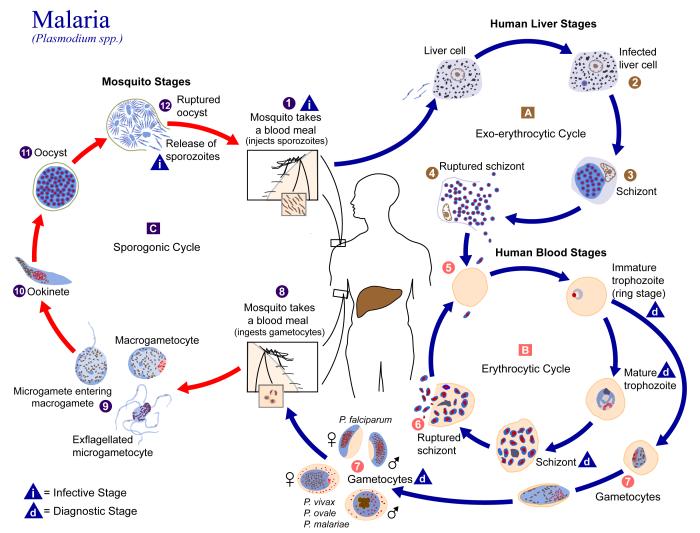
Life cycle of the malarial parasite Plasmodium, alternating between the human host (liver and red-blood-cell stages) and the female Anopheles mosquito (sporogonic cycle). Image: CDC / Alexander J. da Silva and Melanie Moser, Public Domain, via Wikimedia Commons.
Adolescence and Substance Abuse
- Adolescence is the period between 12 and 18 years of age, a bridge between childhood and adulthood.
- It brings major biological and behavioural changes, making it a vulnerable phase.
- Curiosity, need for adventure and experimentation are common reasons for initial drug and alcohol use.
- Peer pressure and desire to excel in studies or sports often push youngsters toward drugs.
- Unstable or unsupportive family and social environments contribute to abuse.
- Media and portrayal of drug use in television and films may also mislead adolescents.
Commonly Abused Drugs
- Opioids such as heroin (smack) are obtained from the poppy plant and are depressants that slow down body functions.
- Cannabinoids like marijuana, hashish, charas and ganja come from the hemp plant Cannabis sativa and affect the cardiovascular system.
- Coca alkaloid (cocaine or coke) is obtained from the coca plant and is a potent stimulant of the nervous system.
- Cocaine, commonly called crack, produces a sense of euphoria and increased energy.
- Plants like Atropa belladonna and Datura have hallucinogenic properties.
- Some drugs such as morphine are also used medically as sedatives and painkillers.
Tobacco, Smoking and Their Effects
- Tobacco has been used for over 400 years, and is smoked, chewed or used as snuff.
- Tobacco contains a large number of chemical substances, including nicotine.
- Nicotine stimulates the adrenal glands to release adrenaline and noradrenaline, raising blood pressure and heart rate.
- Smoking increases carbon monoxide (CO) in blood, reducing the oxygen-carrying capacity of haemoglobin.
- It is associated with cancers of the lung, urinary bladder and throat, and with bronchitis and emphysema.
- Tobacco chewing is linked with increased risk of cancer of the oral cavity.
Prevention and Control of Drug and Alcohol Abuse
- Avoid undue peer pressure; every child has his or her own capabilities and interests.
- Education and counselling help in facing problems, stress and disappointments in life.
- Seeking help from parents and peers allows sharing of worries and anxieties.
- Looking for early warning signs and getting professional and medical help is important.
- Support from qualified psychologists, psychiatrists and de-addiction programmes aids recovery.
- Parents and teachers should look for danger signs and take timely action.